Recruiting Like Carla Connor!

Turn on the TV any weekday at 7.30 and during the next half hour’s soap you’ll almost certainly see someone either looking for work or starting a new job, or a small business looking for staff.

Have you ever seen anyone in Weatherfield or Albert Square register with a recruitment agency or scour a CV database? No...they recruit by asking around.

Who do you know who can do this?
Who do you know who’s hiring?
My old school friend’s moving up here – are there any jobs going at the factory?

Its good old fashioned community recruitment, you recruit who you know or who your employees know. It’s always been that way for small local businesses, hasn’t changed for generations.

Ah but that’s not real life you’ll tell me.

But it is.

Presenting the Evenbase quarterly recruitment review to conference attendees recently, this graph of the route to market for different sized businesses stood out…
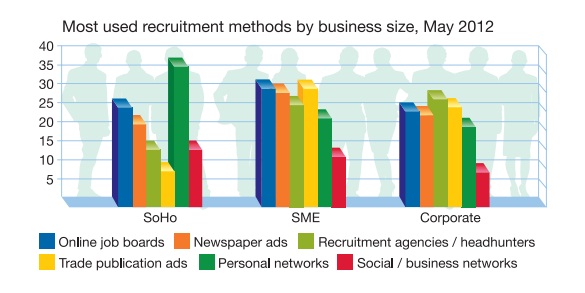
For SoHos – Small office, Home office; businesses of up to 50 staff – personal, social and business networks are the main recruitment channels. Was ever thus!

With cost, technology and time pressures it’s probably no surprise that small businesses continue to recruit in this way. It also helps with on-boarding and integration if a new member of staff already has connections within the business.

I can’t help feel that recruitment agencies have missed a trick over the years. By not focusing on a service for small businesses that makes it easier for them, that takes into account their limited time and budgets, they have lost out on a potentially lucrative market – after all, these are the businesses that are supposed to be at the forefront of job creation and the Evenbase research I referred to earlier also shows that this is the size of business that is seeing an uplift in recruitment.

I haven’t yet seen Carla’s factory set up a Facebook page, nor Lucy Beale’s café tweet out the specials of the day – but there’s little doubt that anything that enhances and widens the extended personal networks of a small business will only further strengthen the community aspect of the way they recruit.
HR, What’s on Your Mind?

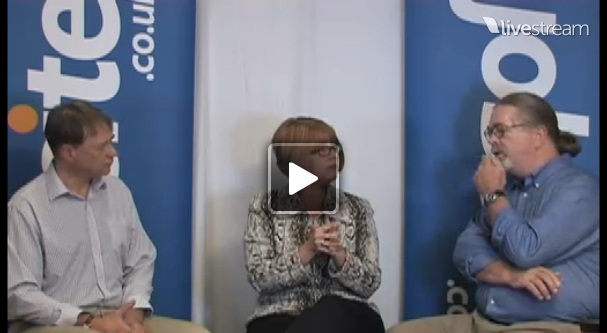
Yesterday I had the pleasure of moderating a TruLondon6 Livestream chat from the Jobsite studio with John Sumser and China Gorman talking about emerging trends in HR.

From workforce planning and creating value to skill shortages and making sense of data, the conversation was lively and varied… and, as you would expect with those two participants, insightful and thought provoking too.

You can watch it here…click on the image below and let me know what you would have added if you had been on the Livestream.


Now We Are 3!

Three years ago I hit the ‘Publish‘ button for the first time on this blog.

145 posts later (ok, so I’m not that prolific) I’ve had a lot of fun and learning, and a little angst too. I look back at some of my old posts and think about how I would write them very differently now, but then I also think some of them are better than some more recent stuff.

I came across this post on why we blog from the now (sadly) defunct My Hell is Other People and was struck by all the reasons people gave for their blogging. I wonder if any would express it differently now, nearly two years later…no doubt some blogs have moved on from hobby to gain more of a business or branding purpose.

My most read blog by far is this one from early 2011 when I was blogging as part of a job hunt. I think its popularity is less to do with the quality of writing and more as a result of the first 6 words in the title being a heavily searched phrase! Barely a day goes by when a few Googlers haven’t visited TRecs through that search…hope they aren’t too disappointed. (For more on the searches that lead to a blog read Doug Shaw’s recent post).

My least read blog is this one from June 2010 on how the interview process you create can send the wrong signals to potential new hires. I felt quite strongly about it so will admit to being disappointed that it didn’t get a wider reach…maybe I’ll re-write it as a rant, as rants always seem to do better!

Most of us blog about our opinions on different things, giving our take on business, or life, as we see it and are happy to debate, either IRL or through the comment sections, but I rarely see anyone post an ‘I’ve changed my mind‘ or ‘I see it differently now’ piece.

Maybe we haven’t needed to, but I was struck by this honest blog from Tory leaning political commentator Tim Montgomerie – recently voted political columnist of the year – on 3 big things he’s got wrong since he started blogging and commenting. OK he is a political blogger who follows an agenda, and has influence over the thinking of people who are passionate about his party, but I still found it a refreshing change.

No grand theme or statement to end this post…but if you have a minute do share your most and least read blogs, and any views you’ve held and blogged about, and which you have since changed…

We Are Not All Passive Candidates

I’ve recently blogged the findings of some Jobsite research which shows that the most important factor in a happy working life is having a good relationship with our work colleagues. Most surprising were the relatively healthy numbers (there were some age and gender differences) who would reject a move with a pay rise in favour of staying with colleagues that they respect and get on with.

I found it particularly interesting as I’ve always considered the belief that all employees are either an active or passive candidate to be a myth. The thought that anyone will change jobs for a pay rise, a promotion, a new challenge or because someone thinks they are headhuntable is daft. It ignores the complex range of motivations, relationships and emotions that make up the human race…in favour of the vision of recruiter as powerful kingmaker who can sell anybody anything.

A few years ago I worked in a business that had a small team placing senior sales people within a niche industry. All the roles were retained – third on target list, third on shortlist interviews and balance on acceptance – yet the team rarely ever billed the last third. They identified the best candidates and got them to final interview…yet few deals were closed. The individuals were all good recruiters but the candidates could not be closed. The client would offer, take them out to dinner with their partners, yet still not seal the deal.

Because the final decision for the candidate was about much more than a new title, an extra £5k or a bigger car. It was about stability, lifestyle, and family security…loyalties, friendships and relationships built in the current company. Some colleagues were golf partners; some had children at the same school as the candidate’s and some had wives or husbands who had also become social friends.

It wasn’t about a lack of vision or confidence but about doing the right thing for everyone.

I have debated this long and hard in the past. I respect the view that the right opportunity will encourage someone to think about moving jobs, but don’t agree that a move will inevitably follow. From my experience it’s not just about the ‘right’ opportunity… security and stability, particularly during tough times, are often overlooked as key drivers for many employees.

The three component model of engagement looks at commitment to an organization as a psychological state, and has three distinct components that affect how employees feel about the organisation that they work for: Continue reading “We Are Not All Passive Candidates”

High Street Britain 2012

Putney in South West London is reckoned to be the 7th wealthiest place in London and the 30th in the UK, according to average income per resident.

The local High Street has been gradually changing over the last 10 years reflecting the way that our tastes and shopping habits have changed. It was back in 2002 that the last independent music store closed, the owner saying to me at the end of his closing down sale ‘soon it will just be coffee shops, phone shops, hairdressers and banks along here’. At that time he was competing against HMV, Virgin, Woolworths and Smiths who were all selling CDs, DVDs and music & film related artefacts.

Now none of them are there – the first three have gone (along with Blockbuster and Game) and the last one has recently stopped stocking CDs and DVDs. Clearly the way we consume these items has changed over the last 10 years, but gradually the replacement clothing and sports stores have been closing too, replaced with discount shops (Poundland) and more cafes (the Sony shop has recently been taken over by an expanding Prets).

As I walked down the High Street yesterday I was struck by how many empty shops have started appearing and how all the existing shops were advertising reduced prices and special offers.

Some empty shops have been taken over by pop up shops, leaving us with this fairly downbeat scene…

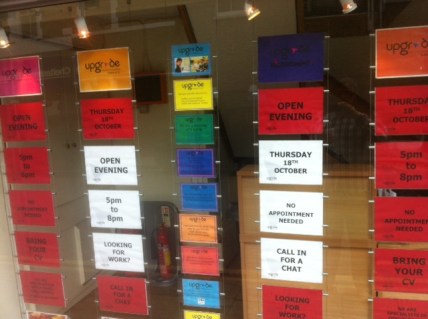
Meanwhile the local independent staffing agency, which used to have a window full of jobs to entice someone in, now has only an invitation to register, with no indication of any jobs…

The area was always crawling with estate agents, yet even they are feeling the pinch. Clearly the optimism which must have accompanied this notice last autumn has disappeared a year later…

As I said at the start, this is one of the wealthiest parts of the UK and the High Street seems to reflect the general economy – flat and lifeless, with temporary pop-up fixes and cut price invitations. In Dominic Sandbrook’s excellent cultural history of the early 70s he writes of the then new obsession with consumption and shopping, referring to shopping streets and centres as:

“A new world in which the guiding lights are spectacle, shopping and sensation”

The current reality seems anything but. There is a campaign to reclaim the local high street for local independents – you can read about it here – but is there the appetite from consumers?

What’s happening in your area? Is it similar? Let me know…

Opinion is Not Fact

Opinion is not fact

Anecdote is not evidence

Neither gossip nor rumours are news

Innuendo is not insight

A theory is just that until it has been proven

A hunch is not a policy

Politicians, commentators, journalists, columnists and gurus sometimes need to remember this.

Rant over.