HR, Social Media & Punk Rock

I’m chairing the CIPDs Social Media in HR conference next week and so I’ve been thinking about how the conversations around social have grown and developed in the space at the apex of social networking, HR and recruitment – pretty much the bubble I live and work in.

I wrote in one of my blogs about CIPD12 of how the questions have clearly been moving from ‘why‘ to ‘how‘ and this is clearly a shift which informs much of the writing and speaking that I see and hear. Sure, there will be many who are going to need some evidence before taking teams and businesses on the social journey, and rather than stamp off in a strop I think more of those who do ‘get it’ need to raise the conversation away from statistics on usage and reach, and talk more of outcomes.

The more I think about the rise of ‘social‘ the more I seem to think about punk rock. Not sure why, but there are similarities.

Punk wasn’t enabled by technology but by attitude. Coming at a time when you needed an ology to be in a rock band it was a clear shout by a ‘forgotten’ generation who felt they had no voice.

The link here is that it started with a younger generation but quickly became more widely adopted. Just as with today’s social media consultants, gurus and evangelists who climbed on the bandwagon quite early, back in 76/77 you had many journeymen rockers getting a spiky haircut, skinny jeans and a few tattoos and ripping out some three chord thrashes to sudden acclaim.

Of course you had the doubters, those who thought it was a fad and would never really catch on. In music broadcasting, for every John Peel you had a Nicky Horne.

Nicky H was the serious ‘rock’ DJ on Capital Radio. He broadcast regular shows that we’re ironically called ‘Your Mother Wouldn’t Like It’ – ironic because it featured just the type of corporate rock music that most people’s mothers WOULD like.

He was quick to rubbish punk, famously and proudly proclaiming that his shows would be punk free, that you wouldn’t hear any punk music on them.

And guess what. Less than a year later you couldn’t move for the punk and reggae that he was playing on his shows!!

How many social engagement naysayers and doom mongers are now evangelising? Even the PM (he of the ‘tweeters are a bunch of twits‘ sound bite) now has an official account. Though I accept he may not have much input!

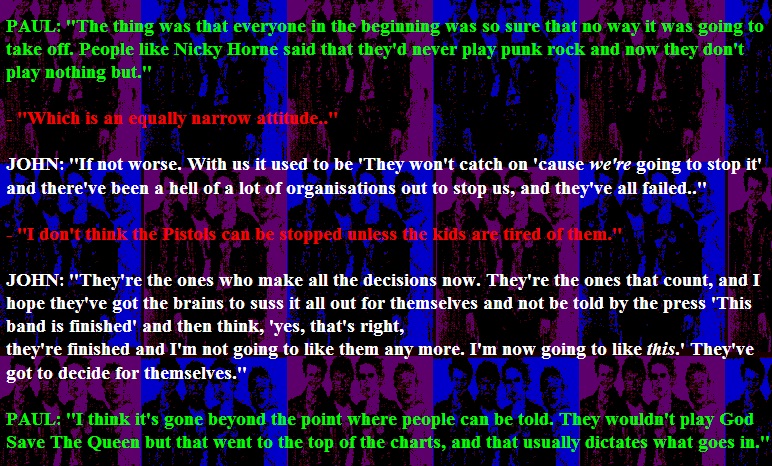
And just to square the Punk circle, here is part of an interview that the Sex Pistols gave to NME in the summer of 77. You can read more of the interview on this website – complete with the famous Sid Vicious ‘The definition of a grown-up is someone who catches on just as something becomes redundant”

Just read though this excerpt and substitute mentions and references to ‘punk rock’ with ‘social media’….

…uncanny!
 

Punk Rock

A Question of Ambition


“Being ambitious is like being thin. It’s nice to have in your youth — but hold on to it into middle-age and you’re going to end up with a sour little face. Let yourself go — it’s later than you think” (Julie Burchill)

Ambition makes you look pretty ugly” (Radiohead)
 

We talk a lot about ambition.

We write a lot about ambition.

We look for it in our children, colleagues, leaders and friends.

We want to work for businesses that show it.

We sometimes confuse it with aspiration.

Politicians and business leaders talk about it a lot.

Coaches, commentators and career advisors also talk about it a lot.

But there’s a big difference between Having Ambition and Being Ambitious.

The first is about talk and the second is about action.

So next time you hear someone speak of ‘ambition’ look at what they do not what they say. Do they live it or talk about it? Do they aspire to it or achieve it?

Do they mean it?

The Elephant in the Room for Tomorrow’s Workforce

As you may have gathered from my previous blog I was impressed with CIPD12s first day session on unlocking the potential of tomorrow’s workforce. On the afternoon of day 2 I was at a keynote panel session on a similar theme – Building the Workforces of Tomorrow. This one left me feeling a little flatter.

Don’t get me wrong, the panel was good – Peter Cheese, CEO of the CIPD, Michael Davis, CEO of the UK Commission for Employment and Skills, Anne Pickering, HR Director for O2, Toby Peyton-Jones Director of HR for Siemens UK & North West Europe and Jo Swinson, Minister for Employment Relations and Consumer Affairs – and the right noises were made early on about the need to train and utilise the skills of the new generation. O2 look for digital savvy people, Siemens believe that apprentices stay with you for life and big businesses should get involved in training their supply chain.

There was also some good insight from UKCES – I like their work, and used some of their research in a previous blog.

If I’m honest it was Jo Swinson who first gave me an uneasy moment which set a train of though off in my mind. Initially it felt like watching Question Time and she made the right noises about government concerns. Then she made an important point about workplace mindset not keeping pace with technological change…but then, almost as an aside, she referred to people applying for jobs and starting their cover letter with ‘hi’ instead of ‘Hi’. This was the reason they were getting nowhere in their job search she said, somewhat (in my mind) dismissively.

And then I thought about the previous half hour and the good intentioned comment from UKCES about the need for companies to invest 15 minutes in giving their rejected candidates feedback – as it would help them in their search if they knew where they were going wrong.

Jo’s comment was another instance for me of the up and coming generation being judged against standards of an older time (though Jo is almost still Gen Y herself)

  • Does the applicant need to write in their role?
  • With so many speakers across the two days talking of a shift from e-mail to social platforms does this grammar matter?
  • Given that no-one seems to write letters in business any more, and anything that is written will have been spellchecked, will anyone know that the original note started with h instead of H?

On the first day we heard of the positives of the Google Generation, how smart and savvy they were, but they are also the Spellcheck Generation – maybe some people see this as a negative.

We need to take their enthusiasm and encourage them, not dismiss them.

This wasn’t the only thing troubling me though. Laurie Ruettiman’s tweet – ‘I chuckle when a bunch of older white people attempt to deconstruct youth unemployment’ – also indicated something else about the conversation.

The panel were talking around the edges ignoring the elephant that was taking up a lot of the room.

The aren’t enough entry level jobs. There is a generation growing up who will probably never know proper full time work, never be truly economically viable.

We talk about skills and attitudes but the youth unemployment rate was rising long before current economic difficulties – and it’s a stubborn statistic that won’t reverse. Low skilled jobs that a 17 year old with precious few qualifications and social skills could do in a service sector dominated economy – stacking shelves, making sandwiches – are now done by unemployed graduates.

Kudos to CIPD for getting the conversations in the open and on to the keynote list. But I don’t think you can truly talk about building tomorrows workforce without also talking into account those who may never be part if it. And working out how you can use their abilities.

Whether they start a sentence in upper case or lower case really shouldn’t matter.

(For an interesting take on the discussion, including a proposal that many may think a bit radical, see Neil Morrison’s blog)

CIPD12 – Unlocking the Potential of Our Future Workforce

Day one at the CIPD Conference and I attended a really strong presentation from David Fairhurst of McDonalds. It seems that understanding the future workforce and unlocking their potential will be a key theme over the course of the three days with several sessions linked to it.

It’s something that I’ve been particularly interested over the past year, and I’ve written about education, youth unemployment and the problems that we may be storing up by under-utilising skills and cutting back on training.

Today’s session was engagingly delivered and rich in soundbites and tweetable phrases. The use of video clips of Gen Y and millennial workers talking about their experiences, hopes and fears provided powerful evidence. This had been put together by engaging them through the @OurYoungPeople twitter account – an attempt to find out what young people are saying and why HR needs to listen to them.

Here are 5 key points that lend themselves to further thought and discussion…I’m looking forward to adding to this list over the next 2 days…

  • This is the ‘Google Generation’ – they are used to getting instant answers at their fingertips. They are confident and know how to find things out.
  • They’ve been raised in an age of scams and fakes and are more adept than older generations at spotting them and avoiding. Loyalty therefore has to be earned – they won’t buy it just because you say it. They need to experience it.
  • Too often entry level roles fail to stimulate or engage them, and give them a poor experience of the workplace. They need variety, challenge, teamwork and customer interaction – try to give it to them; it will bring out their best.
  • Young people remember how you treat them for their whole lives, as customers, consumers and employees. In particular many spoke at their frustrations at not getting any replies or acknowledgements to job applications…seeing it as rude and damaging to confidence and aspiration.
  • They thrive on collaboration and co-creation and gain most benefit from learning that is collaborative, visual and uses information to solve problems. Yet we often ignore these and offer learning through memorising.

I always leave these sessions energised by the potential of the future workforce…I only hope that their enthusuasm and appetite for contributing isn’t strangled bya a failure to understand what motivates and them.

If You’re Not on The List…

I’ve written before of my love of lists, mainly from the perspective of my own life and experience – favourite albums, movies, books, goals, holidays etc. I am also an avid reader of end of year media lists in magazines, papers and online that chart the best moments and cultural artefacts of the previous 12 months. I’m often dubious as to how they rank them but always glad of the chance to check out something that I may have missed.

My journey on Twitter was kick started by a list. It was one from Louise Triance in March 2009 entitled something like ‘Recruiters who Tweet’. Up until that point I was a bit of a lurker, looking for conversations around politics, football and music, but this list helped me see that there was a work angle to what social networking could offer.

I didn’t know if these were the best recruitment tweeters, or the most insightful, but I followed them all and started following who they spoke to and began to build the network that I have today.

So, where’s this going?

Well, earlier this week the re-launched People Management magazine published their list of the Top 20 ‘HR Power Tweeters’ – in their words the ‘HR Twitteratti who are must-follows if you want to stay at the forefront of HR news and views on the microblogging site’.

There are many such lists published all the time and I usually treat them as a bit of fun. Journals and blogs are always highlighting the people they think their readers should follow. Twitter positively encourages anyone with an account to create lists and share them – apparently I appear in 309 Twitter lists, Lord knows who and why but I do. The People Management list seems to have caused offence though. There was much angst on my timeline last week.

I don’t think it was just thrown together as they have taken the trouble to offer their readers a description of each person’s engagement style. But once you commit to producing a list such as this, and rank it, then critique becomes more about who isn’t included then about who is.

As part of the day job I sometimes have to produce similar content – in this case bringing to the attention of digital newbies some of the people that they should follow – and a bit like the list I first followed nearly 4 years ago the focus should always be to highlight a spread of opinions and tweeting styles, enough to raise the curiosity of a new tweeter and encourage them to investigate further.

This, after all, is what we really want. Right?

To get more people using social networking platforms for business – linking, following, engaging, sharing, commenting and generally participating in the conversation that never sleeps.

In my view there were some notable exceptions on this PM list – but then there will be on any list. My ConnectingHR tweeters list runs to well over 100 and it would be difficult to recommend just 20 from it. But the PM piece does include the line…

“Is there anyone we have left out who you think deserves a place in PM’s top tweeters power list, then let us know who and why on Twitter @peoplemgt”

…so whilst it may be a bit of a disclaimer they also give you the opportunity to interact with them over it.

Here are my thoughts on the niggles that this particular article seems to have created…

Should HR sharer par excellence Michael Carty (also the ‘nicest person on Twitter’ I should add) have been on the list?

Yes, of course he should be on any list of top HR sharers but then let’s get real and accept that he works for a business that has a rival online publication to the one that drew up the list. Anyone who follows the people on PM’s list will inevitably also be following Michael within a few hours…he is pivotal to the daily engagement of almost everyone else on the list. Continue reading “If You’re Not on The List…”