HMV and the Inexorable Rise of Social and Digital

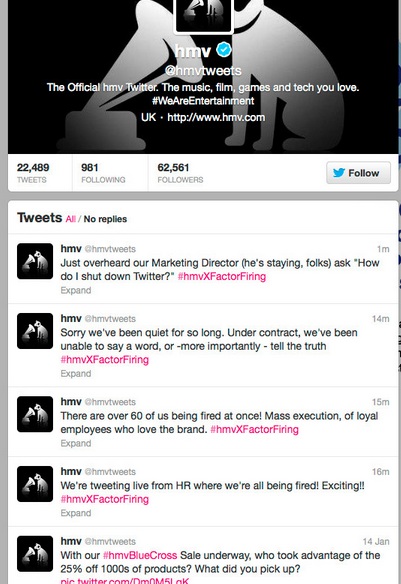
I suspect there will be few readers who haven’t heard about this afternoon’s Twitter jamming series of tweets from @HMVtweets under the #hmvXFactorFiring hashtag. The company eventually managed to access the account and delete the tweets, clearly oblivious to the fact that the damage had been done, the tweets screenshotted and shared, and everyone knew. And that you can delete tweets but hashtags often have a life of their own.

The tweets were sent by Poppy Rose, an intern. Here is her explanation – they came as a series of tweets but I’ve put them together in one piece…

“I would apologise for the #hmvXFactorFiring tweets but I felt like someone had to speak. As someone without a family to support/no mortgage I felt that I was the safest person to do so. Not to mention, I wanted to show the power of Social Media to those who refused to be educated

Just to set something straight, I did not ‘hijack’ the HMV twitter account. I actually assumed sole responsibility of Twitter & Facebook over two years ago, as an intern. When asked (this afternoon), I gladly provided the password to head office. I also set another member of staff up as a manager on Facebook, and removed myself from the admin list. I didn’t resist any requests to cooperate.

Since my internship started, I worked tirelessly to educate the business of the importance of Social Media – not as a short-term commercial tool, but as a tool to build and strengthen the customer relationship, and to gain invaluable real-time feedback from the consumers that have kept us going for over 91 years. While many colleagues understood and supported this, it was the more senior members of staff who never seemed to grasp its importance.

I hoped that today’s actions would finally show them the true power and importance of Social Media, and I hope they’re finally listening.

Now, I should probably go and hide for a while…Thank you so much for your supportive tweets! Much love to the HMV staff & customers”

Clearly it would seem that certain members of the management didn’t really get social. But then they didn’t really get digital either.

It was only a few weeks ago that this blog (written last August) from a former advertising advisor went viral too. After being warned, in 2002, that the company was facing threats from supermarket discounting, downloadable music and online retailers, the MD said…

“I accept that supermarkets are a thorn in our side but not for the serious music, games or film buyer and as for the other two, I don’t ever see them being a real threat, downloadable music is just a fad and people will always want the atmosphere and experience of a music store rather than online shopping”

It would be a shame if the narrative following today is about Twitter because it’s really about people having a voice – and it’s also about those who understand and embrace change and those who don’t.

Power to the people.
HMV

No More E-mail Any More at #HREvent13

It’s hardly a secret that I’m no big fan of e-mail…I’ve covered it in a few blogs. I find it unsociable, a conversation killer and too rooted in process and procedure.

No surprise then that an #HREvent13 session on transforming from an e-mail culture to one of social collaboration would get my attention. It was run by blueKiwi who are part of Atos – maybe not the easiest company to champion in these times but they are large so I was interested in how this transformation came about.

Simply put, it arose during a brainstorm on how to engage and empower the future workforce…a business world without e-mail was a subject up for discussion.

Here are some nuggets I picked up during the session…you may have seen one or two on my twitter fed:

“E-mail is annoying. It’s not a collaboration tool, it’s a communication tool and a task management tool”

“A move from e-mail to social collaboration is not just about systems & technology but really about organisation, culture & attitude as well”

“Social collaboration increases agility, productivity, speed & effectiveness through better talent mobilisation, knowledge sharing & communication”

“Next generation communication tools are necessary to attract & retain new generation talent not just in Europe but worldwide”

“E-mail based management style is creating distance between teams and management which diminishes engagement”

“Introduction of social collaboration flattens hierarchy. Everyone has the same voice. Management behaviours need to change”

OK, so it’s one business in a sea of electronic mail but here are my thoughts…

  • E-mail is not a natural communication medium to the next generation (apparently only 11% of 13-19 year olds use it to communicate with each other)
  • The future flexible, contract, project based, locationally free workforce need a collaboration tool not a communication tool
  • A move away from e-mail is cultural and psychological, rejection mainly a fear both of the unknown and of loss of control
  • Management mind-set and behaviours are the keys. Current e-mail usage is too centred on task assignation/management and control

Moving from e-mail to social collaboration requires significant change management – the presentation dealt with how this was being done. HR plays a key role, and the creation of a network of internal ambassadors is important.

Ultimately it’s also about showing employees how it will make their job easier, tasks quicker, productivity higher and allow quick access to essential information.

The end of e-mail? It’s all in the mind…

Loving Cake and Award Winning Social Recruiting at #HREvent13

I’ve been at #HREvent13 and particularly enjoyed one of the closing sessions on day one – a fun and informative presentation from Social Housing group Bromford.

When we think of social media oriented recruitment campaigns we tend to think of the creative industries, or funky brands trying to attract graduates, but here was a 1200 strong group, in a not particularly sexy area, who were able to find people through the twitter campaign #gottalovecake.

I was right to be impressed…hours after the presentation ended they picked up the Award for Distinction in Recruitment and Employee Branding!

As you would expect, the story is one of a socially engaged company looking to try and do something different and coming up with a campaign that ended up trending on twitter. It was made possible by having a number of their employees collaborating with local and industry social connections in a ‘tweet off’ that ended up getting the hashtag #gottalovecake trending.

I won’t go through the mechanics of the campaign – you can read it here on their own blog – but here are 5 things that stood out for me:

  • When looking for talent, find someone who will love your loves. Trying to identify what bound them all together they arrived at a love of cake! Hence the campaign #gottalovecake. How many recruitment campaigns focus on being the best, sharing the passion, talking about the business objective and not the individual?
  • Let them see the real you. They uploaded videos explaining what the jobs were and what someone whould be doing. Including outtakes and bloopers. Do job descriptions really work?
  • If you’re going to run a twitter campaign for recruitment you’ve got to have good content to put out there. ‘nuff said really. Make it different, descriptive, something that reflects you but lets people engage with you.
  • Let candidates express themselves. Applications could be by any format. If you wanted to send a CV you could, but we saw a self-made video and heard a song that someone had written and recorded especially for their application. (And no, I don’t know how the ATS would have parsed that!)
  • Make a noise! Having so many employees socially active gave them a head start when it came to building momentum on social media channels, particularly the way that they were able to engage other Twitter users to help spread the word

The results were impressive – 19% fewer applications than through other advertised media, but the key was in quality. After a traditional campaign 38% of applicants got through to the second (assessment) stage but none were hired. Following this campaign 87% of applicants got through to the second stage and 4 were hired.

And here are two of the key reasons they were able to pull it off.

You don’t need to be big to make a big noise. The message to businesses considering social recruiting has long been that size isn’t everything. A smaller, agile business can respond quickly and build momentum. Large organisation rarely have that flexibility.

You do need a socially connected organisation. Key was having a business in which so many employees have a social profile and communicate through an internal channel – in this case Yammer. It’s not by accident – the MD positively encourages the recruitment of people with a digital footprint. The final word was ‘all future leaders will need a positive digital footprint…without the ability to communicate across all platforms they won’t survive as credible leaders

Food for thought.

Do Graduate Recruiters Know What They’re Looking For?

New research now tells us that state school educated graduates get better grades than their private school counterparts but they come off worse when it comes to job opportunities and salaries.

Sadly I’m not surprised.

I saw this recent piece in the Telegraph which purports to enlighten graduates as to what companies look for when recruiting them. Here are four quotes…I’ve left out the name of the recruiter and company. They were all sizeable service sector businesses:

“We are after people with a can-do attitude, enthusiasm, interpersonal skills and the drive and ambition to make an impact. Softer skills such as collaboration are also valued, especially as employees often have to work with a variety of people outside their immediate team. For us, it’s less about what you’ve studied and more about why you want to work for us and what you can bring.”

“We want to employ bright, intelligent students with inquisitive minds. We are totally non-specific in terms of the degree taken. We are also keen to see candidates who have gained work experience in industry and are able to demonstrate a real intent to pursue a career in research, marketing and communications.”

“Some of our most successful employees have captained a rugby team or been president of the students’ union. One of the biggest frustrations we have is meeting students with the same CVs and answers — as if they have all been prepped in the same way. At interview we try to assess behaviour as much as any work experience to give us a sense of the future a candidate might have with our company.”

“We’re looking for exceptional, rounded, ambitious individuals who can show sustained involvement in activities other than the purely academic, such as work experience, industrial placements and voluntary work in the UK or abroad.”

Are you any the wiser as to what they’re looking for? If you were making your first foray into the jobs market would you know which one was for you?

They clearly have access to a thesaurus (exceptional, rounded, bright, intelligent, can-do, interpersonal…you get the picture) and seem to have no interest in offering any insight into what  may set them apart.

And beyond that it’s just bland, colourless words.

Remember the findings shared at CIPD12 about youth employment ‘Too often entry level roles fail to stimulate or engage them, and give them a poor experience of the workplace. They need variety, challenge, teamwork and customer interaction – try to give it to them; it will bring out their best’

The two tiered approach I mentioned at the start is entirely consistent with research I did about 18 months ago into PWCs new initiative to get non grads into their business. Read it here – 50% of people don’t go to university yet only 7.7% of trainee positions are for non-grads.

So we really now have a three tiered approach with many of our major businesses. Alas there are no stats for how the grad positions at PWC split between state and private school educated kids….though given that the one professional services firm quoted above talked about looking for rugby captains and student union presidents I think we can make an educated guess….

Barely a day goes by without someone in my timeline moaning about graduates and their sense of entitlement in the job market. Some readers will know that I usually side with the graduate!

The ‘in my day we took any job‘ hirers are right. They did! Except now they are hiring they aren’t looking for someone who wants ‘any‘ job. They want someone who wants their job, in their company, in their sector. And they want someone who will prove that commitment in interview. And if successful will then start a 3 month probation period, after which time if they’re lucky they will get KPIs, targets, appraisals and performance reviews.

The ‘in my day we took any job‘ brigade rarely ever had that. Smart and eager was often enough.

As in so many areas of business at the moment, we have an uncertain future with fewer openings. Maybe graduate recruiters are getting too used to finding reasons to reject rather than looking for reasons to hire.

After all, with 32.7% of degree educated 25-29 year olds working in jobs below their skill levels we’re almost world leaders in under-utilising the skills of our graduates.

There’s talent everywhere. There’s an abundance of talent, a million or so of it are under 25 – young, hungry and keen.

Open your eyes and go get it. Develop it. Nurture it. Invest in it. Stop talking it down, blaming it and making it grateful for 20 – 40 hours a week work. And stop hiding behind bland, colourless words…

…and if you’re obsessing about graduates then heed the words of US HR Blogger China Gorman:

“Four-year college degrees have long been a proxy for base level of skills—that a person can write, work with numbers, and think through difficult questions.  Except that’s probably not true any more.  Not only are there many ways to get those skills these days, there are many ways to get them that don’t include an over-priced experience that saddles the student with tens of thousands of dollars of debt.  Additionally, most employers will argue that a four-year degree isn’t a proxy for anything any more:  they provide no guarantee that the holder will actually be able to write, speak, think or do the most basic math”

80% of Temporary Workers want a Permanent Job!

I keep hearing that flexible working is here to stay and I keep getting told that most people choose to work this way. Which is funny, as most of the newly temporary/part time/self-employed that I come across DON’T seem to want to work that way. They are fearful of finding enough hours, and earning enough to meet commitments.

Interim and temporary recruiters that I spoke to before Christmas said that one of their biggest challenges was that their candidates were now mainly looking for permanent work.

And these are people who are earning professional pay rates – not the low-pay part timers who make up today’s underemployed (as blogged here by Michael Carty).

So, do they want to work this way?? I’ve looked at the official figures…

In the most recent ONS Labour Market report the number of temporary workers is 1,620,000. Look further along the line below and you see reasons for temporary working, and under ‘Do not want a permanent job’ the figure is 325,000. That’s right…only 20% of temporary workers DON’T want a permanent job.

Unsurprisingly this has worsened during the recession. If we look at the figures for September 2008 (average of May – July 2008) there were 1,404,000 temporary workers, of which 405,000 didn’t want a permanent job.

So in the 4 years since the market turned we’ve added 216,000 temporary jobs, yet the number of people not wanting a permanent job has fallen by 80,000.

If we compare the comparative figures for part time work then you get a higher proportion who say that they don’t want fulltime work, which is understandable – these numbers will include people who are working parents, carers, semi-retirees and independently wealthy so will include a higher proportion who choose that arrangement.

Even here though there has been a similar change between 2008 and 2012. Now 5,273,000 out of 7,935,000 don’t want full time work whereas in 2008 it was 5,238,000 out of 7,353,000.

So since the market turned we’ve gained 582,000 part time workers…but the number of those not wanting full time work has only increased by 35,000.

This isn’t a surprise to me.

When the recession started I was placing HR interims. I worked with a pool of day rate interims that had chosen to work that way. Few wanted to work that way forever though, some were doing it for a few years – usually until the kids were older, or until they completed another project (often a second business or property development). Most said they wouldn’t rule out a permanent job.

And then the recession started and a whole bunch of newly unemployed HR specialists, at all levels, suddenly had to set themselves up as self-employed. Overnight they went from being an employee to becoming their own sales manager, marketing manager, accounts manager, credit control manager, procurement manager and IT manager.

As FlipChartRick says, self-employment isn’t for everyone.

So flexible working may be inevitable, and I happen to believe it is, and we all know a few people who now work that way – but that doesn’t mean that they all want to or can afford to.

The Year of Recruiting Sensibly

Thumbs_up

I had a lot of fun putting together my last two blogs – an allegorical fable about impulse recruitment, poor on-boarding, weak management and blinkered selection criteria – which drew from many scenarios encountered during my years as an agency recruiter, and from my current day to day interactions with job seekers.

There were some serious points to be made about mistakes and frustrations in the recruitment process, which I wanted to cover in an illustrative way. I’ve now listed some of them below…they may bring a bit of context to the story of Frank the Fish.

So as we begin a new recruiting year, let’s be sensible. This is what I want to see more of…and I know that every job seeker would like to see more of it too:

  • Properly defined recruitment brief. The why, the how, and the who of a perceived vacancy should be carefully thought out, budgeted and planned for. Knee jerk hiring decisions rarely produce long term beneficial results.
  • Robust on-boarding and assimilation. Once you’ve identified the person then how are you going to bring them in and get the best out of them?
  • Effective management. Who will manage them? Do they fully understand what the business wants from the new recruit? And can they incorporate them in a team or division that may not understand the rationale for the hire?
  • A proper plan for success. How will you measure whether it’s working out? Have you managed the new employee’s expectations…do they know how you will assess, manage and monitor them, and what is expected of them. And what will happen if they don’t measure up, or if something unforeseen happens to casts doubt on whether you need them.
  • Consider an ex-employee. So many companies close the door to re-hiring even when one of their alumni may be the most suitable candidate available. I tried to put a few clues in the story to show that Frank’s company hadn’t properly replaced him. Humility can be more potent than pride…on both sides.
  • Look at the person, not just the CV. This is not a new problem, but it seems to cause the most frustration. It may have seemed a stretch in my story to infer that companies wouldn’t consider Frank because of the previous 3 months, but unfortunately it isn’t. It’s a familiar tale. Look at what someone can bring in to a business, don’t try and second guess their current mind-set or skill-set based on recent events.

And one last thing.

Every person you hire is part of another network – friends, family, alumni and online connections. This network plays an important part in the decision and they will be affected by the decisions that you make about the employee. Each candidate will have their own motivations, commitments, concerns and goals.

I’m not absolving them of their obligations in a new role, nor suggesting that a poor hire is kept on for the sake of their kids, but suggesting a little sensitivity about someone’s situation before the decision to hire – particularly if there is some doubt over fit or the long term viability of a role. The ramifications of unsuccessful recruitment are felt by many, so maybe more care is needed to get the match right.

Let’s recruit sensibly this year…and get the best results for everyone.