
If there’s one topic that has both dominated and divided the on-going conversations around HR over the last year or two, then its data. Specifically big data and what to do with it. We constantly seem to be told that HR doesn’t have the capability or know-how to properly leverage the opportunities that all these extra insights offer us. When I wrote about the topic last year I found a range of perceptions and misconceptions – from the size of the data to the complexity of technology, solution focus to looking beyond the quantitative – that cloud the conversations in detail and jargon.
Keen to understand more I went along to the recent HR & Workforce Analytics Innovation Summit and heard a range of speakers – from Coca Cola, Aviva, Nestle, Metropolitan Police, Unilever, Serious Fraud Office to name a few – share case studies and insights about how they had used analytics to drive business value and achieve results.
Here are some of the thing that stood out for me.
Getting the right people.
With a background as a recruiter I’m always looking at how we can get the hiring right. Certainly talent acquisition and performance are two areas with much to gain from deeper insights, and where there is already a lot of data available.
As with any specialist area it starts with scoping what you really need – “an HR analytics team needs to understand data and present it in a way that engages the business – they don’t need a background in HR”
We can have a tendency to compile a long shopping list of attributes, skills and experience that we want and then complain that we can’t find it. The key for analyst roles is to understand what you really need. Don’t look for a list of technology and software skills, but for someone who can understand problems and tell stories. Analysts are hot property at the moment so not easy to find – many presenters came not from an HR background but from one involving maths, statistics and analysis. HR generalists can get bogged down with data and detail whilst analysts can’t always present or tell stories so the best teams will blend a range of skills.
Once there is data and analysis then someone needs to be able to bring it to life, tell a compelling story that will engage stakeholders. More than one speaker observed that stakeholder management is a very hard skill to locate when recruiting in this area.
The concept of storytelling came through loud and clear during most presentations and is one that resonates with me, given the day job. How many HRDs look for separate people? Those to work with the data and those who will present the results? And how many look at the people they already have in their teams who could develop into a role like this with some help and training. One suggestion was to ‘steal’ someone from another business area – maybe the capability is already within the business, just not HR.
The key attributes were described by fellow event blogger David D’Souza as “The 4 N’s – Nosiness, Numeracy, Narrative, Networking“. But also remember that analysts need a career and personal development plan just like everyone else – they need scope to hone their skills.
Quick wins, simple wins, ask questions.
The clear message was to understand exactly what you want, and to be patient and realistic, starting with basics. Many teams have little or no budget, but however small it is there will need to be some budget to either hire or train the right person.
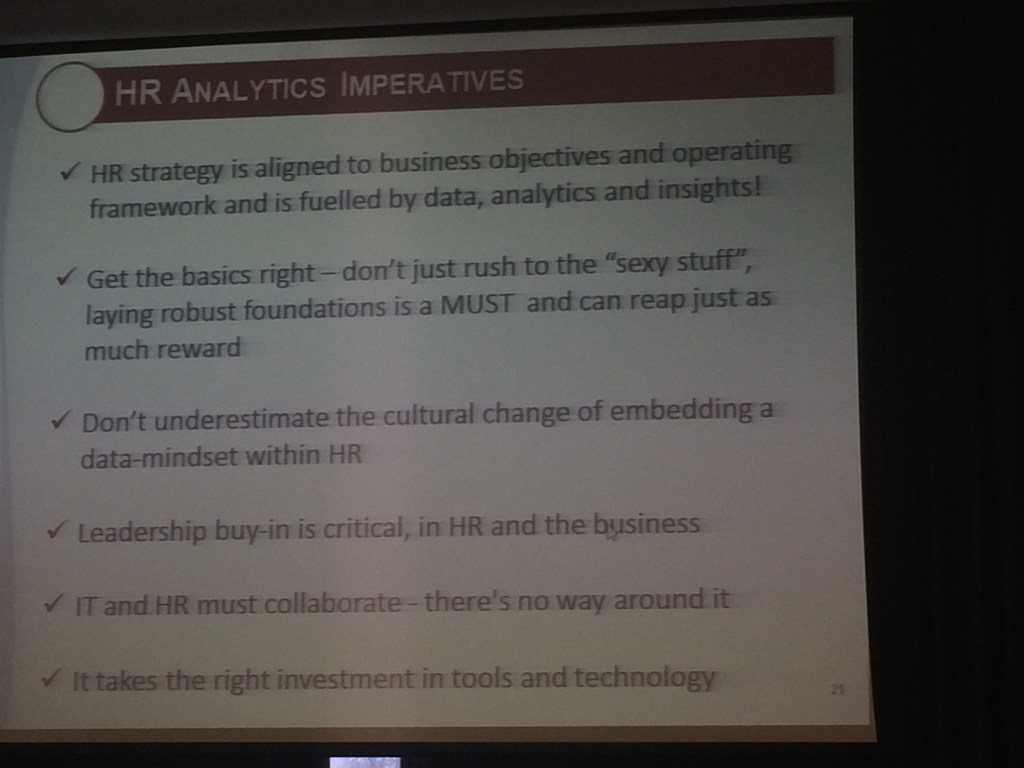
Think big, start slowly, and get in at the top! When you start make sure you meet the CEO and FD. Let them know what’s happening. Coca Cola’s Vanessa Varney told us “Get the basics right. Don’t rush to do the ‘sexy stuff’. Laying robust foundations is a must and can reap just as much reward“. She also stressed the need to get buy-in from leadership and the rest of HR and warned not to underestimate the cultural impact of embedding a data-mindset within the HR team.
The simplest way to then start is to find out what problems that business has that need answers, and that means asking questions not offering metrics. As Andrew Gamlyn said “the business don’t want metrics, they need answers to questions. Educate the business in a mindset of asking for answers to business questions instead of metrics from HR“. Understanding the real issues is key else you’ll just be defending data. One example involved data showing that the best performers were those whose previous job title matched their new ones – but was this a real measure of capability or really just a measure of recruiter or hiring manager behaviour?
“There is HR data everywhere in the organisation” said Hendrik Feddersen “understand how the business operates. Then engage with users, tell stories, use graphics”
And collaborate.
One of the most tweeted soundbites of the day was from Vanessa Varney “IT and HR must collaborate. There’s no way around it“. Although you need to lay ground rules as well. I chaired a panel that included Vanessa and Sally Dillon from Aviva, who took responsibility for FTEs from finance saying “You look after the £££, we own the FTEs“.
The quickest wins often seem to come from straightforward employee metrics. Absence, sickness, resignations and links to overtime, workplace pressure or even length of tenure of managers, the ‘people game-changers’ are all areas that provide valuable insights to the business – if the managers don’t like the data then they can fix the problem.
During Sally Dillon’s presentation she described the HR analytics role as “kill complexity, never rest, care more, create legacy” and reminded us that “we own definition, methodology and tools – we don’t own the data, the business leaders own the data“…
…whilst Vanessa Varney’s summary provided a useful round-up of many attendees’ takeaways…

 Talent Trends & Insights