
For decades, research around happiness has suggested a predictable pattern: life satisfaction followed a “U-bend.” Young adults begin relatively optimistic, hit a slump in middle age, and then rebounded later in life. While the precise age of peak misery varied from country to country, the overall shape was remarkably consistent.
But new research published in PLOS research journal by economists David Blanchflower, Alex Bryson, and Xiaowei Xu reveals that this curve has shifted in a striking – and potentially troubling – way.
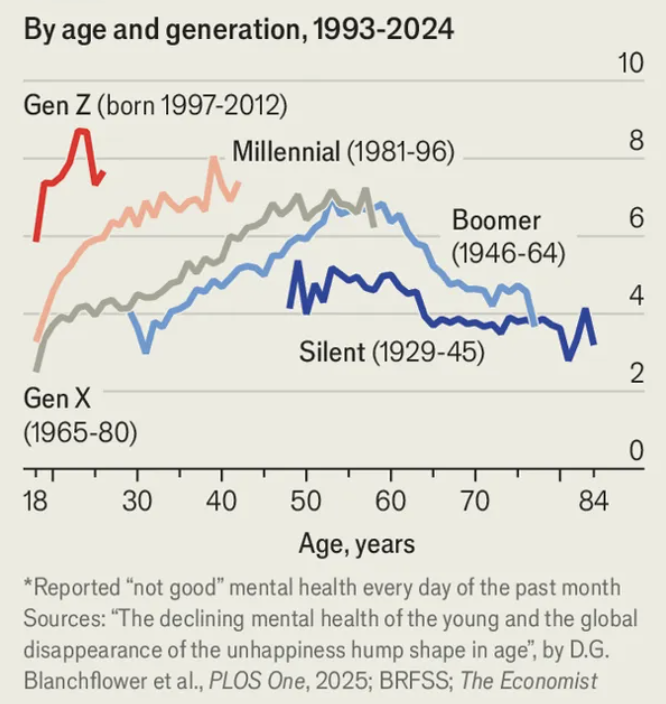
Across much of the world, it is no longer middle-aged adults who are the most miserable. Instead, young people, especially Gen Z, are reporting the highest levels of unhappiness of any age group.
A “Ski Slope” of Misery
The researchers analysed large-scale surveys in the United States, United Kingdom, and 44 other countries. Historically, data such as the Behavioural Risk Factor Surveillance System (BRFSS) in the US showed unhappiness peaking in middle age between 2009 and 2018.
Yet between 2019 and 2024, the familiar “hump” disappeared. Mental health among older groups remained stable, while despair amongst younger people climbed rapidly. A similar pattern emerged in Britain, where rates of anxiety and poor mental health surged among under-40s after 2016. The global picture is no different: across Africa, Asia, Latin America, Europe, and the Middle East, young people consistently report worse mental health than their elders.
This generational shift is profound. Older adults, once seen as the most vulnerable to despair, now appear more resilient than the youngest members of the workforce.
Why Are Younger People So Unhappy?
The causes are complex, and there is no real single explanation that fits across countries. But the research did highlight several possibilities:
- Labour market changes. Traditionally, employment was a buffer against poor mental health. Yet for young American workers – particularly the least educated – this effect has weakened. Falling job satisfaction and economic insecurity are probably contributing factors.
- Technology and social media. The rise of smartphones and social platforms has coincided with declining youth mental health since the early 2010s. Whilst they are usually blamed for this, the research covered a number of studies and found only a weak link between social media use and sustained declines in wellbeing.
- Generational drift. Each successive generation has entered adulthood more miserable than the last – millennials and Gen X reported midlife malaise earlier than the baby boomers. Gen Z, however, are beginning their adult lives at historically low levels of happiness, raising concerns about how they will cope as they age.
In short, Gen Z are not only starting from a worse position than previous generations – they may also face deeper challenges as they approach midlife.
What This Means for Society and Work
The implications extend way beyond statistics. Rising despair among young people matters because they represent the current and future workforce. If left unaddressed, poor mental health risks affecting productivity, engagement, and social cohesion.
For organisations, this underscores the importance of investing in employee well-being, mental health support, and meaningful work. Younger workers may be the most digitally connected generation, but they also report the highest levels of disconnection, anxiety, and dissatisfaction. Employers who recognise and respond to this reality will not only support their people – they will also secure a competitive advantage in talent attraction and retention.
Cause for Cautious Optimism?
While the findings are sobering, they are not unchanging. Some evidence suggests that the mental health of young Americans has improved modestly in recent years, hinting that today’s “ski slope” of misery may not be permanent.
Still, the shift should serve as a wake-up call: the youngest generations, once assumed to be the happiest, are now struggling most.
Addressing this challenge will require action from policymakers, educators, employers, and communities alike. The “U-bend” of happiness may well return in time, but for now, Gen Z are facing an uphill climb. And organisations, professions and colleges can’t afford to look away.
 Talent Trends & Insights