The Elephant in the Room for Tomorrow’s Workforce

As you may have gathered from my previous blog I was impressed with CIPD12s first day session on unlocking the potential of tomorrow’s workforce. On the afternoon of day 2 I was at a keynote panel session on a similar theme – Building the Workforces of Tomorrow. This one left me feeling a little flatter.

Don’t get me wrong, the panel was good – Peter Cheese, CEO of the CIPD, Michael Davis, CEO of the UK Commission for Employment and Skills, Anne Pickering, HR Director for O2, Toby Peyton-Jones Director of HR for Siemens UK & North West Europe and Jo Swinson, Minister for Employment Relations and Consumer Affairs – and the right noises were made early on about the need to train and utilise the skills of the new generation. O2 look for digital savvy people, Siemens believe that apprentices stay with you for life and big businesses should get involved in training their supply chain.

There was also some good insight from UKCES – I like their work, and used some of their research in a previous blog.

If I’m honest it was Jo Swinson who first gave me an uneasy moment which set a train of though off in my mind. Initially it felt like watching Question Time and she made the right noises about government concerns. Then she made an important point about workplace mindset not keeping pace with technological change…but then, almost as an aside, she referred to people applying for jobs and starting their cover letter with ‘hi’ instead of ‘Hi’. This was the reason they were getting nowhere in their job search she said, somewhat (in my mind) dismissively.

And then I thought about the previous half hour and the good intentioned comment from UKCES about the need for companies to invest 15 minutes in giving their rejected candidates feedback – as it would help them in their search if they knew where they were going wrong.

Jo’s comment was another instance for me of the up and coming generation being judged against standards of an older time (though Jo is almost still Gen Y herself)

  • Does the applicant need to write in their role?
  • With so many speakers across the two days talking of a shift from e-mail to social platforms does this grammar matter?
  • Given that no-one seems to write letters in business any more, and anything that is written will have been spellchecked, will anyone know that the original note started with h instead of H?

On the first day we heard of the positives of the Google Generation, how smart and savvy they were, but they are also the Spellcheck Generation – maybe some people see this as a negative.

We need to take their enthusiasm and encourage them, not dismiss them.

This wasn’t the only thing troubling me though. Laurie Ruettiman’s tweet – ‘I chuckle when a bunch of older white people attempt to deconstruct youth unemployment’ – also indicated something else about the conversation.

The panel were talking around the edges ignoring the elephant that was taking up a lot of the room.

The aren’t enough entry level jobs. There is a generation growing up who will probably never know proper full time work, never be truly economically viable.

We talk about skills and attitudes but the youth unemployment rate was rising long before current economic difficulties – and it’s a stubborn statistic that won’t reverse. Low skilled jobs that a 17 year old with precious few qualifications and social skills could do in a service sector dominated economy – stacking shelves, making sandwiches – are now done by unemployed graduates.

Kudos to CIPD for getting the conversations in the open and on to the keynote list. But I don’t think you can truly talk about building tomorrows workforce without also talking into account those who may never be part if it. And working out how you can use their abilities.

Whether they start a sentence in upper case or lower case really shouldn’t matter.

(For an interesting take on the discussion, including a proposal that many may think a bit radical, see Neil Morrison’s blog)
CIPD12 – Unlocking the Potential of Our Future Workforce

Day one at the CIPD Conference and I attended a really strong presentation from David Fairhurst of McDonalds. It seems that understanding the future workforce and unlocking their potential will be a key theme over the course of the three days with several sessions linked to it.

It’s something that I’ve been particularly interested over the past year, and I’ve written about education, youth unemployment and the problems that we may be storing up by under-utilising skills and cutting back on training.

Today’s session was engagingly delivered and rich in soundbites and tweetable phrases. The use of video clips of Gen Y and millennial workers talking about their experiences, hopes and fears provided powerful evidence. This had been put together by engaging them through the @OurYoungPeople twitter account – an attempt to find out what young people are saying and why HR needs to listen to them.

Here are 5 key points that lend themselves to further thought and discussion…I’m looking forward to adding to this list over the next 2 days…

  • This is the ‘Google Generation’ – they are used to getting instant answers at their fingertips. They are confident and know how to find things out.
  • They’ve been raised in an age of scams and fakes and are more adept than older generations at spotting them and avoiding. Loyalty therefore has to be earned – they won’t buy it just because you say it. They need to experience it.
  • Too often entry level roles fail to stimulate or engage them, and give them a poor experience of the workplace. They need variety, challenge, teamwork and customer interaction – try to give it to them; it will bring out their best.
  • Young people remember how you treat them for their whole lives, as customers, consumers and employees. In particular many spoke at their frustrations at not getting any replies or acknowledgements to job applications…seeing it as rude and damaging to confidence and aspiration.
  • They thrive on collaboration and co-creation and gain most benefit from learning that is collaborative, visual and uses information to solve problems. Yet we often ignore these and offer learning through memorising.

I always leave these sessions energised by the potential of the future workforce…I only hope that their enthusuasm and appetite for contributing isn’t strangled bya a failure to understand what motivates and them.

If You’re Not on The List…

I’ve written before of my love of lists, mainly from the perspective of my own life and experience – favourite albums, movies, books, goals, holidays etc. I am also an avid reader of end of year media lists in magazines, papers and online that chart the best moments and cultural artefacts of the previous 12 months. I’m often dubious as to how they rank them but always glad of the chance to check out something that I may have missed.

My journey on Twitter was kick started by a list. It was one from Louise Triance in March 2009 entitled something like ‘Recruiters who Tweet’. Up until that point I was a bit of a lurker, looking for conversations around politics, football and music, but this list helped me see that there was a work angle to what social networking could offer.

I didn’t know if these were the best recruitment tweeters, or the most insightful, but I followed them all and started following who they spoke to and began to build the network that I have today.

So, where’s this going?

Well, earlier this week the re-launched People Management magazine published their list of the Top 20 ‘HR Power Tweeters’ – in their words the ‘HR Twitteratti who are must-follows if you want to stay at the forefront of HR news and views on the microblogging site’.

There are many such lists published all the time and I usually treat them as a bit of fun. Journals and blogs are always highlighting the people they think their readers should follow. Twitter positively encourages anyone with an account to create lists and share them – apparently I appear in 309 Twitter lists, Lord knows who and why but I do. The People Management list seems to have caused offence though. There was much angst on my timeline last week.

I don’t think it was just thrown together as they have taken the trouble to offer their readers a description of each person’s engagement style. But once you commit to producing a list such as this, and rank it, then critique becomes more about who isn’t included then about who is.

As part of the day job I sometimes have to produce similar content – in this case bringing to the attention of digital newbies some of the people that they should follow – and a bit like the list I first followed nearly 4 years ago the focus should always be to highlight a spread of opinions and tweeting styles, enough to raise the curiosity of a new tweeter and encourage them to investigate further.

This, after all, is what we really want. Right?

To get more people using social networking platforms for business – linking, following, engaging, sharing, commenting and generally participating in the conversation that never sleeps.

In my view there were some notable exceptions on this PM list – but then there will be on any list. My ConnectingHR tweeters list runs to well over 100 and it would be difficult to recommend just 20 from it. But the PM piece does include the line…

“Is there anyone we have left out who you think deserves a place in PM’s top tweeters power list, then let us know who and why on Twitter @peoplemgt”

…so whilst it may be a bit of a disclaimer they also give you the opportunity to interact with them over it.

Here are my thoughts on the niggles that this particular article seems to have created…

Should HR sharer par excellence Michael Carty (also the ‘nicest person on Twitter’ I should add) have been on the list?

Yes, of course he should be on any list of top HR sharers but then let’s get real and accept that he works for a business that has a rival online publication to the one that drew up the list. Anyone who follows the people on PM’s list will inevitably also be following Michael within a few hours…he is pivotal to the daily engagement of almost everyone else on the list. Continue reading “If You’re Not on The List…”

Recruiting Like Carla Connor!

Turn on the TV any weekday at 7.30 and during the next half hour’s soap you’ll almost certainly see someone either looking for work or starting a new job, or a small business looking for staff.

Have you ever seen anyone in Weatherfield or Albert Square register with a recruitment agency or scour a CV database? No...they recruit by asking around.

Who do you know who can do this?
Who do you know who’s hiring?
My old school friend’s moving up here – are there any jobs going at the factory?

Its good old fashioned community recruitment, you recruit who you know or who your employees know. It’s always been that way for small local businesses, hasn’t changed for generations.

Ah but that’s not real life you’ll tell me.

But it is.

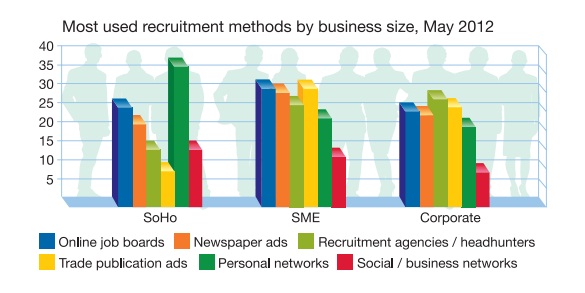
Presenting the Evenbase quarterly recruitment review to conference attendees recently, this graph of the route to market for different sized businesses stood out…

For SoHos – Small office, Home office; businesses of up to 50 staff – personal, social and business networks are the main recruitment channels. Was ever thus!

With cost, technology and time pressures it’s probably no surprise that small businesses continue to recruit in this way. It also helps with on-boarding and integration if a new member of staff already has connections within the business.

I can’t help feel that recruitment agencies have missed a trick over the years. By not focusing on a service for small businesses that makes it easier for them, that takes into account their limited time and budgets, they have lost out on a potentially lucrative market – after all, these are the businesses that are supposed to be at the forefront of job creation and the Evenbase research I referred to earlier also shows that this is the size of business that is seeing an uplift in recruitment.

I haven’t yet seen Carla’s factory set up a Facebook page, nor Lucy Beale’s café tweet out the specials of the day – but there’s little doubt that anything that enhances and widens the extended personal networks of a small business will only further strengthen the community aspect of the way they recruit.

HR, What’s on Your Mind?

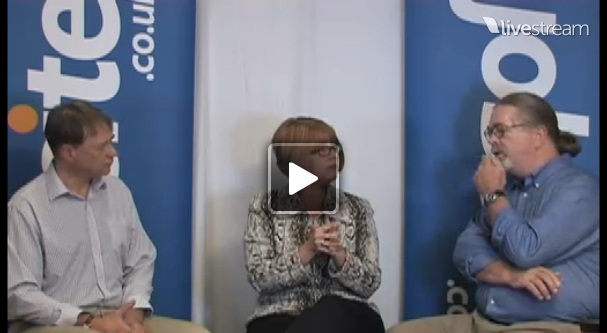
Yesterday I had the pleasure of moderating a TruLondon6 Livestream chat from the Jobsite studio with John Sumser and China Gorman talking about emerging trends in HR.

From workforce planning and creating value to skill shortages and making sense of data, the conversation was lively and varied… and, as you would expect with those two participants, insightful and thought provoking too.

You can watch it here…click on the image below and let me know what you would have added if you had been on the Livestream.


Now We Are 3!

Three years ago I hit the ‘Publish‘ button for the first time on this blog.

145 posts later (ok, so I’m not that prolific) I’ve had a lot of fun and learning, and a little angst too. I look back at some of my old posts and think about how I would write them very differently now, but then I also think some of them are better than some more recent stuff.

I came across this post on why we blog from the now (sadly) defunct My Hell is Other People and was struck by all the reasons people gave for their blogging. I wonder if any would express it differently now, nearly two years later…no doubt some blogs have moved on from hobby to gain more of a business or branding purpose.

My most read blog by far is this one from early 2011 when I was blogging as part of a job hunt. I think its popularity is less to do with the quality of writing and more as a result of the first 6 words in the title being a heavily searched phrase! Barely a day goes by when a few Googlers haven’t visited TRecs through that search…hope they aren’t too disappointed. (For more on the searches that lead to a blog read Doug Shaw’s recent post).

My least read blog is this one from June 2010 on how the interview process you create can send the wrong signals to potential new hires. I felt quite strongly about it so will admit to being disappointed that it didn’t get a wider reach…maybe I’ll re-write it as a rant, as rants always seem to do better!

Most of us blog about our opinions on different things, giving our take on business, or life, as we see it and are happy to debate, either IRL or through the comment sections, but I rarely see anyone post an ‘I’ve changed my mind‘ or ‘I see it differently now’ piece.

Maybe we haven’t needed to, but I was struck by this honest blog from Tory leaning political commentator Tim Montgomerie – recently voted political columnist of the year – on 3 big things he’s got wrong since he started blogging and commenting. OK he is a political blogger who follows an agenda, and has influence over the thinking of people who are passionate about his party, but I still found it a refreshing change.

No grand theme or statement to end this post…but if you have a minute do share your most and least read blogs, and any views you’ve held and blogged about, and which you have since changed…

We Are Not All Passive Candidates

I’ve recently blogged the findings of some Jobsite research which shows that the most important factor in a happy working life is having a good relationship with our work colleagues. Most surprising were the relatively healthy numbers (there were some age and gender differences) who would reject a move with a pay rise in favour of staying with colleagues that they respect and get on with.

I found it particularly interesting as I’ve always considered the belief that all employees are either an active or passive candidate to be a myth. The thought that anyone will change jobs for a pay rise, a promotion, a new challenge or because someone thinks they are headhuntable is daft. It ignores the complex range of motivations, relationships and emotions that make up the human race…in favour of the vision of recruiter as powerful kingmaker who can sell anybody anything.

A few years ago I worked in a business that had a small team placing senior sales people within a niche industry. All the roles were retained – third on target list, third on shortlist interviews and balance on acceptance – yet the team rarely ever billed the last third. They identified the best candidates and got them to final interview…yet few deals were closed. The individuals were all good recruiters but the candidates could not be closed. The client would offer, take them out to dinner with their partners, yet still not seal the deal.

Because the final decision for the candidate was about much more than a new title, an extra £5k or a bigger car. It was about stability, lifestyle, and family security…loyalties, friendships and relationships built in the current company. Some colleagues were golf partners; some had children at the same school as the candidate’s and some had wives or husbands who had also become social friends.

It wasn’t about a lack of vision or confidence but about doing the right thing for everyone.

I have debated this long and hard in the past. I respect the view that the right opportunity will encourage someone to think about moving jobs, but don’t agree that a move will inevitably follow. From my experience it’s not just about the ‘right’ opportunity… security and stability, particularly during tough times, are often overlooked as key drivers for many employees.

The three component model of engagement looks at commitment to an organization as a psychological state, and has three distinct components that affect how employees feel about the organisation that they work for: Continue reading “We Are Not All Passive Candidates”

High Street Britain 2012

Putney in South West London is reckoned to be the 7th wealthiest place in London and the 30th in the UK, according to average income per resident.

The local High Street has been gradually changing over the last 10 years reflecting the way that our tastes and shopping habits have changed. It was back in 2002 that the last independent music store closed, the owner saying to me at the end of his closing down sale ‘soon it will just be coffee shops, phone shops, hairdressers and banks along here’. At that time he was competing against HMV, Virgin, Woolworths and Smiths who were all selling CDs, DVDs and music & film related artefacts.

Now none of them are there – the first three have gone (along with Blockbuster and Game) and the last one has recently stopped stocking CDs and DVDs. Clearly the way we consume these items has changed over the last 10 years, but gradually the replacement clothing and sports stores have been closing too, replaced with discount shops (Poundland) and more cafes (the Sony shop has recently been taken over by an expanding Prets).

As I walked down the High Street yesterday I was struck by how many empty shops have started appearing and how all the existing shops were advertising reduced prices and special offers.

Some empty shops have been taken over by pop up shops, leaving us with this fairly downbeat scene…

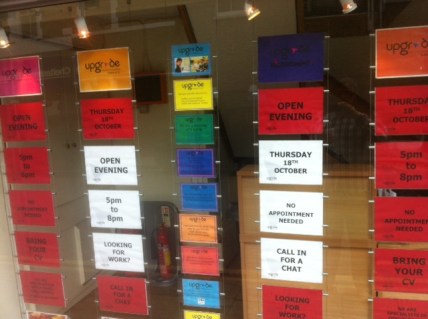
Meanwhile the local independent staffing agency, which used to have a window full of jobs to entice someone in, now has only an invitation to register, with no indication of any jobs…

The area was always crawling with estate agents, yet even they are feeling the pinch. Clearly the optimism which must have accompanied this notice last autumn has disappeared a year later…

As I said at the start, this is one of the wealthiest parts of the UK and the High Street seems to reflect the general economy – flat and lifeless, with temporary pop-up fixes and cut price invitations. In Dominic Sandbrook’s excellent cultural history of the early 70s he writes of the then new obsession with consumption and shopping, referring to shopping streets and centres as:

“A new world in which the guiding lights are spectacle, shopping and sensation”

The current reality seems anything but. There is a campaign to reclaim the local high street for local independents – you can read about it here – but is there the appetite from consumers?

What’s happening in your area? Is it similar? Let me know…

Opinion is Not Fact

Opinion is not fact

Anecdote is not evidence

Neither gossip nor rumours are news

Innuendo is not insight

A theory is just that until it has been proven

A hunch is not a policy

Politicians, commentators, journalists, columnists and gurus sometimes need to remember this.

Rant over.

Watering Plants, Putting Out Fires and other Social Networking Folk Songs

Three events attended last week and at two of them I gave a presentation about the current trends in online recruitment – more of that probably in a future post.

The other event was an enjoyable evening hosted by Bernie Mitchell of Engaging People in which four social media networking professionals shared their take on Gary Vaynerchuk’s book Thank You Economy.

At these more informal events, where networking is mixed with learning, the Twitter stream is usually alive with ideas as attendees interpret and assimilate what they’re hearing with their own impressions and thoughts.

Previously the hashtag thread would have mainly contained oft repeated soundbites with speakers tailoring their quotes and slides to be tweetable.

But now most of those who present are telling stories and sharing experiences so the input from those listening is crucial. Some of the key points are delivered anecdotally. In the way traditional stories and folk songs were passed on and down, each time gaining a little more colour and emphasis, so those who share these new ‘stories’ are likewise creating a heritage – albeit a constantly shifting and evolving one at 140 characters a time.

So here are my top 10 nuggets from last week’s event…

  • Can we stop talking about social media and social media f***ing marketing. It’s social networking
  • Our grandparents are better equipped for being social because they remember the importance of real relationships
  • Social networking is about watering plants and putting out fires
  • Don’t wait until you know how important someone is before you say sorry, please or thank you
  • Tonight I was happy people DIDN’T talk about social media ROI. It is about connecting with people: do that & the sales will come
  • The fact is that people don’t join social networks to be sold to or marketed to
  • I think everybody in marketing should take an exam in social networking
  • Making your customers smile can bring you business
  • Service & relationships first, sales & commerce second, people share emotions not facts.
  • You wouldn’t push crap product on your friends – see every customer as your friend

…hope you find one there to share with someone today