Talking Talent & Potential at #HREvent14


I’ve just returned from an interesting 2 days in Birmingham at the HR Directors summit. It was well run – fast paced, varied and lively with a strong stream of case studies and masterclasses topped and tailed with keynote speakers who were largely from outside the traditional HR sphere. Kudos to Clare Dewhirst, Nicole Dominguez and the rest of the WTG team for organising.

There was some excellent live blogging from Ian Pettigrew and Gemma Reucroft whilst the hashtag #HREvent14 managed to reach number 1 in the trending list once or twice over the two days.

A few observations on some of the things that were talked about….

Talent is an asset

But what is talent? Quite a few sessions looked at this subject, both from the angles of finding it and identifying it, with a focus oh high potential programmes and thinking outside the box. Many key points across the two days:

  • Current top performers are not necessarily the same as your high potentials
  • The key attributes for potential are aspiration, ability and engagement
  • 46% of leaders moving in to new roles fail to meet business objectives through a mixture of wrong promotion criteria and unclear objective setting (CEB research)
  • Strengths based recruitment for those with little or no work experience significantly improves quality (Nestle case study)
  • Don’t just look outside for talent, create from within
  • A lot of talent gets wasted through a mix of poor management, disengagement and lack of proper workforce planning
  • Look beyond certificates and the CV, find people who have overcome obstacles and interference to achieve
  • Putting it another way, we overrate certificates and underrate attitude
  • Recruit for individuality and capability to innovate, don’t just focus on past experience
  • Companies need to transition mindset from owning the talent to the talent being with the individual

Recruitment woes

Much of the talent points arose from recruitment. Certainly many of the breakout discussions were around the folly of hiring to rigid specifications and failing to spot people with attitude and ability who may have been unable to fulfil their potential elsewhere or in difficult circumstances – a failure to assess skills or performance within context.

On the second morning Rasmus Ankersen (by far the most inspiring keynote speaker) produced a slide containing a quote from the CEO of Capital One Bank saying:

“Most companies spend 2% of their time recruiting and 98% of their time managing their recruitment mistakes”

This quote was well received by the auditorium (full of HR Directors and senior practitioners) but was met with dismay from recruiters following online. I don’t know where the figures came from, they may have been a CEO embellishment or just a personal view, but many attendees (the ones who inevitably do some of the 98%) felt a ring of truth, something that became apparent during a panel session later in the morning.

Tellingly the quote was also endorsed by Facebook (no slouches when it comes to finding talent) during their afternoon presentation.

I’m guessing that a lot of the 98% didn’t represent recruiters failing to do their jobs properly, but hiring managers poorly scoping the role or looking for the wrong characteristics and capabilities.

Leadership and the people agenda

We had a fair few CEOs amongst the speakers and panellists (pretty good for an HR conference) signalling a shift in the people agenda. Some of it was to do with social, though more was about leadership. Some nuggets:

  • If you want great things to happen don’t worry about getting the credit
  • Leadership isn’t about what we are now but about what we can be, what we can do and where we can go.
  • I need bad news. I don’t shoot the messenger but need to act on what I’m told to put it right.
  • If you deal with people for a living you have a much harder job than those who deal with predictable things. (HR isn’t easy!)
  • Leadership isn’t about a handful of people. It’s about everybody.

Question time!

In a first for an event of this type there was a daily panel to discuss the themes being talked about. Placed in the main exhibition hall, with capacity for 70 attendees, it was a mix of discussion and questions from the floor.

I’m proud to say that I was on the panel both days and really enjoyed it. The reception was good – standing room only on both days – and between myself, Perry Timms, Mark Ellis and Peter Reilly we got some quite lively debates going.

And in true ‘Question Time’ tradition we had a range of topics raised by the delegates to discuss, including Kevin Pietersen’s dropping by the England cricket team and the impending strike by Tax officials!

We got some great feedback and I hope this kind of participation becomes regular at similar events.

Generational myth making and myth busting

When I wrote my preview for the event I observed that this was one conference that seemed to avoid the usual generational stereotyping presentations. Unlike certain others, there had been little of the ‘why Gen Y are different‘ content and when the topic had been touched on it was from a different angle, using research that avoided the usual suspect cliches.

Anyone following my twitter feed over the 2 days will know that, sadly, this year was different. The cliched stereotyping of the attitudes, behaviours and aspirations of people under 30 cropped up in many presentations, culminating in a bullshit bingo full house during the Facebook presentation.

I’ve blogged on this before so will not go into depth on it here – I may deal with it another time. What I would say is that the Facebook session also included many supposed stereotyped traits of Gen X and Boomers and in closing, the speaker Stuart Crabb admitted to (and kind of apologised for) using stereotypes. He also observed that all generations are represented in the Facebook workforce, and all of them embrace the ‘Gen Y‘ culture that the company work so hard to create. Which does make you wonder why he didn’t just describe the culture and approach to work without having to resort to representing it as something designed to appeal to a certain age group.

And as I’ve written many times, the defining of a group of people by perceived personality and behavioural traits is not something that should have any place in HRs thinking. No-one in 2014 would host – or attend – a session entitled ‘How to get the best out of the over 60s‘ or ‘How to manage women‘ so I don’t know why it seems acceptable for consulting firms (it’s always consulting firms) to do this type of research and then present it as insight.

Maybe I should paraphrase (misquote) Mr Einstein – not everything that matters can be researched, and not everything that is researched matters.

The future’s bleak

Unusually for a conference, the opening keynote was a bit like the grim reaper coming for our global labour market. David Arkless, founder of the Future of Work consortium, had few moments of optimism or positivity for us with many global problems of a social, work and financial nature being aired. There was a strange passage in which he seemed to praise dictatorships as they tended to got their workforces productive and operating efficiently whilst democracies hindered talent management (cue blogs on 5 things HR can learn from Kim Jong-un) and then offered a stark visualisation of the world’s inequalities.

It was a downbeat and, frankly, quite worrying message for a conference opener, which may not be a bad thing as it did get people thinking, but overall seemed a bit incongruous with what followed.

HR in the headlines

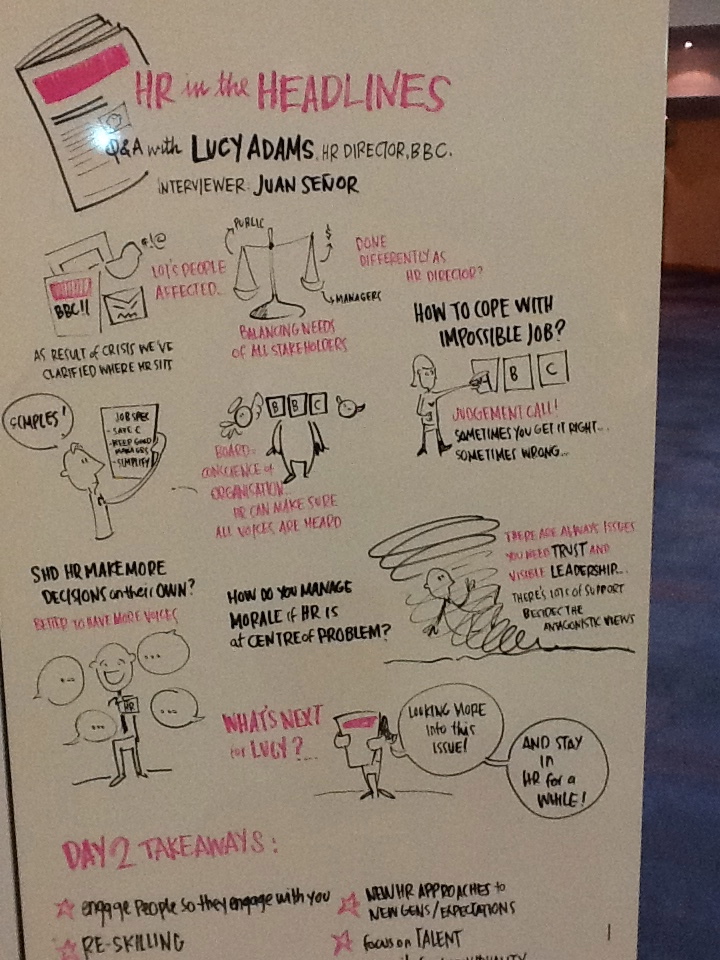
The final conference session was a Q&A with Lucy Adams – still, just, HR Director at the BBC. Needless to say the questions, put by business TV presenter Juan Señor, were about the media storm that followed her appearance before the Commons select committee last year.

She handled herself well and spoke with humility and honesty, talking of the need for visible leadership when morale is low. The questions weren’t exactly probing (fairly standard TV business interview fare) but the audience did get the opportunity to ask questions. I wanted to ask her if she thought that the reaction she got was worse because she was a woman, and that a male HR Director at the BBC may have got an easier ride. I nearly put my hand up but have to say that after a couple of days of criticising the Gen Y stereotyping I though better of raising something that may have looked sexist.

I did manage to spend a couple of minutes with her at the end though so asked the question one to one. I got the impression that she wished I’d have asked it during the session, and had expected the question to come up at some stage. Next time I won’t be so timid. And yes, needless to say, she did seem to feel that gender played a part in her situation.

Overall messages from the two days? Talent and potential…recognise it and nurture it – use it don’t waste it. And people like to be treated with respect at work…whatever their year of birth…


Job Applicants Have Feelings Too

I spent Thursday at the Enhance Media ‘Year Ahead’ Online Recruitment Conference. Now in it’s 14th year this event is a must-attend for those with an interest in online/digital recruitment and goes far beyond the usual job boards/mobile mix.

Once again Giles and the team pulled together an agenda that was interesting and provoked much thought and discussion during the break out sessions. Speakers from Google, Glassdoor, BT and KPMG were joined by specialists, practitioners, commentators and bloggers from the online recruitment world to look at emerging trends and some future developments.

There was some excellent live blogging from Alan Whitford – check out his RCEuro site for posts on several of the presentations.

I tweeted a lot of the content on the #EMConf2014 hashtag, so here are some of the things that were talked about…

We’re Only Human

Opening keynote was from the charming DeeDee Doke, Editor of Recruiter Magazine. She talked about the alarming disparity between the often exemplary client/customer experience and the, frankly often appalling, candidate experience that many businesses offer. She urged recruiters to look beyond the application to the person who had put a lot of effort into that application and to treat them with respect. She expressed concern that technology was dehumanising the recruitment process “Let’s make technology work right. Get the basics right then explore the potential”. She wanted every application acknowledged properly, not an automated email response.

There was little to disagree with. Recruitment is a people business, that helps bring real people into businesses to enable that business to meet it’s goals and objectives. Yet the process by which we do that is becoming ever more mechanical and pays little regard to the emotions, hopes and aspirations of the people.

I’ve written before that the recruitment agency industry largely operates to a transactional business model that has been untouched for probably 50 years (how many other sectors can say that) and whilst there’s money to be made it’s unlikely to change. To an agency there is little money in the candidate experience, unless that candidate is liable to be a client in the very near future.

We can only hope that somewhere in the room were recruiters taking heed to DeeDee’s call for humanity. For now it looks like recruitment technology is a lot more about the recruiter than the applicant.

We’re Always Mobile

Google made the prediction that by 2020 the entire global population would be online. I doubt this highly but can accept that their multi device world – laptop, mobile, tablet, TV, wearable, in-car – will impact on they way we do nearly everything. Including job hunting. Their figures showed that 88% of job seekers had used a mobile device at some point last year to search for jobs, which is in line with other research that I’ve seen. Interestingly their tracking software threw up the factoid that 87% of people who had searched for a job also went to Youtube shortly after (either in the same browsing session or an adjacent browsing session). Clearly an opportunity that too many recruiters miss out on.

Mixed in to all this was some ‘end of the CV’ stuff – sorry Google but even though my digital footprint tells a future employer all of what they need to know about me, very few will be looking for it and all will still want a traditional CV into their ATS – and a call to arms for companies to get creative in the recruitment process, to challenge the status quo.

We’re Under-skilled

Recruiters aren’t just recruiters anymore, they’re marketers, copywriters, strategists, social media experts amongst many other things‘ we were told by Giles Guest of Enhance Media. And he’s right. We were also told that you can’t successfully direct source if you haven’t got the right capabilities, which is very true.

All in all this talent acquisition business needs a bit more depth than we’re used to. The days of telephone jocks and super slick sales guys are becoming a memory and we need proper investment in capabilities if we are to rise above the post and pray mentality into some real sourcing. Some businesses are getting good at it but too many don’t even try.

I have to say that I don’t see this coming yet. Most recruitment presentations that I see are rooted in cost per hire and time to hire reductions and not in quality. To many recruiters a role like ‘Social Media Manager’ isn’t one that they actively source the channels for but one that they advertise and let the technology do the parsing.

We’re Looking For The Wrong Things

Those presentations that centred on social media and digital optimisation were clear in the message that we look for the wrong things. This manifested itself in different ways:

  • Too much ‘noise’ not enough engagement
  • Volume of links and likes not the quality of them
  • Obsession with large traffic not relevant applications
  • Continuous pursuit of new candidates without converting or properly assessing the ones we already have

Glassdoor told us that 90% of job seekers find company information and perspectives on social media useful in decision making, whilst 61% of new employees say that their new job is not what they were expecting. Conclusion is that many companies oversell and under-deliver on their roles. They also showed how real social engagement (proper conversations not robotic interactions) improves candidate flow.

We’re Facing Big Changes

So what are my thoughts from the day?

  • That the industry is going through a lot of change as working patterns, workforce planning and employee expectations all evolve
  • There’s too little investment in our recruitment teams. Some really are becoming a low cost automated, process led function and are in danger of becoming low skill too.
  • Candidates are ahead of recruiters on mobile, digital and social and their expectations of being able to use these in their job hunt are not being met
  • Some rays of hope. The tools are there and the data (small not big) is there to help recruiters and job seekers better align, to help expectations be better met on both sides and to help companies and job seekers avoid any nasty surprises in the hiring and on-boarding phase
  • There was a room full of recruiters eager to learn…let’s hope they go back and practice what they heard

And one final observation…

…it wasn’t until 2.32 in the afternoon that first mention of Google+ was heard…

Brand New Year. Same Old Recruitment Content?

In each of my many years working in and around the recruitment industry it’s always been the same old story as you put the Christmas presents away and turn your attention to all the different things you resolve to do in the new year – recruitment businesses in almost every sector dust down the ‘New Year, New Career‘ message.

It used to be print adverts, created in October and November and booked to appear in the first issues after Christmas. Then it was by email – actually I still got a few of those between 27th and 31st December this year. And now it’s on social media channels thanks to hashtags like #NewYear #NewCareer.

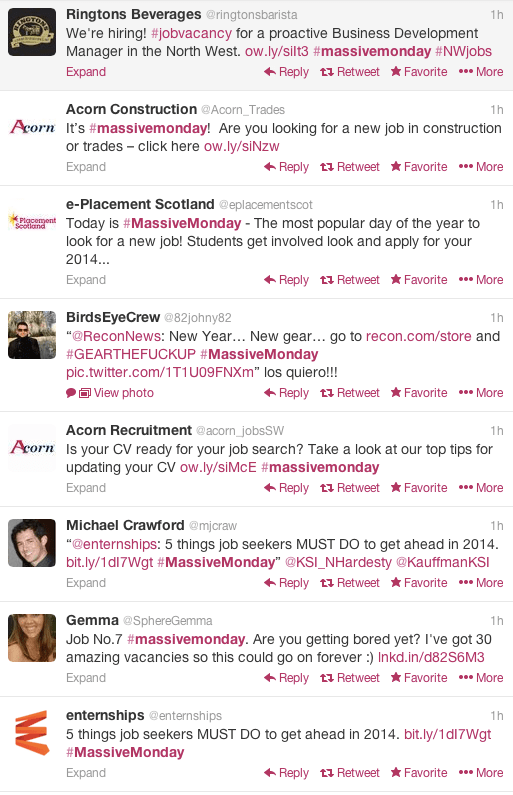
More of that later, because now we also have #MassiveMonday – the first Monday of the New Year when record numbers of people supposedly visit job boards and other digital recruitment sites. And hasn’t this hashtag taken a hammering this year – here’s just a few minutes worth of Twitter…all summed up with the ‘are you getting bored yet‘ tweet from an award winning digital marketing recruiter. Great message to their community!


So where does #MassiveMonday come from? Certainly in my years as a billing recruiter there was no surge in applications on the first Monday of the New Year. In fact the main things bothering recruiters straight back from a Christmas break were usually – Which clients are recruiting now? Who’s looking to interview straight away? Have the new starters all started? Has any client or candidate changed their mind over Christmas?

A quick search of Google to trace the origin leads you to a press release from Reed.co.uk as the primary source of all the #MassiveMonday stories in the print and digital media. They usually get more traffic on the first Monday of New Year. Not surprising really as in recent years that’s been the day on which most of the main job boards have started TV campaigns…which is the reason they get increased traffic.

No new insight, nothing of any real interest to candidates – they want an increase in job openings not CVs!

So what about #NewYear #NewCareer??

Well, what is a career?

An occupation undertaken for a significant period of a person’s life and with opportunities for progress

Now this can be a vocation or trade, or it can be a series of roles (possibly all in one or two companies) which should attract increasing levels of responsibility and rewards at each stage. Sorry guys, people don’t spend their Xmas break planning a new career.

A quick look at Google shows that the tumult of recruitment firms and sites that are gratuitously using this hashtag are clearly not attaching them to any roles that seem to imply progress, development or skill enhancements.

Of course people rarely change careers but they do change jobs. Now #NewYear #NewJob may not have the same ring but may be more accurate. After all, we call them JOB seekers and JOB hunters, not career seekers.

Amongst the plethora of New Year predictions for social business, the one constant was that 2014 is the year of story telling and content. The year of effective content that energises and engages, enchants and enlightens. The year where all businesses (and that includes recruiters) ask themselves what their candidate journey is, what are the pain points, where can they add value? What problems do their candidates have and how can they solve them.

Content is a big issue for recruiters this year. As the REC says in it’s 2014 industry forecast:

The challenge in many managerial and professional markets is the growing shortage of skills and talent…we are re-entering a candidate driven market. Successful recruiters will need to develop content that attracts this scarce talent whilst building meaningful relationships that keeps the talent close.

And what do you need to think about when producing meaningful, engaging, shareable content?

  • Quality content is what your clients want to read, not what you want to tell them
  • Content that gets highly shared is content with heart
  • Take time to engage with your online community

So recruiters, let’s get 2014 off on the right footing. Let’s engage our candidates and job seekers with what they want to know and read about. Stuff that addresses their concerns and doubts. Stories that they want to share and be part of. Let’s stop selling them nonsense like #MassiveMonday and #NewYearNewCareer because it adds nothing to their search and says very little about your understanding of their situation.

Fact is, if you got to ask them if they’re getting bored…then they most probably are…

…and there’s no such thing as a boring industry…just content creators who aren’t very creative


If you want to find out more about what good content looks like and how recruiters can use it to source and attract the best talent through social channels then book your place on this one day workshop when ace social recruiting trainer Katrina Collier and myself will tell you how

Telling Stories in 2014

Last Thursday I saw a Q&A with author, speaker and social media strategist Gary Vaynerchuk. He was in the UK to promote his new book and took a lot of questions from the floor. He was funny, anecdotal, energetic, swore a lot and made a number of observations on social media marketing, most of which resonated with me…

  • Can’t automate the human touch. It takes time to build a relationship. You can’t apply email marketing techniques to social media.
  • Social media is a marathon, it takes time to build engagement.
  • Every business is now in the media business, the only way to compete is to become an authority on content.
  • Stop thinking of social media as a distribution channel, think of it as a storytelling channel.
  • Storytellers are controlling the conversation and making the money.

My last two blogs have been about the importance of content, blogging, brand journalism and story telling, so it was good to hear many of Gary’s takeaways refer to the same topics. As with much social media marketing wisdom, it’s the simple principles that many seem to find difficult to grasp – yet the notion of conversation, relationship building, give before you ask, speak with an authentic voice are all part of the basis of meaningful human interaction and should be second nature to a marketer.

The creation of content and building of authority may be something that comes less naturally, particularly to businesses used to pushing out one way messages, but the concept that Gary mentions of everyone being in the media business is one that is recurring. This recent piece on IBMs predictions for the top social media trends of 2014 observed:

They have a reported 40,000+ content producers and brand journalists within IBM, some of which are writing for their industry’s most well-known publications. IBM is becoming a powerful media house and does not rely on the media to tell their story

For businesses from all sectors and industries there can be no excuse for not embracing storytelling and developing customer relationships that rely on conversation and engagement rather than telling and one way dialogue. As Gary says:

Your core story must remain constant. No matter how you tell your story, your personality and brand identity must remain constant, too

And for those still unsure there’s no better place to start than this slideshare on Storytelling in 2014…

The End of the Press Release and Corporate Website?

No sooner had I posted my last blog than I noticed more content marketing research showing a drop in the outsourcing of content creation from 56% to 40%. This makes more sense to me – you can’t outsource your voice to someone else, but you can hire in people who are able to bring your stories, culture and values to life – articulate them in a way that engages others.

CocaCola have recently created a new blogger network of experts. Watch the following video, which says a lot about changing attitudes to content marketing. It only lasts a couple of minutes, but in it Ashley Brown from Coke is able to give us a glimpse of the future:

  • The corporate website is dead – think beyond it and turn it into a media property.
  • The blog is more important.
  • Kill the press release – by 2015 in Coke’s plans
  • Create something that you would want to share if you weren’t at Coke – spark emotion and connection
  • Hire brand journalists

To fully understand brand journalists we need to think about what we understand a journalist to be. According to author David Meerman Scott:

“A story teller is a story teller no matter who is telling the story”

Anyone who writes or creates something, who understands the need of the reader, could therefore be classed as a journalist. As the journalist Dan Gillmor said:

“We are all creating media. Any one of us can, and many of us will, commit an act of journalism. We may contribute to the journalism ecosystem once, rarely, frequently or constantly. How we deal with these contributions – deciding to try one, what we do with what we’ve created, and how the rest of us use what’s been created – is going to be complex and evolving, But it’s the future”

As I said in my most recent post, it is the blogger who is most likely to be able to articulate the brand for the reader that you want to engage.

And I’m now finding this through experience – companies are currently approaching me to write for them not because I am a trained writer, but because I can write things in a way that engages HR professionals and InHouse and Agency Recruiters. They are my network, and an audience whose needs and concerns I understand.

A future without a traditional corporate website, press releases and old school comms may seem a big leap but it will certainly happen. If Coke can envisage this for 2015 then smaller businesses can be looking at this now, leading the way and innovating.

It will start with understanding your customers and employees, their journeys and needs, and finding story tellers with the insight, authority and creativity to talk to them.

Bloggers, Brand Journalists and The Importance of Content

CONTENT

If there’s a word that’s been impossible to escape in 2012 or 2013 then it’s CONTENT. Even more than ‘Talent‘ it’s been a word that unites sectors and disciplines, marketers and HR, managers and non-managers. A word on which everyone has a view, for which every business has a need, and one that inspires many to claim that they know all the answers.

As someone who spent the last two and a half years creating, curating, sharing and searching for content on behalf of a major digital business I can tell you that there’s a lot of it about – much of it of questionable quality and value.

I’ve also spent almost 5 years creating my own, through social channels and this blog, but when it’s for you then the odd misfire is acceptable (still can’t believe how few of you interacted with this blog on my favourite band Wilco, and what we could learn from them about talent management!) and the attempts to try something different aren’t always as critically viewed (although I accept you’ve probably seen enough pictures of my fish & chip dinners on Instagram).

Earlier this year the Content Marketing Institute produced this presentation on 2013 trends in content marketing…and some of it’s survey findings would have come as no surprise:

  • Top challenge is producing enough content
  • Next top challenge is producing content that engages
  • Other challenges such as variety, integration and measurement seemed much less important
  • The main goal for content marketing is brand awareness
  • The second goal is customer acquisition
  • The goal of customer retention/loyalty came in 4th
  • Case studies were deemed the most effective tactic
  • Larger companies tend to outsource content creation

So let me get this right, given that it came from marketers themselves – content marketing is mainly aimed at awareness and getting new customers, volume over quality is the challenge, and someone else is being trusted with your voice. Hmmm.

Does anyone know the customer journey? At what point the potential new customer may be interacting with the content? How is it being shared? How many existing customers (seemingly unimportant) are being turned off by this noise? And why is someone else talking for us?

For social platforms, as with email and the phone before, is it a case of new shiny communication routes being flogged every which way to try and create as much noise as possible? Because noise = success. Right??!!

The content that’s right is the content that works, the stuff that connects, informs, enlightens, educates, amuses or captivates – all or any. So it’s important to get the right balance and the right people producing and sharing it. The number of likes has ceased to be of relevance – it’s the quality and identity of those likes that are important. Repurposing the old marketing approaches for a new platform will miss the opportunity to create something fresh and vibrant that will capture the imagination.

And strategy is important too…is keeping and building loyalty with your current customers really only the 4th most important??

There seems to be a trust of external agencies. I’ve heard many reasons – they can scale content, produce a broad range, have access to the tools for video and graphics – but what about the words and pictures? Have they got the knowledge, insight and authority to write them? Can they authentically speak for you? And do they understand your customers and clients? Can they really create a connection? How will they share the content that they produce – or support your sharing? What are the social profiles of the people who will be working on it?

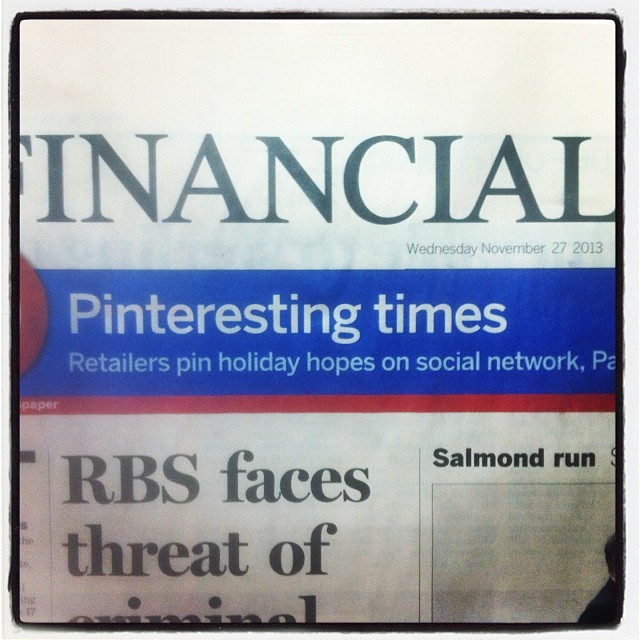
In my last (short) blog I featured a current newspaper analysis of how the retail industry is looking to Pinterest to save their Xmas trade – sorry guys, but a social platform doesn’t do it by itself…it needs time and attention, to be planted and watered, and tended with care and engagement.

But if we are to trust agencies, why not individual bloggers?

This post on predictions for 2014 via IBM makes reference to the importance and increasing relevance of ‘brand journalism‘ and the positioning of their business as a ‘media house‘ that doesn’t rely on the media, but on getting people onside and into your business who can tell your story. This includes employees too.

And crucial to telling this story will be journalists, bloggers and influencers. People with authority, followings and reach, and the skills to create the type of content that engages, connects, inspires and informs.

In the hospitality sector many companies are already teaming up with bloggers to marry social networks and content marketing campaigns and are able to leverage their networks for greater reach as well as gain further insight to how their customers and potential customers think.

As the Content Marketing Association said, writers, bloggers and the like “already understand that the craft of storytelling is based not on sentences or arresting straplines but on a journey in which characters represent our lives“.

They are also able to bring knowledge, network, access to information, influence, trust and authority. You need to get the best people – they will be your voice and the cost of not getting it right will be greater than the savings from doing it cheaply.

At this point, if I were a tech or consulting business I’d be topping and tailing this blog with some self serving research that showed I was the solution to everyone’s content problem…but I’m just a humble content and social engagement guy hustling for some new work who happens to tick all the boxes above 😉

Let me know if you want to talk more about content…

(image via www.boscoanthony.com)

If you want to find out more about what good content looks like and how recruiters can use it to source and attract the best talent through social channels then book your place on this one day workshop when ace social recruiting trainer Katrina Collier and myself will tell you how

A Social Network is for Life, Not Just for Christmas

Maybe it’s better to focus long term on a proper two way social engagement strategy rather than a one-off gimmick?

Social is an HR Issue

Social-media

Next week I’ll be chairing the CIPD Social Media in HR Conference 2013. I chaired last years’ too so it’s nice of them to invite me back! At the event they will be presenting survey findings from their ‘Social Technology, Social Business‘ research.

They have already written about some key findings. Unsurprisingly they find that younger employees use social channels more than their older counterparts, but they do find some more interesting behaviours amongst senior employees:

  • Over 50% of senior leaders use social media for work, compared to 33% of Managers and 20% of non Managers.
  • Senior leaders are externally focussed and see social media as a way to build networks
  • 52% of the senior leaders who use social use LinkedIn
  • Senior leaders are more likely to comment on forums and post blogs
  • Managers are more likely than non-Managers to job hunt using social media

There was one point of caution sounded though…

“However, senior leaders don’t seem to have seen the potential for social media as an internal leadership tool, helping them to be visible to their employees, gain trust and focus employees on strategy – indeed the data suggests thy could learn a thing or two from their middle managers here”

This interest in using the platforms probably won’t come as a surprise to regular readers. I’ve always believed that senior leaders, the C-Suite, are quite comfortable with social and that the real roadblock often lies within middle management. But the inability to see social as an enabler of better leadership is very disappointing, as is the nagging reluctance of many in HR to see this whole area as one for them. If anything should bring HR to the social table its the potential for better and more engaging leadership – visibility, trust and focus.

There’s not really a road back. This is evolution in the way that people connect and share information, and just like the phone and email, businesses need to adapt it if they are to survive and thrive in future.

Too often HR practitioners seem to see social technologies as something for marketing or internal comms to get their heads around, happy to leave it to the broadcasters and external message conveyors, but this is a gross dereliction of duty!

These tools and platforms aren’t just for external use – they are for internal use too! And that’s the point at which marketing need to let go of the reins.

  • If an an employee says something on Twitter that causes the business a problem, then that’s ultimately an HR issue.
  • If your key workers are posting on how they hate Mondays and wish the weekend could last an extra day or two, then that’s likely to be an issue for HR they are highlighting too.
  • If they go on to Glassdoor and post an anonymous review of how awful it is to work four you, then that’s also flagging up an issue for HR.
  • If you’re missing out on the talent you need because other companies have social technologies embedded, and a range of employee advocates telling their story online, then that’s another HR issue.
  • If there’s a lack collaborative working in the company, then that’s a managerial issue, which will almost certainly become an issue for HR.
  • If employees are disengaged through a lack of leadership visibility or a lack of trust in senior management, then that’s certainly an HR issue.
  • If your employees already have their own social media policy (as Euan Semple has said) then it’s certainly an issue for HR to make sure that the company is included in it.

When I say it’s an issue for HR, I don’t mean for HR to control and police…I mean for HR to get with the programme and start understanding how these tools are used and how they can be harnessed for creating the type of work environment in which employees feel valued, proud and able to give their best efforts. Not workplaces where people moan, hide, feel undervalued and generally have no desire to perform.

Of course, some of these issues require HR to challenge, not to accept the status quo or meekly follow leadership will. As Neil Morrison says, HR needs to be a trusted partner, and that means knowing when to tell a hard truth.

And to tell that hard truth you need to understand it. The opportunities are there for collaboration, learning, sharing of knowledge, different working arrangements, and creating a stronger bond with customers, clients, suppliers and partners…it needs to be grabbed.

As the recent book Attenzi – A Social Business Story defines ‘social business’:

“Social business is about adapting the way in which an organisation delivers its mission and pursues its vision by designing the organisation around influence flows, connecting: its people, partners, customers and other stakeholders; data, information and knowledge in and all around it…more openly, productively and profitably with the application of social web, big data and related information technologies.”

In my conference preview a year ago I likened social media to punk rock, but the clock is now ticking and this time it’s even more vital, not something you can indulge in if you like.

As Peter Cheese said when he opened CIPD13 “The future’s already here. It’s just happening at different speeds in different companies

I’m hoping #CIPDSocial13 offers a great way to start getting everyone up to speed…

(image via xln business blog)

Can The Candidate be King Again?

Throne

When I first started working as an agency recruiter the candidate was most definitely king. Or queen. Without the best talent at your fingertips, and in your rolodex, you wouldn’t be able to get in front of clients on a regular basis. This helped to create a candidate driven mindset with importance placed on getting to know who was best, who had good training, who was open to something new and who was adaptable, and then the candidates that you helped would always recommend other friends and colleagues to you – they even invited recruiters to their leaving drinks (not always advisable if their bosses were there, as I found out on one occasion).

Clients would speak to you as an adviser, someone who knew what was going on in the market and would often confide future plans so that you could keep an eye open for specific skills. Some of your successful placements would invariably become clients too. The right candidate was often your value proposition. The only metric that seemed to matter was getting the right person.

Times changed and email, hiring boom, graduates needing to earn commission, LinkedIn, RPO, recession, direct sourcing models and now social have all helped to shape the service and change client, candidate and recruiter expectations. Many agencies that have prospered over the last fifteen years have followed a low cost blueprint involving (amongst other things) a transactional sales model, PSLs and volume job orders at a discounted rate.

The candidate has too often gone from king to cannon fodder, usually the last person to know what’s going on and considered needy or too demanding if they expect any more than a basic level of communication – effectively an email grunt of recognition. The individual candidate now seems of low value provided that time to hire and cost of hire metrics are met.

When I first started this blog over four years ago many posts were over the future of recruitment and what needed to change. The comment threads on posts about the transactional sales model, the telephone and relationship building indicate that as the recession began to really bite in the industry there was little consensus over how to move forward.

We’re now three years on from those posts and times have changed.

Last week I saw Kevin Green (CEO of the REC) present on the Future of Recruitment at the UK Recruiter Conference. You can see his slides here.

Starting with an overview of the market, we could see an improvement in vacancy and activity levels, even though they are still some way below the pre recession peak. However there was one rather concerning statistic that must have chilled perm recruiters – over the last year there has been a 12% increase in the volume of permanent placements, but only a 2.2% increase in fees. A lot more work for comparatively a lot less money. Average annual billings for perm recruiters are also running 13% below early 2008 levels.

The culprit was fingered as ‘procurement‘ but I think it goes a lot deeper than that. Attitudes have changed, budgets have changed and for many smaller businesses, agencies are becoming the talent supplier of last resort.

Kevin talked through what he sees as the three models of recruitment success now. Two interested me greatly as I have encountered them both already during my short time job hunting.

Specialist

Specialist

For me the focus on specialist knowledge, access to talent, strong relationships, consultancy and candidate centric behaviours kinda makes this The One Where We Go Back To Recruiting Principles As They Used To Be. The candidate, and market knowledge, is clearly part of the value proposition. To profitably operate this model you need to look after candidates and put them back on their throne! And, coincidentally, the type of agency mentioned in this post from Julia Briggs looking at recruitment from the HR angle.

Low Cost

Low Cost

Here I see the focus as being more operational, centred around process, scale and workforce management. The candidates are probably quite interchangeable and of similar skills, with the business value being in meeting cost/time metrics and managing budgets. I already have some experience of this approach and as the candidate you’re pretty much left to do the work. Light on detail, you fit in with set timeframes and do the chasing if you want any kind of feedback or perspective.

The third model was for smaller, multi-branch or regional generalists. Here the business focus was on SMEs and avoiding intermediaries, PSLs and public sector.

So, can the candidate be king again? Well, it will largely depend on which model you’re dealing with.

Certainly if you’re applying through a low cost operator, or multi branch group, then my personal experience combined with recruiter sixth sense tells me that canon fodder may well be the name of the game still.

However if you can get on the radar of a specialist recruiter who’s doing it right then maybe there’s a seat on the throne again.

Am I dreaming? Let me know what you think…

(Image via @godfather_90 and #IndiaHRChat)

#CIPD13 – Where’s The Inspiration?

So the dust has settled on another CIPD Annual Conference and Exhibition. The vendors are busily following up the new leads and the delegates are returning to their desks, open workspaces or even their dining room tables (for home working, naturally) with lots of inspirational new ideas for making their businesses better places to work.

Or are they?

I’m guessing that the true test of an event like this is how many people return next year, how many new people come in 2014 through word of mouth (or online buzz) generated by this year’s delegates, and how many can put their hands up in the future and say that their businesses or culture have been improved, or their own personal vision and goals have shifted positively, because of something they heard – or some new technology they acquired – by having been at ACE 2013.

This is the hidden bit that no-one really knows. HR professionals like my friend Robert have ventured back and been surprised and encouraged by what they have seen. We know this because he is part of a vibrant online HR community that shares it’s views and commentary through blogs and social networks. We won’t necessarily know that much about the experience of those who have yet to embrace these tools.

Which is why the growing presence of bloggers and socially connected delegates at this event is so important. Whether we are giving coverage to what’s being said, perspective on some of the opinions aired, or merely bringing the event to life for those not in attendance, the online chat is now an integral part of events such as this. And kudos to the CIPD for realising this. By increasing the number, range and backgrounds of the ‘blog squad’ they ensured a vibrant online buzz around the two days – and it was great to see so many attendees and exhibitors on the hashtag #CIPD13.

We had a rousing start from CIPD CEO Peter Cheese. “The future’s already here. It’s just happening at different speeds in different companies” he said in his opening address. He was a highly visible presence throughout the two days, getting to as many sessions as he could, and always finding the time to stop and talk. I think this helped no end in making the event more personal, social and less formal. Maybe that’s why he opened the hack session by saying “I’m always up for new ideas

So here are a few of my thoughts on the event itself…

Two Days Better

The shortening from three to two days was a real positive. The whole event felt more compact, the content not spun out, and there was no ‘drag’ when delegates were maybe a bit conferenced out and exhibitors in need of a sugar rush to regain some enthusiasm. Three days is a lot of time for people (delegates and exhibitors) to be away from wherever they work, and the ones that I spoke to certainly seemed to favour the shorter event. I hope this remains next year.

Social Outreach Good

I’ve already mentioned the blog squad as a real positive, and I really did get the impression this year that we have moved, ever so slightly, on from having to tell people how and why they should embrace social…they were doing it for themselves! Certain sessions had their own hashtag, the twitter wall was showing in the main auditorium, and we got twitter handles for most of the speakers. I believe on the first day we trended on Twitter too! Long may it continue.

The Speakers

Hmmm…have to say that although I have blogged about the opening keynote from Jones and Goffee I was fairly underwhelmed by their presentation. I spoke to some who have seen them before and felt that this was below par – in which case I have to say WHY?? Opening keynote, in front of a large audience, to showcase their own research…and they were flat. No pace, perspective or chemistry, it felt a bit like an academic lecture, with plugs to purchase previous works. Considering the topic was building better workplaces the lack of passion and inspiration seemed really poor. Daniel Pink was much more robust and charismatic for the closing keynote, playing somewhat to the gallery. He’s an in-demand speaker and paces his presentation with facts, jokes, insights and audience participation. At HRTechEurope many were asking why there were so many US speakers and not enough Europeans. Well, the two keynotes here gave us one reason.

Elsewhere, as Sukh has noted, there was a noticeable lack of diversity, as well as a bias towards larger organisations. When I blogged from the HRD show in April I commented on a lack of passion noticeable in presenters from larger organisations as well as the lapse into lazy stereotyping. At CIPD13 we had Facebook trotting out a whole bunch of generational stereotyping cliches – come on guys, the average age of a Facebook user is 41!! The Facebook generation isn’t just a bunch of college kids! We did get some smaller companies showcasing their achievements. I went to one from UKFast about how to preserve culture whilst growing rapidly. For me though, this was as much cliche as some other presentations. The quartet of inspirations for their journey were Tony Robbins, Jim Collins, Muhammad Ali and Richard Branson. Whilst the speaker did radiate endless energy and enthusiasm for the business, there was little about preserving a culture and more about how to quickly grow a company from 2 to 200 whilst keeping staff happy. There were some interesting developments but I wasn’t sure what the culture was before or after, and felt the whole thing was a bit of a sales pitch – I’ll accept it’s just my view, others may have seen it differently.

Some Takeaways

As always when I’m live tweeting, certain phrases stand out and almost need no further explanation. Five of my favourites this time were…

  • What your company spends money and time on shows employees what’s important. It’s that simple.” Neil Morrison (Penguin Random House)
  • Start creating talent and stop fighting for it” Rob Zajko (Hilton)
  • Moving the customer to the centre changes everything. Job descriptions, incentives and behaviours” Monique Jordan (Pearson)
  • We’ve gone from buyer beware to seller beware. We’ve gone from information asymmetry to information parity” Dan Pink
  • The war for talent ended at Barclays 18 months ago. We had focused on graduates but had missed out on talent aged 16-21” Mike Thompson (Barclays)

The Talent Question

Two of those quotes came from a very interesting session on apprenticeships involving Hilton Worldwide and Barclays. I’ve covered future talent before from other CIPD events, but what I liked about this one was two large organisations coming clean about the focus on graduates to the detriment of those who either choose not to do a degree, or leave school at 16. There were some heartwarming examples given of young people who had been overlooked but thrived once given the chance. There were two particular themes that intrigued me.

One was whether companies were competing when they should be collaborating over the 16-21 age group. Someone who might be wrong for one company could be suited to another. If business is going to unite to help offer real hope and experience to some of the 1 million young unemployed then there needs to be more collaboration, particularly in identifying those who who ‘fall through the gaps‘.

The other was the realisation that ‘not right‘ really means ‘not right for now‘ and that each person not deemed suitable could become so in the future. To hear two large, global businesses talk in terms of each rejected candidate in this age group being a potential future customer, employee or supplier marked a change for me.

So, Where’s the Inspiration?

The overarching theme of the two days was about inspiring the future…so how many people left the conference feeling inspired? I’m not sure. Having been to a few HR related conferences recently there seems to be a certain format that binds them all. They are topped and tailed with keynotes from authors who have a book, new research or product to promote, and who have a (possibly vague) connection with HR. In the middle are a mixture of case studies and shared experiences from a range of medium to large sized businesses, often presented by someone who doesn’t always look like they want to be there – but it was their job.

Inspiration or perspiration? Practicalities or bigger themes? Do any of these really inspire HR for the future? Doug has raised the point of getting more CEOs along, and this would certainly help. But I think the real solution is to look outside the profession. Why can only HR people inspire other HR people? If we really want to embrace the future and take new ideas and thinking back to our businesses then maybe we need to look elsewhere for some insight.

The day after CIPD13 I went to a small, thought provoking conference in Brighton called Meaning2013. This was purely content – no exhibition or vendors – and drew from a wide range of fields. The common theme was that they were all ‘thinkers and doers from business, academia and activism, each bringing their view of the challenges and opportunities open to us‘. To hear (amongst others) Lee Bryant challenge on who was building the institutions of the future, Anne Marie Huby talk through how JustGiving was launched and the principles that drive it, Falkvinge showcase how to mobilise and influence people, James Watt share some fairly unbelievable stories of the risks that BrewDog took to get established, were all…well, inspirational. There was a real passion and energy about it, and a belief that things can be different.

So maybe the future for a conference like CIPD is to take chances and look outside the profession for inspirational speakers who may get people thinking in a different way. Whether this is through a fringe event, or part of the mainstream, inspiration for the profession doesn’t have to always come from within it. After all, as FlipChart Rick notes, Peter Cheese did say earlier in the year that HR need to become synthesisers and provocateurs.

I did enjoy the two days in Manchester. There’s certainly been some forward momentum in developing the event. Now, perhaps, it requires more of a leap of faith?

Which, if the profession are really to become synthesisers and provocateurs, may be no bad thing…

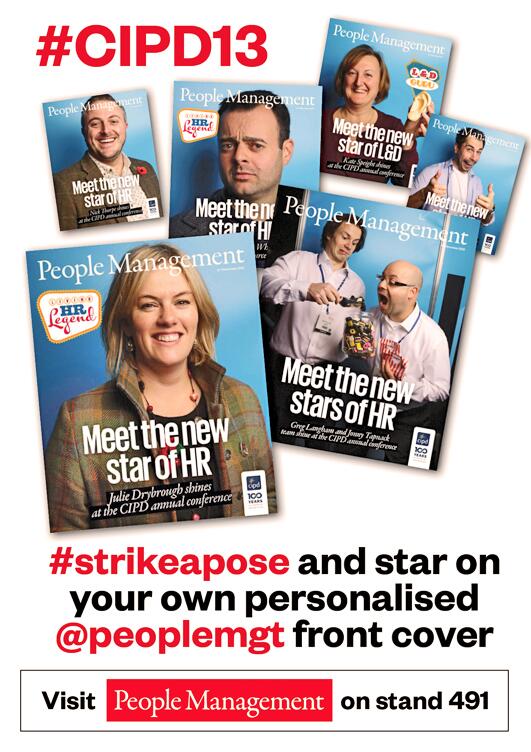
CIPD13

Everyone’s at CIPD13 – everyone’s a star 🙂

(Image courtesy of People Management)