HR Dreamers

The 2013 CIPD Annual Conference and Exhibition opened with a keynote from Gareth Jones and Rob Goffee on creating the ‘Best Workplace on Earth’. Effectively building the workplace of your dreams…and dreams being what they are then needless to say that this one is full of engaged, inspirational, authentic and effective people all working with a shared purpose and belief in what they do.

According to Jones and Goffee employees want DREAMS…as in:

  • Difference
  • Radical honesty
  • Extra value
  • Authenticity
  • Meaning
  • Simple rules

Talk over? Well not quite. I did tweet out most of what they had to say, and four of the blog squad – Gemma Reucroft, Ian Pettigrew, Doug Shaw & David D’Souza – were quick off the blocks with a good run down of the key points they raised.

Here are some of my thoughts…

Why Would Anyone Work Here?

Not sure how many business leaders ever ask themselves, or their employees, this. Presumably many think it’s charisma, a great product or service, or just that it’s work for us or draw jobseekers allowance, but what Jones and Goffee told us was that there are four reasons – Culture, Performance, Employer Brand, Engagement. Does your business deliver on these? Does the image, or perception, match the reality?

Rob Goffee talked of living the brand and culture through purpose, standards and relationships, and of emotional sociability.

Importance of Conflict

There was a call to encourage conflict rather than suppress it. Conflict can help to drive the creative process. Leading on from this was the need to have characters around – they are the people that make the place special.

I would caution with a ‘be careful what you wish for‘. Whilst these were two very popular soundbites a business rife with conflict and characters often isn’t a very good place to work. For every example of this approach being productive I’d wager that there are plenty of others whose progress has stalled amidst poor engagement and staff attrition.

Radical Honesty

Tell the truth before someone else does” was the message to HR….”if you sanitise bad news then the people at the top will never know what’s going on“.

The angle here may have been about the need for truth and honesty and to avoid spin, but in reality everyone else bar the leadership is already on to this. It’s my theme of the Autumn – ‘Organisational Nakedness‘ – cropping up again. The truth is that outside of the business everyone is already telling the truth about your product, your customer experience, your employee experience, your candidate experience and so on. The new reality is that HR doesn’t need to persuade the business to come clean – it needs to show the cost of not coming clean. Businesses that aren’t true will soon being to feel it through the bank balance.

The Department of Rules

A dig at HR and the desire to wrap a process around everything. I’ll take this in context with one of the closing statements which was not to confuse systemisation with bureaucratisation. With a number businesses this is probably easier said than done as the concepts of trusting people and self direction are hard for many to embrace.

Rules that do exist need to be simple and tested, not complex of imposed. Do the people who have to abide by them consider them fair? The concept of fairness is one which has appeared in a few conference keynotes recently and there is nothing that dis-engages your key workers more than a feeling of being treated unfairly.

Societal Good

People want to do good work” Gareth Jones told us. “Work is a defining human characteristic. Good work equals good societies” HR needs some moral authority, and should be about doing the right thing, which should help create better societies was the message.

Quite a weight on the shoulders then. There is little doubt in my mind that HR professionals have a desire to do the right thing and make working life better for everyone, but is this what their leaders want? As Gemma asks – do you really know what the CEO wants? To create a better society through work probably requires different behaviours, which will need to be influenced by different rewards.

As Rob Goffee noted “Meaning comes from connections to others, community, cause. The most profitable businesses are not necessarily the most profit oriented

I’ve seen 3 opening keynotes at 3 HR Conferences across 3 time zones in the last few weeks and all have similar strands running through them. Whether it’s building better workplaces, investing in new technology or devising a new reward system to encourage the right behaviours, the challenges for HR come from several new business norms…

  • Openness
  • Sharing
  • Collaboration
  • Authenticity
  • Inspiring leaders
  • Heightened expectations
  • Experience over functionality
  • Self direction over controlling management

Can HR harness these to build better workplaces…or are we really just dreaming?

Organisational Nakedness

(Image created by Simon Heath)

Social Snarks and Hashtag Hecklers

I’m heading off to Manchester later for the CIPD Annual Conference and Exhibition. Condensed to two days this year there promises to be much rich content with a wide range of speakers and contributors. We’ll be opening with a keynote on ‘Creating the Best Workplace on Earth‘ and closing with ‘Leadership and the New Principles of Influence‘. The latter session will be delivered by Daniel Pink – after live tweeting, and blogging about, his two presentations at HRTechEurope I’m in danger of becoming a fanboy!

For this event the CIPD have put together a blog squad of more than 20 of your favourite HR bloggers and tweeters, and between us we will endeavour to capture the essence of what’s being said, and which exhibitors have an interesting story to tell.

For some of the squad it will be their first live tweeting/blogging experience – I’m looking forward to reading what they have to say – and with such a cross section of people there will inevitably be a range of styles and viewpoints.

I noticed during my visits to HRTechConference and HRTechEurope a greater embedding of bloggers in to the event conversation as they become important conduits of the various messages. Everyone has their own style – I tend to live tweet a lot of what’s being said as an aide memoire to help me blog about it later. I don’t often give my perspective on it until my post event review – I see my role as someone who is taking the content to people who aren’t able to attend, drawing in a much wider audience than usual, and then reviewing afterwards. A bit like a sports journalist commenting on the live action and the writing an opinion piece later.

Others in the blog squad are likely to do it differently, giving a view or perspective on what’s being said. Only by following the hashtag #CIPD13, rather than individual tweeters, can you get the full picture.

For those of you following from afar there are three channels to follow:

The event hashtag on Twitter – #CIPD13

The individual blog squad members, their tweets and blogs – this list from Steve Bridger will help

The CIPD Tumblr – curated by Doug Shaw

It’s been noticeable during events over the last year or two, particularly those around recruitment and HR, that the twitter hashtag thread often draws in comments from those not in attendance. This is a good thing as it broadens the conversations, and also offers a useful way to spot examples of those two growing live event phenomena – the Social Snark and the Hashtag Heckler.

Social Snark

They aren’t in attendance, usually because they are too busy – but not so busy they aren’t following the twitter chat for 140 character updates that they find less than insightful or (cardinal sin) something they’ve said before. They are usually dismissive of the quality of the content believing that the conversation hasn’t moved on and hence justifying their decision not to go.

Hashtag Heckler

They can’t shoot down the message so take it out on the messenger. They’re different from the snarks in that they want a debate, usually to publicly call out the speaker, so start disagreeing with the live tweeter. Again there is usually a link to something that the heckler has blogged previously. This type is not to be confused with the Hashtag Hijacker who basically uses any popular conversation thread to promote themselves irrespective of whether they have anything to contribute.

Enjoy the conversation and if the buzzword bingo gets too much you can always go snark and heckler hunting 😉

Here are a few posts I’ve written from previous CIPD conferences:

Unlocking the Potential of Our Future Workforce
The Elephant in The Room for Tomorrow’s Workforce
Blogging and Learning at #CIPD11
Trust is The Word

Myths and Learnings at #HRTechEurope

Euan slide

Latest stop on my Autumn Tour of Discovery (previous stop Vegas, next stop Manchester) was Amsterdam for HRTech Europe, a two day HR Technology exhibition plus conference with content stretching from talent management, data analytics and technology to building social businesses and the future of work and learning. The event attracted upward of 1500 delegates across the two days and logistically was focused around a central exhibition hall with auditorium attached and breakout rooms upstairs. The networking sessions and coffee breaks also took place around the central hall which created a lot of buzz and energy, rippling through the whole event.

There were some top notch speakers from the US as well as a few from Europe – I have some sympathy with those who feel that we could have done with stronger representation from Europe on the main platform, but the important thing for me is that the speakers have something to say that makes me think and can back that up with research, case study or some clear rationale.

Here are four of the main talking points that got me thinking…

Organisational Nakedness

I’ve used the expression before but, just as in Don Tapscott’s opening at HRTech in Vegas, this was a noticeable thread running through many of the main sessions dealing with collaboration, sharing, connectivity and the new social openness, particularly those from Prof Costas Markides (London Business School) and Euan Semple. The talk was very much about people not processes. However much a business may try to resist the urge to embrace social collaborative platforms, their employees, customers and partners – their advocates – are almost certainly using it…and will expect to communicate openly. This exposes the organisation, its structure and values, to wider scrutiny – are they ready for it?

We’re all Technologists, Sales Professionals, Marketers and Recruiters Now!

Jason Averbook said that we’re all technologists. Daniel Pink said that we’re all sales people with everyone having persuasion somewhere in their role. And we’ve known for some time that every employee is potential marketer, recruiter and source of referrals – they represent the company, its internal culture and proposition, to everyone who knows them. In the new world of work we’re all ambassadors for our business, role, skills, products and services – having said that we probably always have been, but now we’re much more visible. There is also an expectation of multi-skills, adaptability and resourcefulness that will drive the future workforce.

The Importance of Mobile is UNDER Hyped

For possibly the first time our customers/clients and our current and future employees have better technology than the business…and this leads to greater expectations. ‘The importance of mobile is UNDER hyped‘ said Dan Pink at the start of his masterclass. Most people keep their smartphone within 3 feet all day and night and expect to communicate through variety of channels at all times. If you lose their luggage they’ll write a song and/or make a video. If you treat them badly they’ll resign in a spectacular way.

When they interact with technology they expect it to do what they want it to do in the easiest, simplest and quickest way – ‘solve my problem and make me feel good‘ as my old boss Felix Wetzel used to say – and they have little time for a process that is difficult, obtrusive or leaves them in the dark about what’s happening.

Customer and employee expectations are heightened. Whether they are using it to apply for a job, or book leave, or to buy your latest product, the technology we use in our businesses needs to deliver an experience to the end user that matches theses greater expectations.

The Manager of the Future

I had two really interesting and insightful conversations with Dr Katherine Jones from Bersin by Deloitte about management, the future of work and the future of HR. I’ll write more about them in a different post, but one thing that really intrigued me was when she talked about the opportunity for managers to take over many of HRs responsibilities.

Currently we tend to promote people who do a good job to manager level, but what if employees are empowered and responsible for their own workloads and careers? Then we would be looking for people who could develop, counsel and manage – different competencies requiring different promotion criteria. I remember Daniel Pink saying ‘human beings don’t engage by being managed or controlled but by self-direction‘ and also how ‘control leads to compliance whilst autonomy leads to engagement‘ implying that a different approach to management was required. I could also sense this need for a shift in emphasis when he spoke of how cognitive skills were becoming increasingly important – ‘Analytical skills are necessary but not sufficient. Artistry, empathy, imagination and conceptual now more important‘.

Costas Markides also spoke of the need to embed your values in the hearts of your workers, much like a family. Tomorrow’s managers will need to inspire as well as develop.

Many of the conversations that I had around the event indicated a clear shift for job seekers from looking for jobs to looking for work. People who may be joining your team or business may not be doing so for long term prospects but to help you complete a task or project. This will require a different kind of management and engagement.

So what about the HR myths?

Well, they came from Josh Bersin, during his session on the datafication of HR. During the section ‘Applying Science to People Decisions‘ he debunked 5 Workplace myths. Each one solid gold!

  1. People from top universities with good grades are high performers
  2. Training and education reduces loss and fraud
  3. Customer service will increase client retention
  4. People will leave their jobs if we don’t pay them enough
  5. Our leadership development process will work around the world

I was blogging from the event on behalf of RC Euro – check out the posts that I wrote for them…

Once again I noticed an increasingly important role at the event for bloggers – there were more than 20 – encompassing vendors and speakers in an attempt to reflect the full range of content and solutions available and give some insight behind both. With 61% of HR professionals seemingly looking to change their technology within the next 18 months practitioners, vendors and bloggers are very much part of the same conversation.

There is an appetite for a richer and more in-depth level of online event coverage – will be interesting to see how this develops at other events over the coming months, and how it translates to UK conferences. The HRTech Europe event moves on to London in March 2014 and will be back in Amsterdam for October 2014 – I’m looking forward to seeing how the conversations develop.

(Image from Euan Semple presentation)

In Praise of Experience During a Time of Social Media Crisis

There have been a few blogs recently about social media crises. Storms around Tesco, The Sun, Ryanair and even our own HR brouhaha over Peacockgate have all thrown the good and bad of open social comms in to a sharp light…possibly adding fuel to the arguments of those who fear and want to control it.
This comprehensive post from Rachel Miller offers much information and sound advice on how to prepare for a potential crisis. I like that she crowdsourced some of it, as this helps underline the collaborative, community style of the social comms – we can learn from each other and the best ideas need not come from multi national businesses.  In fact in these type of crises it’s often the bigger names that are most susceptible…although some the biggest can also afford to do very little or even ignore it completely – as Amazon showed earlier in the year.
I saw Euan Semple talk recently of the connection between your internal comms structure and your social approach – if you need a dozen people to approve a blog post then it’s unlikely that your social updates will have a natural flow to them.
Regular readers will know that I think posts like this one on why a business’ social engagement should be the preserve of the young, digitally native Gen Y/Millennials/interns are complete nonsense and you need look no further than a social media shitstorm to bear that out.
The keys for any of theses situations are usually tone, context and perspective. Knowing when the storm is at an early phase and when we’re reaching the eye. When to apologise, when to educate, when to pull the plug and how to turn it into a badge of honour. And never knee jerk in panic.
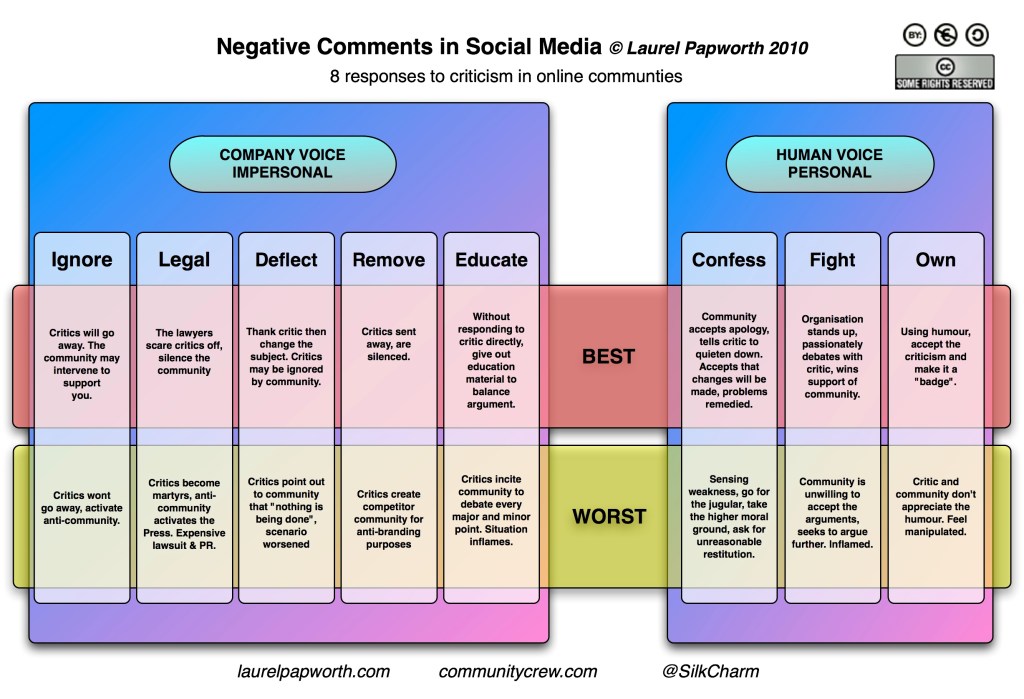
When I present on dealing with negative comments I always use this post and chart from Laurel Papworth.
It’s a pretty foolproof way to assess what to do and how, and you’ll notice that pretty much all the actions require sensitivity, perspective and balance. All things that come with experience.
Now you could be forgiven for thinking that someone who has a mile or two on the business experience clock would say that – but then what it does give you is a more measured, less excitable and responsible approach. For example I wouldn’t have responded to Peacockgate with a hashtag campaign of #ProudtoworkinHR as it appears to marginalise the profession with a whiff of minority defiance, implying that we know that most others see us as being different or a problem. It also failed to tackle with the points being raised…there were more sensible ways to tackle it and take ownership of the debate.
Once in a while there’s nothing wrong with having a bit of experience – hell, it may even be a positive.

I’m a Content Curator…Get Me Out Of Here!!

Jungle

Amongst the insightful, and some not-so-insightful, comments emanating from the recent Social Media Week London was one about content that seemed to slightly slip under the radar but was visible enough to be picked up and mentioned in a few presentations since…

…namely that a leading supermarket chain (oh go on then, Asda) delete any update that hasn’t attracted at least 100 likes within 5 minutes.

Now I find that fairly extreme content curation, the kind of thing you could build a reality show around – gather a group of community managers, let them create or find some content, and watch the twitchy fingers as they decide whether to hit delete or wait a few more minutes, send out a few more tweets, and try and get those likes.

Of course it raises the question of what type of content can pass the 5 minute/100 like test – particularly if you’re not a major consumer brand and have to rely on a healthy mix of curating third party content as well as creating your own, with the bias usually on the former.

This question was perfectly illustrated a couple of Mondays ago as two pieces of content popped in to my timeline almost simultaneously.

First up was this blog from my friend Doug Shaw looking at the importance of taking time out to have lunch with colleagues, break bread, chat, share and generally be social. If you’ve heard Doug speak you’ll know this is one of his pet topics, and rightly so.

Not long afterwards followed this piece on Metro online. Someone has made small plastic knives, forks and spoons that fit on the top of your pen, meaning that you barely have to break stride from in front of your screen when you want lunch. No need to head for the kitchen to stretch your legs and look for cutlery.

The two pieces are from opposite ends – one suggesting we use lunch to have a break, the other helping to ensure that lunch makes no dent in your productive hours.

So in my game of Extreme Content Curation which one would you go for?

Doug’s piece, framed and shared in the right way, should certainly spark some debate and chatter within your community, particularly if you’re working around the HR, Recruitment, Workforce, Management space. The value of a lunch break, the aid to collaboration, knowledge sharing and conversation pitted against the structure of a working day.

But on the other hand, the Metro piece has great images – ready made for hitting the like button without actually reading what it’s about – and novelty value. No doubt many would think it was a good, even fun, idea even if they shared Doug’s view of how your lunch should be taken.

So let me know what you would do.

The clock’s ticking.

And & Dec are waiting to interview the losers.

You’ve got to choose one piece to share and frame.

And there’s five minutes to get the likes…

…which piece would you go for?

(Image via Radio Times)

Disclaimer – this blog in no way intends to infer that chasing likes at all costs is in any way a social media strategy that should be pursued

#HRTechConf – We’re All Technologists Now!

HRTech

The final keynote at the recent HR Technology Conference was from Jason Averbook, who delivered an overview of HR technology – where we were, where we are now and where we should be going.

His rallying call was that we need re-imagination – we’re getting bright shiny new technology but we’re doing old school things with it. To emphasise this point he ran through 5 generations of technological development, the 4 different eras of what we’ve called HR, and concluded that despite all that change we’re still basically doing what we’ve always done.

He also had news for the HR professionals who think that technology isn’t for them – We’re all technologists!Do you call IT when you want to search Google?” he asked. “Who keeps their smartphone nearby when they go to bed at night?” got a clear majority show of hands.

Another show of hands revealed that only 5 people in an audience of many hundreds were from the payroll function, yet payroll is usually the first HR process that we get technology for. A couple of comments on the twitter channel questioned whether this was because the process didn’t innovate – but I’m not sure that’s true.

When I first started work I got paid cash on a weekly basis, then by cheque on a monthly basis, and more recently by direct transfer. I used to be given payslips with my cash/cheque but now I have to log in to a system to find them. And because I don’t do it regularly I invariably have to reset passwords – coming up with a new on each time! Payroll evolves much the same as any other process, yet where were the specialists at this show?

Jason also touched on the irregularity with which people interact with their internal technology. He asked when we last got married, had a child or moved house, as these are three key events when we will interact with the HR technology at work. Clearly for most people these events happen very rarely – maybe every few years – giving them little reason to interact with that technology, yet most HR professionals will complain that employees aren’t using the tech. Again you need it to do different things if you want more interaction.

The importance of measuring for now was another key point. Performance reviews, engagement, development are all measured and reviewed historically, yet employees are more interested in what’s currently happening. The technology for real time measurement is available so why not use it for now as opposed to what’s already gone.

Some other points that Jason covered:

  • People come to work and expect to get connected, most people keep their phone within 3 feet at all times of the day and night, yet we often deny them that connectivity.
  • If you go to a website that sucks, you don’t stay on it for too long. But do you ever go back to see if it’s better? Probably not, this is why businesses need to get their tech right.
  • For possibly the first time consumers now have better technology than businesses do. Expectations are raised.
  • The Cloud doesn’t change cultures – it’s just a delivery mechanism.
  • Give them real time access to social channels – or they’ll post on Glassdoor!
  • “HR sucks at simple”. Contentious, but it got a reaction.

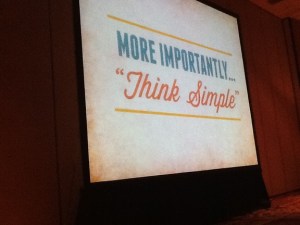
The closing call was ‘If interaction is not embedded in the process then it won’t get done’ with a plea to ‘think simple’.

Jason is a good speaker who puts his points across with energy and simplicity. I took away a clear message that too many HR professionals see technology as something that isn’t really their thing, but a box that needs to be ticked. Clearly everyone in the room used technology constantly in their personal lives and there shouldn’t be a disconnect when it comes to embedding it in the workplace.

My view is that the things we look for in the technology we use in our personal lives – ease, relevance, convenience, enhanced experience – should also apply to the technology we use in our working lives. Technology should not be a barrier to getting work done but should be an enabler to getting a better job done. As Jessica Merrell tweeted ‘innovation & technology change isn’t just the vendor’s responsibility – amen!’

Laurie Ruettiman’s blog on the automation of HR is worth a read – ‘you might want to think about understanding the technology that’s about to upset your apple cart. If you know your enemy, you can destroy it’

After all, it’s never really the computer that says no….

Living in Interesting Times

Hire me

It’s almost three years since I last started a social job hunt. Back in November 2010, the concept of leveraging social media channels to create awareness of yourself to potential employers, whilst along the way creating content that both chronicled your insights and perceptions of the job hunting process, as well as showcasing the knowledge and attitude that you could bring to a role, was fairly new.

In October 2013 this is now more commonplace; in fact for many individuals it’s expected.

Using Social Networking for Job Hunting

At the recent Social Media Week London I joined Steve Ward and Bill Boorman in presenting to job seekers how they could effectively use social media as part of their job hunt. My session covered three areas:

Research – find out about sectors, businesses and individuals. Who is hiring, who may be hiring and who’s doing what in the industries that interest you and what skills, capabilities and knowledge they may require.

Engage – it’s not just enough to find out the information, you need to interact with the individuals, put yourself on their radar. You need to connect to the people who are doing the hiring, which may mean identifying those who can introduce you to them. And not just the companies and recruiters but also bloggers from your preferred sector; read what they write, comment and share.

Self-Promotion – make sure that what you do brings you to the attention of the people you are trying to reach. Use a video of yourself, create a blog (Tumblr or WordPress), use images and seek out and share interesting and unusual content and become known as someone who has access to and shares interesting insights. Develop reach and contacts.

Influence and Network

There’s little doubt in my mind that the importance of what someone can bring to an organisation in terms of knowledge, network, access to information and (crucially) that oft misused word influence will be crucial hiring factors in the very near future.

Attendees at the recent Discover Sourcing event heard Andrew Grill (ex CEO Kred, now IBM) present onTalent in the Age of Social Business’ and talk of the importance of influence to a business both internally and externally, how to recognise it, source it and the importance of hiring it in to your organisation.

For me Kred are different from Klout, PeerIndex and other influence measures because of the outreach factor and the transparency – not about how much stuff you put out, or how often and how many followers see it, but about how you interact with and share others’ content, and how they interact with what you do.

Are you a trusted source? Do others share what you have shared? Do people trust and act upon what you say? Do you build authority? Or drive unique interactions from new sources? Do you build relationships? These are some of the things that hiring managers will be considering in the future.

When they hire you they will also be hiring a network, a community of people around you who are part of what you can bring to the day job. Connector, facilitator and enabler will be key attributes.

It’s over two years since an IBM Social Jam had as one of its conclusions that employees have a personal brand, existing both inside and outside the business, that companies do not own but effectively ‘rent’ from them whilst they are at work. They went on to say that these personal brands should be rewarded based on how they help the company.

Future of Talent Communities

I found it interesting to hear Don Tapscott talk at HRTech of how talent communities should be about getting tasks within an organisation completed and not just be a ‘pipeline’ of potential future employees. This reminded me of conversations a couple of years ago about how the future of talent community management would be building a network of flexible, freelance workers, creatives and writers, designers and UX specialists, analysts and data scientists. Keeping them engaged and informed, able to share and help, refer and recommend. And maybe some future employees too.

Business as Usual

Where is this leading us? Well, I think that as ‘social’ business becomes business as usual, and sentiment begins to overtake likes, shares and clicks as a key metric, then having a socially enabled workforce, a proper social engagement strategy and the ability to share the stories and create the content that encourages customers, clients, employees, suppliers and partners to want to be a part of what you do, will become crucial, and the organisations that fail to take advantage of this may well get left behind.

Customer and consumer expectations are rising. They often now have better tech than companies and are changing the way they communicate and collaborate. Smartphone ownership is driving a different kind of consumption. For example, we spend too much time talking about ‘mobile’ recruitment when all our candidates are doing is job hunting – the medium through which they connect and apply is irrelevant to them, convenience and experience matters more.

And employees, your number one brand advocates, are not only using social channels but expect to be able to harness the opportunities they offer in their day to day business roles.

Social Job Hunt 2013

And so it’s into this evolving business landscape that I head off on my Social Job Hunt 2013.

I’ve learned a lot over the last three years, and have gained much knowledge and insight from an ever evolving network of connections covering recruitment, HR, employment law, the future of work, digital marketing, social strategy, branding, FMCG and agency. Not forgetting content creation and curation, community building, encouraging employee and management participation and building reach and influence. A lot has changed, and a lot of change is yet to come.

Judging from some of the conversations I’ve participated in, and from the experiences and insights shared, at various events recently we are certainly living in interesting times.

I’m excited about the future, the opportunities and avenues that are being opened up, and am looking forward to playing my part in helping business navigate these interesting times.

It should be a fun ride. Let me know if you would like to talk…

#HRTechConf – 5 Observations From Across The Pond

HRTech panel

Recently back from Vegas having attended my first HR Technology Conference in the US…a three day extravaganza of exhibitors and demos, content and parties, and most importantly, connections and networking.

I was lucky enough to have an access all areas blogger’s pass so here are some of my random thoughts on what stood out for me as a first time attendee…from a UK perspective, obviously!

1) Its Huge. The Expo was larger than anything I have seen in the UK and the press room alone was big enough to hold a one day conference! Massive scale but still with a personal touch as everyone I came across took the time to network, get to know you and talk enthusiastically about their particular area of expertise/interest.

We’ve all walked round expo floors dodging glances from slick sales people manning the stands and looking to collect business cards and email addresses to help them spam you with messages and calls. I wasn’t sure how this one would go but have to say that every exhibitor I spoke to wanted to engage in a conversation (OK, maybe it was my accent) and talk you through their product, usually displaying a real passion and pride in what they do. That may be because my inbuilt anti-sales radar kept me away from the others.

2) Bloggers Count. At this event bloggers are important. We had our own room, sponsored by Dice, and numbered about 30. I remember Rob Jones writing about how having blogger as opposed to a sales prospect’s job title on his badge at CIPD11 elicited a more ambiguous approach from exhibitors. Not here. Most businesses wanted to engage the bloggers and tell us about their tech and what it could do. They seemed to see us as important conduits of their message. They scheduled meetings with us, made sure we were at all the parties and receptions, sought our views on trends and generally saw us as a valuable, and influential, channel…something UK event organisers should take note of. I really appreciated, and learned from, time spent with Glassdoor, RoundPegg, Success Factors and MTM Recognition.

The impression I got was that bloggers were seen as an important part of the conference and an important link for exhibitors and speakers.

3) Swag and Parties. From some of the blogs I had read covering previous years I was expecting to need an extra suitcase for all the swag on display – I’m a sucker, I really did think there would be t-shirts with slogans like ‘HR chicks/dudes do it better’ ! As it was, amongst the stress balls, pens and flashing party specs I will make use of my Cornerstone on Demand shirt proudly proclaiming that I’m a Millennial at Work (I took a survey, honest) and my limited edition ‘Seize the Night’ Virgin Pulse launch one. Not forgetting my SumTotal iPhone/iPad charger, Glassdoor lip salve, mints and torch/bottle opener key ring, Technomedia USB, Broadbean beer cooler and many more!

The parties…well, I’ve shared what I need to on Instagram, Facebook and Twitter! There were many of them, often 3 or 4 on at the same time, offering part networking and part fun. No expense spared either. My top three were courtesy of Reputation Capital/Blogging4Jobs/Technomedia, Jobvite and Virgin Pulse/Starr Conspiracy. If you really need reasons to go to this conference then the parties are as good a good place as any to start!

4) Content. The actual conference part provided me with a mix of great, good and average. The keynotes from Don Tapscott and Jason Averbrook were excellent. The panel sessions were good value too. Some of the breakout presentations were less insightful though – maybe I was spoiled by attending HRevolution the day before as there was certainly more energy, ideas and insight at that event than in some parts of the larger conference. Will be interesting to see how this shifts with Steve Boese now at the helm of HR Tech.

Of course the real big noises of the content show were that perennial fave ‘talent management’ which jockeyed for overuse with the younger rising star ‘big data’. For me both are default terms that cover for a lack of more interesting conversations…would have been good to have a deeper dive into both these areas particularly with reference to the end user. We heard how both Amazon and LinkedIn know more about employees than their employer does but no real insight as to the relevance and impact of this.

For me the three most interesting, and encouraging, technologies at the event were about sourcing & candidate identification, using social reach and conversations to provide something a lot deeper – Dice’s Open Web, and two emerging businesses that didn’t exhibit but were certainly active participants in the conversations – eitalent and entelo.

5) Connections and Conversations. This was a huge part of the conference experience and one of the strongest. Some really great conversations and insights were shared, with the opportunity to have face time with many people who are often just avatars on a social networking platform, being a particular highlight. It’s difficult to put a value on this kind of interaction, but I know that this part made the whole trip worthwhile for me.

As you may have gathered, I enjoyed the experience. The interactions, insights and social aspects were hugely important. Technology is an enabler, a delivery platform that is now embedded in almost every action that HR and Recruiters take on a daily basis. From payroll to on-boarding, rewards to succession planning every professional needs to understand how technology can help deliver an improved and enhanced service, and experience, to current, past and future employees, managers and directors.

This event was a great place to start – I’m planning on coming back next year!

(Image from Trish McFarlane)

Is HR Ready to Get Naked?

The HR Technology Conference opened with a keynote from author, consultant and business strategist Don Tapscott. His talk – Radical Openness – was based on his latest book (of the same name) and looked at the social enabled evolution in business organisation and the challenges and opportunities it offered.

He started with four principles of openness…

Collaboration
Transparency
Sharing
Empowerment

…and then looked at how each are being driven by shifts in technology, social and behaviour.

Some of the key points he talked about:

The age of networked intelligence – we talk about the Information Age but what technology is enabling isn’t just a link to information but to other peoples’ intelligence. Their brain power, insights and analysis.

Talent communities shouldn’t just be about candidates – we should be building and growing these with the aim of helping to get the job done, tasks completed. Instead of using to hire externally we should be using them for collaboration.

Many organisations are not used to the breaking down of tasks – if we are going to effectively use these talent communities as channels of collaboration then we need to change the way we think of work.

The need to deal with business changes – a tweet from Jason Averbrook nailed this as the need to be agile in our approaches to process and technology. He later tweeted that HR was enabled precisely because it spoke HR language and not business language…not sure how that one plays out with the UK audience.

Forget talent inside – a key point about changes to organisation structures around innovation. Again this relates to using outside talent collaboratively. Again it was Jason Averbrook who commented ‘the organisations that only think of talent management as looking at internal talent will have a very hard time competing in the future’.

Customer collaboration and co-creation – too many talk about customer engagement as the holy grail, but the future business should be focused on the customer or consumer as a partner in collaboration.

Leadership can com from anywhere in the organisation – a new type of business structure will lead to a breaking down of traditional hierarchies. Culture should encourage anyone in the organisation to take a lead role on any process or project.

The final thoughts centred on how businesses will cope with openness and specifically how HR will adapt. Some examples were shared of organisations reverting to protectionism in the face of collaboration or co-creation.

Transparency, openness, sharing and collaboration point to a new organisational ‘nakedness’ creating a huge opportunity for HR professionals to play a major role in steering businesses forward.

Is HR ready to get naked….

What I’m Looking For at #HRTechConf

I’ll be spending the next few days at the HR Technology Conference – the first time I’ve been able to go.

I’m lucky enough to be part of the blog squad so have been thinking about what new trends and innovations I’ll be looking for.

In recent months I’ve been at a recruiting leaders round table, as well as two FIRM (Forum for Inhouse Recruitment Managers) conferences, and at all three events current recruiting pain points have been discussed. Invariably they are very similar, whichever group of delegates has been bought together. The key ones, unsurprisingly, have been:

ATS – specifically how to get one to do what you want them to do
Creating a positive experience for everyone who applies
Reducing the volume of unsuitable candidates tied in with better screening
Talent pipelines
Improving internal mobility
Difference between generating names and creating candidates
Hiring for potential vs hiring for now

Many of those are linked to technology so wearing my recruiter’s hat I’m going to be looking at how tech suppliers can help ease that pain. And how they can give a better experience to applicants and candidates.

From an HR perspective I’m keen to see how the employee experience can be enhanced. From attraction and nurturing, through on-boarding and performance management to internal collaboration, personal development, promotion and succession, I’ll be interested to see if what works for the employer is also creating a great experience for the workforce. And how technology can help not hinder.

As the level of connectivity, and the demand for an experience that has a positive, shareable impact, all grow it will be interesting to see if technology that offers a streamlined, cost effective and superior service to the company can also create an enhanced experience for the end user – the job seekers, recruiters and employees.