Health, Work and the New Reality: Thoughts on the 2025 CIPD Survey

The 2025 CIPD Health & Wellbeing at Work survey gives us a fairly clear picture of how employees across the UK are really feeling – physically, mentally and emotionally – and how their working lives are shaping that experience.

While many organisations have invested heavily in wellbeing initiatives over recent years, the data is showing a far more complex and nuanced reality. Some indicators are moving in the right direction, but others highlight systemic issues that employers cannot afford to ignore.

A Workforce That’s “Mostly Fine” – But With Warning Signs

At first glance, the findings are reassuring. Around two-thirds of employees say that their mental and physical health is good or very good. This suggests that most workers feel able to cope with day-to-day demands and maintain a baseline of resilience.

But that headline masks a significant minority who are struggling. Around 14–16% of employees say their health is poor, and almost a fifth feel neither positive nor negative – a sign of stagnation rather than wellbeing. When scaled to the UK labour force, these figures translate to millions who feel their health is deteriorating or stuck.

The emotional landscape at work is similar: many employees regularly feel enthusiastic and immersed in their work. But behind this lies a substantial group experiencing exhaustion and excessive pressure. These two factors – energy depletion and sustained pressure – are among the strongest precursors to stress, burnout and declining productivity.

When Work Makes People Unwell

Perhaps the most concerning finding from the survey is that a quarter of employees say work has a negative impact on both their mental and physical health. This represents around eight million people who feel that their job is actively damaging their wellbeing. Given the pressures of the past few years, from economic uncertainty to rapid organisational change, this figure may not be surprising – but it is concerning.

Only a third of workers feel that work positively affects their physical health, and fewer than half say the same for mental health. In other words, for many people, work is at best neutral – and at worst, harmful.

What’s Driving Poor Health at Work?

The survey points clearly to the underlying factors. Employees reporting negative health impacts are far more likely to experience:

  • High workloads and the sense of having far too much to do
  • Excessive pressure from the organisation
  • Consistent exhaustion
  • Poor relationships with colleagues
  • Weak or unsupportive management

This reinforces a crucial truth: wellbeing is not an “HR programme” – it is the lived experience of work. No number of mindfulness apps can offset an environment where people feel overworked, unsupported or poorly led.

The Organisational Costs Are High

Employees who feel that work harms their mental health behave very differently from those who feel supported. They tend to be:

  • Less satisfied in their roles
  • More likely to quit
  • Less likely to recommend their employer
  • Less motivated to give extra effort
  • Less likely to share innovative ideas

This is not just a wellbeing issue; it’s a performance, retention and cultural issue.

A Mixed Picture on Workplace Support

The survey finds that 69% of employees view their line managers as open and approachable about mental health. This is a significant cultural shift and shows progress in destigmatising conversations at team level.

Across organisations, however, support is patchier. Only 55%-59% feel their employer encourages open dialogue or supports mental health. This gap suggests that managers are often carrying more of the emotional load than the organisation around them.

Hybrid Working: The Healthiest Balance

One of the clearest patterns in the data is the relationship between working location and health. Employees with access to hybrid work report:

  • The best mental health (66% rate it as good)
  • Strong physical health outcomes — significantly better than those working fully remotely

Fully home-based workers appear most at risk of declining physical health, while those with no access to home-working report lower mental health outcomes than hybrid workers.

The takeaway? Flexibility remains a powerful enabler of wellbeing – but the healthiest model appears to combine autonomy with connection.

What Employers Need to Take Seriously

The 2025 CIPD survey sends a clear message: wellbeing is not achieved through standalone initiatives. It emerges from workload design, management capability, team relationships, organisational culture and the conditions in which people work.

If employers want healthier, more resilient and more engaged workforces, they must focus on:

  • Reducing chronic workload pressure
  • Equipping managers to lead with empathy and clarity
  • Strengthening social connection and psychological safety
  • Designing work that energises rather than drains
  • Maintaining flexible work options, with hybrid as the sweet spot

Work can be a force for good – but only when organisations take responsibility for shaping it in ways that support, rather than undermine, employee health.

Happiness at Work: Why Leaders Hold the Key

Happiness is becoming one of the most discussed – and most misunderstood – topics in the modern workplace. We talk a lot about engagement, retention, and productivity, but beneath all of these lies a simple truth: people do their best work when they’re happy. And there is an undeniable link between how people are treated at work, and how happy they feel in other areas of their life.

Yet, despite the research, many organisations still treat happiness as a “nice to have.” The World Happiness Report consistently places the US lower than one might expect, and studies like the Global Flourishing Study reveal worrying patterns: young adults today are significantly less happy than previous generations. The workplace is not the sole reason, but it plays a powerful role.

In a recent episode of the #FromXtoZ podcast Danielle Farage and I talked about happiness at work and looked at research from the Global Flourishing Study and World Happiness Report. Here’s my take on our conversation….

The Shifting Landscape of Work and Happiness

For older generations, entering the workforce often meant joining an employer who invested in training, mapped out career paths, and offered stability. There was a sense of reciprocity: employees committed to their employer, and employers committed to developing their people.

Nowadays, many young professionals enter the workplace burdened by student debt, often competing for a smaller number of opportunities (especially in sectors disrupted by technology and, most recently, AI) and often navigating companies who are reluctant to invest until new hires “prove themselves.” Instead of stability, they are encountering uncertainty – and instead of development, they can often face a “sink or swim” mentality.

This lack of investment is more than a skills gap – it contributes directly to unhappiness, anxiety, and disengagement.

The Factors Behind Unhappiness

The Global Flourishing Study found that the unhappiness of young adults stems from a combination of:

  • Poor mental and physical health
  • Lack of meaning and direction in their careers
  • Financial insecurity
  • Weakened relationships

When these challenges are layered on top of work environments that lack support, training, and clear pathways, many employees start to feel adrift.

The Chicken-or-Egg Dilemma

Many organisations hesitate to invest in training and development because they fear people will leave. But as the old conundrum goes: “What if we invest in them and they leave? But what if we don’t and they stay?”

Leaders must accept that employee turnover is inevitable. What matters is whether your organisation earns a reputation as a place where people grow, thrive, and feel valued. A workplace known for investing in its people will always attract strong talent. A workplace that withholds investment creates a revolving door of disengagement.

The Role of Leaders: Parenting, Not Policing

Leadership plays a defining role in workplace happiness. The parallels between parenting and leadership are striking. Parents know that over-controlling, fear-driven rules often backfire, while support, guidance, and freedom to explore can build resilience and loyalty.

The same is true in the workplace. Leaders who cling to employees out of fear of losing them can often end up driving them away. Leaders who provide tools, training, and opportunities for growth — even if it means employees may one day leave — build trust and long-term commitment.

Culture and Colleagues Matter Too

Happiness is not just shaped by leaders, but by the culture and people employees interact with daily. A supportive team, a culture of recognition, and a sense of belonging can make the difference between a job that drains people and one that energises them.

Employees spend a large portion of their lives thinking about, or engaging with, their workplace, and if the culture is toxic or indifferent, unhappiness spills into life outside of work. Conversely, when people feel supported, trained, and valued, happiness at work enhances happiness in life.

Who Owns Workplace Happiness?

Some leaders will argue that happiness is ultimately a personal responsibility. They provide the platform and environment…and employees must bring their own positivity. There is some truth to this — no one can outsource their happiness entirely. But leaders cannot ignore their influence.

The reality is that organisations shape many of the factors tied to happiness: financial stability, growth opportunities, meaning in work, community, and recognition. Leaders may not be responsible for every aspect of happiness, but they are undeniably responsible for creating the conditions in which happiness can thrive.

So How Can Leaders Foster Real Happiness at Work?

If you want to foster real happiness at work, then here’s a plan:

  1. Start Development on Day One Give every new hire a clear onboarding plan and at least one formal training opportunity within their first 90 days. Pair them with a mentor or buddy so they feel supported and can learn informally as well as formally.
  2. Make Career Conversations Routine Schedule quarterly career check-ins that focus on growth, not performance ratings. Ask questions like: “What skills do you want to build this year?” and “Where do you see yourself in two years, and how can we help you get there?”
  3. Give Recognition Weekly, Not Annually Make it a habit to acknowledge good work in real time — a quick thank-you, a public shout-out, or a personal note goes a long way. Encourage peer-to-peer recognition so appreciation comes from all directions, not just the top down.
  4. Check the Pulse Regularly Use short pulse surveys or informal check-ins to understand how people are feeling — about workload, culture, and well-being. Act on feedback quickly so employees see that speaking up makes a difference.
  5. Be Transparent About Challenges Don’t gloss over tough realities (economic shifts, AI disruption, restructuring). Acknowledge them honestly, explain the “why,” and share how you’re supporting employees through them. Even a simple “I know this is a difficult time, here’s what we’re doing to help” builds trust.

Happiness at work isn’t a perk or a slogan. It’s the outcome of deliberate choices leaders make every day — to invest, to listen, to support, and to trust. Employees don’t expect perfection, but they do expect authenticity and care. And when leaders get that right, happiness follows.

Check out our full podcast chat here : https://www.youtube.com/watch?v=jJkwto14YlA or through the image below….

…and check out more episodes of #FromXtoZ here – https://www.purpleacornnetwork.com/shows/from-x-to-z

Why Are Gen Z the Most Miserable Generation?

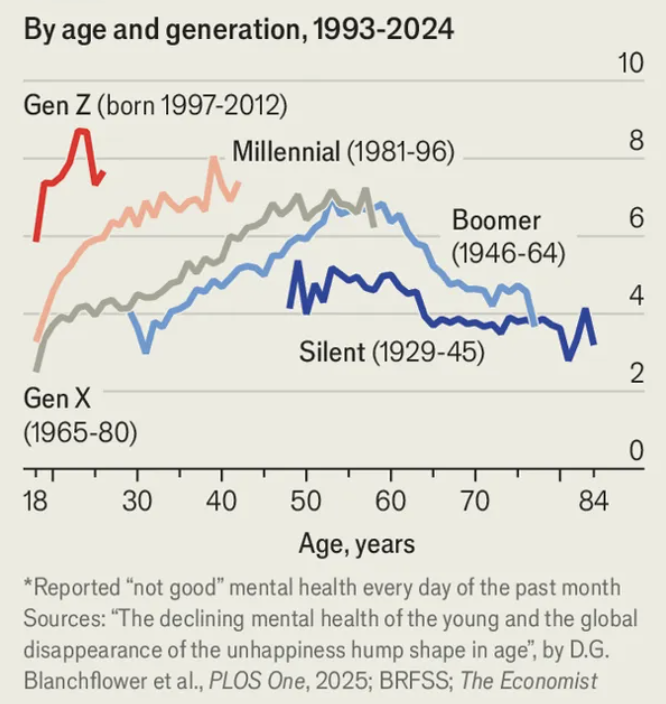
For decades, research around happiness has suggested a predictable pattern: life satisfaction followed a “U-bend.” Young adults begin relatively optimistic, hit a slump in middle age, and then rebounded later in life. While the precise age of peak misery varied from country to country, the overall shape was remarkably consistent.

But new research published in PLOS research journal by economists David Blanchflower, Alex Bryson, and Xiaowei Xu reveals that this curve has shifted in a striking – and potentially troubling – way.

Across much of the world, it is no longer middle-aged adults who are the most miserable. Instead, young people, especially Gen Z, are reporting the highest levels of unhappiness of any age group.

A “Ski Slope” of Misery

The researchers analysed large-scale surveys in the United States, United Kingdom, and 44 other countries. Historically, data such as the Behavioural Risk Factor Surveillance System (BRFSS) in the US showed unhappiness peaking in middle age between 2009 and 2018.

Yet between 2019 and 2024, the familiar “hump” disappeared. Mental health among older groups remained stable, while despair amongst younger people climbed rapidly. A similar pattern emerged in Britain, where rates of anxiety and poor mental health surged among under-40s after 2016. The global picture is no different: across Africa, Asia, Latin America, Europe, and the Middle East, young people consistently report worse mental health than their elders.

This generational shift is profound. Older adults, once seen as the most vulnerable to despair, now appear more resilient than the youngest members of the workforce.

Why Are Younger People So Unhappy?

The causes are complex, and there is no real single explanation that fits across countries. But the research did highlight several possibilities:

  • Labour market changes. Traditionally, employment was a buffer against poor mental health. Yet for young American workers – particularly the least educated – this effect has weakened. Falling job satisfaction and economic insecurity are probably contributing factors.
  • Technology and social media. The rise of smartphones and social platforms has coincided with declining youth mental health since the early 2010s. Whilst they are usually blamed for this, the research covered a number of studies and found only a weak link between social media use and sustained declines in wellbeing.
  • Generational drift. Each successive generation has entered adulthood more miserable than the last – millennials and Gen X reported midlife malaise earlier than the baby boomers. Gen Z, however, are beginning their adult lives at historically low levels of happiness, raising concerns about how they will cope as they age.

In short, Gen Z are not only starting from a worse position than previous generations – they may also face deeper challenges as they approach midlife.

What This Means for Society and Work

The implications extend way beyond statistics. Rising despair among young people matters because they represent the current and future workforce. If left unaddressed, poor mental health risks affecting productivity, engagement, and social cohesion.

For organisations, this underscores the importance of investing in employee well-being, mental health support, and meaningful work. Younger workers may be the most digitally connected generation, but they also report the highest levels of disconnection, anxiety, and dissatisfaction. Employers who recognise and respond to this reality will not only support their people – they will also secure a competitive advantage in talent attraction and retention.

Cause for Cautious Optimism?

While the findings are sobering, they are not unchanging. Some evidence suggests that the mental health of young Americans has improved modestly in recent years, hinting that today’s “ski slope” of misery may not be permanent.

Still, the shift should serve as a wake-up call: the youngest generations, once assumed to be the happiest, are now struggling most.

Addressing this challenge will require action from policymakers, educators, employers, and communities alike. The “U-bend” of happiness may well return in time, but for now, Gen Z are facing an uphill climb. And organisations, professions and colleges can’t afford to look away.

Are Workplace Friendships the Secret Ingredient to Employee Retention?

Employe Attrition – or rather worsening Employee Retention – is top of mind for most businesses. Over the last 2 to 3 years there definitely seems to have been an increase in employee mobility, whether through a post pandemic reaction to our relationship with work, or because the workforce feel they now have more agency in choosing when, where and how they work….and who for and with.

Award winning and best selling author Michael Arena has done some research into this, sparked by Gallup research that indicated 51% of the US workforce were either actively – or keeping a watch – looking for new roles. The three reasons that consistently surface for job mobility are poor pay and rewards, lack of career growth opportunities, and the need to find more flexible working arrangements.

However what if there was another reason, not often talked about? Less expensive and more human?

One of my main research areas recently has been the concept of keeping Humanity in an AI world. Or rather, putting the Humanity into Human Resources in an AI driven world. Research increasingly indicates that workplace friendships can play a pivotal role in employee retention. Employees who have strong social connections with colleagues are significantly more likely to stay, creating a unique opportunity for HR professionals to reimagine retention strategies.

So how can businesses harness the power of workplace friendships to build – and retain – a more connected, engaged, and loyal workforce?

There are four areas that need attention.

Creating Opportunities for Employees to Connect

To develop the relationships that will lead to a settled and productive workforce we need to start by looking at the opportunities for interaction and support. Certainly in-person and virtual meet up sessions can be very useful for this – whether it’s interest or hobby based meet-ups, or collaborative projects based on current work priorities.

Employee led interest groups are a great way to develop this. Many years ago, when social media was a relatively new concept, I started a weekly lunchtime get together at the business I was with for colleagues interested to find out more about social media channels, how to use them for friends, family or personal interest, and how to build connections.

It was a loose arrangement – so there was no compulsion to attend – but it certainly helped people within the business connect, especially if they worked in different areas.

Look For Collaborative Project Opportunities

Again, these can be work related or personal interest based, but getting collaboration between colleagues who work in different areas, and rarely get the opportunity work together, can lead to a settled and harmonious culture within the business. It also gives colleagues who don’t work in the same area a chance to understand the full range of skills, knowledge and perspectives from people around the business. Any project can be work related, environment related, or mutual upskilling or knowledge sharing.

Strengthening Workplace Connections

Organisational network analysis can help to evaluate workplace relationships – strong and weak – and, most importantly, can identify anyone at risk of being isolated or disassociated from the organisation culturally. Employee surveys can often help with this, and any measure of group participation in activities that help engagement.

Fostering an Inclusive Culture of Belonging

Creating a sense of belonging is essential. One way to help promote this is through Employee Resource Groups, particularly those that support colleagues in areas such as DEI & B. These can provide spaces for individuals with similar backgrounds or interests to connect.

Getting leadership support – and sponsorship – is usually crucial to building successful ERGs to show that leaders are taking issues seriously and are making sure that their people get the support they need. These programmes should be designed to be open to everyone within the organisation, accommodating all neurotypes and physical abilities.