#HRTechEurope – We’re All Millennials Now!

Last week’s HRTechEurope conference and exhibition spanned 2 full days of interesting content and thought provoking presentations, 1500 delegates and lots of fun. There was a blog squad of 21 leading to a range of views and insights as we digested what we heard, and there is definitely some variety in the follow up blogs.

For me the HR takeaways were about flatter and faster workplaces, with greater personal responsibility and a different kind of leadership, offering seemingly less secure employment. The 20th century definition of employment may not be helpful for addressing the way work is transacted in the 21st Century. And as networks of influence and knowledge shift power from the institution to the individual then reputation will become an important currency. All of this requiring a mindset that we may not be used to finding. And its millennial!

Too much is happening too quickly. Technology is transforming customer and employee expectations and several industries are experiencing challenges to the way they operate. The need for agile and flexible structures was referenced by many speakers, as was the writing of Frederic Laloux on reinventing organisations. And Tom Fishburne’s alternative org chart got an airing in presentation slides…


How can workplaces keep up with the pace of technological change? “The new normal isn’t technology, it’s speed” said Peter Hinssen “if things move fast then hierarchies are dangerous“. His “work is the brief period of the day where I have to use old tech” slide (above) was one of the most shared images from the event and the concept of today’s workers as time travellers illustrated this well, but maybe even the most agile organisations might struggle to keep up. The reliance of adult workers on email and the phone (50% of business comms) is at odds with experiences of the future workforce, for whom they make up around 5% of communication.

Peter’s main message was about networks, for information and knowledge – “We’re still building companies with old fashioned structures…we need networks where information is shared. If a brand doesn’t speak the language of its network it will die” Network vs hierarchy was pitched as fluidity vs rigidity, with HRs role as enabler of the network.

Change requires more than technology though. “Social tools can help but can’t change the organisation alone” said Lee Bryant in an afternoon keynote. They do make new structures possible though, relying less on visionary leaders, whilst organisational change is not a technology project and more about continual improvement – “Change shouldn’t be top down, or something that only happens every 3 years, but it should be agile, gradual and on-going

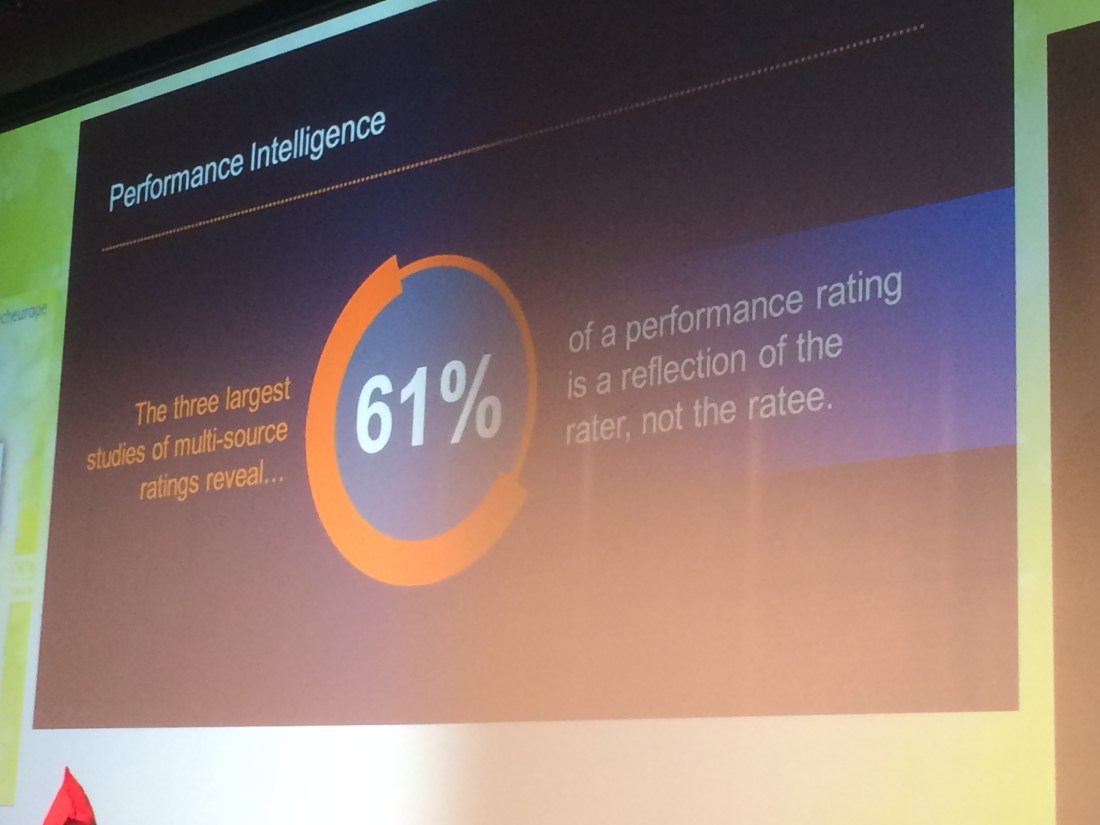
Continuous improvement was also a theme underpinning a new approach to performance management. “Do you have confidence in the performance data within your organisation?” asked Heidi Spirgi. 1 hand was raised out of an audience of over 300. The new approach is based on leaders having frequent strengths-based conversations over the course of the year “what are you working on and how can I help?“. There is a shift from purely delivering feedback to regular coaching whilst performance ratings are becoming a thing of the past, with research indicating that 61% of a performance rating its a reflection of the rater not the ratee.
In another session on the performance appraisal, Armin Trost asked who was the customer – employee, manager or Board? He berated those who tried to set objectives for 12 months when they didn’t know what would be happening in their business the next month, whilst also observing that what usually starts out as an appraisal about performance usually ends up being about the person.

Rachel Botsman closed the event with a look at the Collaborative Economy. Rich in positives – “using technology to allow trust between strangers“, “untapped value of assets through collaborative models that enable empowerment efficiency and greater access” – she said the next phase for this technology would be about ‘unlocking the value inherent in human potential‘. Work was being ‘consumerfied‘ with new app Wonolo being showcased in a video – a collaborative platform for basic low skill, repetitive work.

Rachel had questions for HR. The 20th century laws for classifying workers is no longer relevant for new working models. Is the future of work not just about flexibility and empowerment, but also precarious, with no benefits and no guaranteed income? She called it the murky side of the sharing economy. The personal ratings element within this technology is interesting though with personal reputation and a kind of ‘peer capital’ becoming the new currency of work – from institutions to individuals.

The showcasing of Wonolo interested me. I’ve long thought that this kind of technology will impact staffing agencies and this was the closest yet. There have always been threats to agencies – job boards, in-house teams, social media – but this is different. The business needing a basic skill is directly in touch with the person offering the skill. The fact they connect, and the worker has a rating, covers validation, certification and availability with the pay rate set. Once these scale then things could get interesting.

So what about millennials?

I took part in a panel discussion, chaired by Andy Campbell from Oracle, about them. We heard research on what they want from the workplace – and the list could have been what the over 50s want from the workplace. or what 30/40 somethings want if they didn’t have childcare costs and associated expenditure. We heard about their aspirational employers of choice – Google, Apple etc – yet these are purely based on brand perception. Most look fun but don’t necessarily offer the flexibility, opportunities and rewards that we heard earlier the millennials want.

Employer branding didn’t start with the internet – there have always been aspirational employers of choice. Step back in time and Virgin, Marks & Spencers, John Lewis, BBC, NHS, British Airways and a plethora of banks, consulting firms and advertising agencies would all have topped those lists for older age groups.

Whilst the socio-economic, cultural and family factors that have influenced the values and aspirations of millennials during adolescence may have been different from previous generations (though not those growing up in fluctuating economic times) their mindset towards technology, change, personalisation, consumerfication, instant gratification, speed and opportunity is something we all need to share in the future world of work.

And if its a mindset, and not a date of birth, then we’re all millennials now.

Looking for Collaboration and Simplification at #HRTechEurope

The conversations around HR, recruitment, technology and the future of work move on to Docklands next Tuesday and Wednesday as HRTech Europe rolls in to Town. Always one of my favourite events, the mix of practitioners, theorists, commentators, suppliers and collaborators usually makes for some lively dialogue, great networking and thought provoking takeaways. And I’ll be part of an awesome (and I don’t use that word lightly) blog squad who will be helping to try and make sense of it all for everyone following online.

For those working in the people space, technology is posing some interesting problems and exciting possibilities. The recent Human Capital Global Trends report, along with other recent workforce overviews, have all flagged up findings such as:

  • People analytics has the second highest HR capability gap
  • Increasing investment in technology is not being matched by investment in the people and processes that would gain maximum benefit
  • 70% employees say that technology has changed their role or career in the last year
  • Using technology/new devices is ranked as the second highest training need by employees
  • Identifying and implementing the right technology is only a priority for around 20% of HRDs
  • Half of HRDs see their work environment as complex, and another 25% as very complex.

Are we being overwhelmed by an inexorable onslaught of automation and robotisation? Or do we just need to step back and take stock of the opportunities on offer?

I think there are a few strands here, most of which will be aired at HRTech next week by speakers as diverse as Peter Hinssen, Rachel Botsman, Lee Bryant, Nick Holley, Costas Markides and Euan Semple.

Some of the questions on my mind looking ahead to the event:

Should we be leveraging networks more? Peter Hinssen will be looking at networks of intelligence. Maybe customers and employees can provide some of the inspiration.

Is collaboration a choice or a necessity? I’ve been hearing about HR collaborations with IT and finance over analytics and data. I’m thinking this needs to become the norm not the exception.

How should we define performance? Most would agree that the yearly, school report style assessment of past performance isn’t fit for purpose, but what’s the replacement? Ongoing dialogue and continuous learning, with flexible goals, may be more relevant, with collective feedback. Do we have the culture, and leadership. to bring this about?

How do we define leadership? A culture? A collective mindset? Agile and flexible, future leaders need to be change agents comfortable with spearheading organisational change.

If responsibility for personal, professional and career development is now with the employee, what’s the future for the L&D function? I’ll be joined on the blog squad by some learning professionals, who will no doubt have a view!

How can we make work simple? Businesses may be facing increasing complexity but passing that on to the employee will reduce effectiveness and increase stress. Only just over half of companies have some kind of programme in place to help simplify work processes and practices – we clearly need to do more.

And then there’s the Millennial Mindset. I’ll be taking part in a panel discussion (along with Jo Dodds and Perry Timms) on ‘Employing the Millennial Mindset‘ chaired by Oracle’s Andy Campbell. It’s Tuesday at 3.30 on the main stage and we’ll be answering questions that you’ve all asked – you can start submitting them now through the hashtag #OracleAndyAsks. Come on, it’s about Millennials…you know I’ll have something to say!

One of the main concerns over technology is how intrusive it’s becoming. The 24/7/365 always-connected working environment, with more responsibility being shifted to the employee, can have a serious impact on wellbeing. I recently took part in a panel discussion for ADP on people and technology. here’s the video for the part of the debate on technology and wellbeing – I’m hoping to hear more about this on Tuesday and Wednesday…

HR Tech is coming to Town…are you ready??


Talking HR Data & Analytics at #HRAnalyticsLDN

Is 2015 the year analytics finally goes mainstream for the HR profession?

A few thoughts:

In most areas of our personal and professional lives we now have endless information on which to base a decision. No longer do we invest time and money without prior research – instead we do as much checking as we can to ensure that the decision we’re making is right.

And yet in business we’re too often stabbing in the dark. We hire the person that our instincts tell us may be right, even though we’ve got years of data to show the type of people who succeed in the organisation. We look to recruit someone who’s done the job before, without seeing how successful that approach has been in the past.

Walmart in the US have recently raised the pay of their lowest paid workers to try and reduce churn, yet as one commentator pointed out “if retailers really want to reduce churn, the next frontier will be promising more predictable schedules, rather than higher wages“. We have the data to produce predictable schedules – do we use it?

So why do so many in HR often see data and something big and insurmountable, rather than the way we can make better informed, more robust decisions? Or as Neil saysan HR person who “doesn’t like numbers” is a bad HR person.  I just think the idea of data being BIG in HR is a bit of a myth‘.

The 2015 Human Capital Global Trends Report found only 8% of respondents believing they have a strong HR analytics team in place., with this specialism registering the second highest capability gap. Suggested areas in which good people analytics can help the business immediately were:

  • Understanding and predicting retention
  • Boosting employee engagement
  • Expanding sources and quality of hire
  • Profiling of high performers in areas such as sales and customer service.

Starting doesn’t have to be painful nor involve massive expenditure – getting the right people in the team (mixing business and technical skills), starting with the tools you already have and focusing on a specific business need rather than a scattergun approach across multiple teams is sometimes all you need.

And learning from those who have already begun the journey.

Which is why I’m really looking forward to the HR & Workforce Analytics Innovation Summit in London next week. Across two days there will be sessions and presentations from HR professionals representing all sizes and sectors, and all at different stages of the journey. There should be some useful takeaways, whether your looking for quick wins of playing the long game. Some of the sessions I’m looking forward to are:

  • Beginning HR Analytics with No Budget (Andrew Gamlyn, SIG plc)
  • HR Analytics for Beginners (1 hour interactive workshop – learning from those who have taken the journey)
  • Driving Business Value from HR Data (Sally Dillon, Aviva – includes case study using data to reduce absenteeism, driving bottom line benefit)
  • Employer Branding Analytics (Alison Hadden. Glassdoor)
  • Analytics and Driving Cultural Change (Nicki Makin, Morrisons – the journey of moving from relying on gut feel to making data driven decisions)
  • Planning with a Blank Canvas (Dan Gordon, England 2015 – planning a large workforce for the Rugby World Cup from scratch)

Readers of this blog can get a £200 discount by using the code RECS200 when registering. If you want to know what to expect then check out this presentation from last year’s event – ‘Using Workforce Analytics to Create a Recipe for Success’ from Vanessa Varney, Senior Manager of HRIS Analytics at Coca-Cola.

Look forward to seeing a few of you there – and to finding out more about data driven workforce decision making.

Talking About Employer Brand

Whenever I attend an in-house recruitment conference, and attendees break out to discuss their big challenges, the two issues most consistently raised are pipelining and brand. Cost of hire and quality also feature along with volume of irrelevant applications and the need for better internal mobility.

Inevitably it’s the employer brand that links all of these, yet the very concept still seems diverse and difficult to nail down. Many have an opinion on what it includes and how to showcase it, but the whole area of marketing to engage, attract and retain still remains a challenge for many recruiters

Over the last couple of years I’ve seen presentations on, and judged HR and recruitment awards for, employer branding and it would be easy to conclude that it’s a fairly amorphous topic that means anything from a new logo or learning programme for some to reputation and rewards for others.

Of course its all of those things and much more, but the challenge of defining and illustrating the experience of working for a business, the compelling reason why someone would want to join, nailing what someone says about you when they’re not with you, to promote what is effectively your reputation as an employer, is elusive to many. Yet the benefits of getting it right – reduced recruitment costs, fewer hiring mismatches, greater awareness, stronger pipeline, communities, better quality and retention, differentiation, alignment with consumer brand to name a few – are great.

And the window on your employment experience is already wide open. This graphic (from research on employee activism earlier in the year) illustrates that employees are already shining a light on their day to day work experience through social channels, even before they decide to log in to Glassdoor.


And it isn’t just your people. The second most popular job search activity on social media is researching potential employers, with 47% also checking out what other people say about the company.

I’m always interested in finding out how businesses from different sectors manage to achieve this successfully and overcome barriers, whether its buy in from the C-suite, measurement or creating long term growth, so I’m looking forward to this Friday’s Employer Brand Management Conference at which a range of businesses – including Sky, Deloitte, RAF, First, Shell, TfL, ebay, Carphone Warehouse – will share insights, learnings and benefits. I’ll be aiming to tweet the best ones.

The conference is run by Transform Magazine and there are still a few places left – readers of TRecs can get a 15% discount by using the code EBM_15 when booking here.

Should be an interesting event. With job seekers searching out what people say about working at a company, and existing employees/alumni offering their help, possibly inadvertently, its not surprising that employer brand remains a priority for recruiters.

It’s the Sunshine Summer Solstice #HRCarnival!

It’s midsummer. Whether you’re celebrating, ignoring or just happy that we’ve got as much daylight as we’re going to get in a day this year, the HR Carnival has rolled into Town and it’s my pleasure to be your host.

For us in the UK this part of the calendar usually means RRRAAAWWWKKK at Glastonbury or strawberries and cream at Wimbledon, whilst across the pond a fair few readers will be jetting off to the Sunshine State and SHRM National in Orlando.

For those heading that way make sure you check out the first carnival post from Dwane Lay on The Big Lebowski tribute that will be helping to raise money for the very worthy No Kid Hungry campaign. Hope to see many of you taking part.

No doubt a lot there (and here for that matter) will be thinking about the HR profession and why they go into it. In which case this post from Will Thomson, writing on the Blogging4Jobs site, is a must read.

If you want to chat this over with a few others then you’d better make sure you learn your ‘Mench‘! Don’t know what I mean? Then let Dorothy Dalton’s blog enlighten you on the pitfalls of over-communication.

And talking of communication, will you be using your mobile? Anita Lettink’s post makes some observations about HR delivery and the emerging workforce.

There are many times when we need to be thankful for what we’ve got. In this very personal blog Jeff Harmon reflects on something that happened to him last year, and what he’s learned from it in 2014 so far.

Well that kind of rounds up the Carnival entries – not a lot to share this time round – so I thought I would add in 3 posts that have really got me thinking over the last couple of days. Hope they resonate with you.

Firstly Perry Timms writes it as he thinks it in a look at the ‘Soundbite City’ we inhabit. Who needs Pharrell when you’ve got some early Joe Tex.

Then top blogger FlipChart Rick looks at big vs small and concludes that small may not be that powerful after all, unless…well, I’ll let you read it.

And finally my old boss Felix Wetzel asks if the folks in Silicon Valley are spreading socialism and anarchy around the world in ‘Anarchy in the USA’.

Hope you enjoy the Carnival, and remember that sun protection cream if you decide to read it on your deckchair 🙂

(image via English Heritage)


Leadership and Legacy Under The Spotlight at #HRVision14

Three hours in to HRVison14 and we’ve been hearing a lot about leadership. In amongst the presentations on culture change and learning, and during the almost complete silence as people listened, spellbound to Tim Macartney, the underlying theme is leadership.

Tim said:

Leadership is a choice.
An invitation to become truly courageous.
Explore what would make a beautiful life.

He captivated the 200+ delegates with a passionate plea to create a greater purpose, to challenge the notions of wealth accumulation, competition and streamlining by having business purpose & values centred around being proud of what have achieved in this lifetime.

He channeled the native American Indians “no product or service, no manner in the way we do business, should be allowed to impact the children for seven generations to come“. In their eyes he believed that today’s core leadership focuses of competition, market share and being top in their field may ultimately seem like hollow victories.

Before Tim we had heard from Frans van Houten, Global CEO of Phillips, on their global culture transformation. Bringing about change within a traditional, established global business, with embedded organisational structures and inevitable silo mentalities, takes time and a fresh approach – “it’s easy for established businesses to work in silos that create a survivor mentality, inevitably leading to people ducking decision rather than taking risk

A few of his messages that I noted were:

  • Focus on innovation and entrepreneurship, bringing value to customers that makes them smile and makes them happy
  • Always act with integrity
  • It’s not about working harder but about working differently
  • Equip people with new tools, it will help them solve different problems
  • You need to make sure that change doesn’t just happen on the surface
  • Courageous conversations break the cycle of victim mentality and complaining mindset
  • Make the purpose your ‘north star’, the guiding principle that everyone wants to follow

Clearly all this requires a huge shift of mindset from leadership, particularly those used to meeting challenges by shuffling the org structures. Frans was particularly scathing of those who change structures expecting an uplift in performance; his preference was for agile teams created around a problem or project operating across functions.

The session after Phillips was from GE who spoke of strong leaders having a confident humility and learning agility. Their philosophy – Together, we all rise.

Starwood Hotels later spoke of leaders needing to embrace individualism, identity and inclusion within their teams (diversity is nothing without inclusion) whilst at the same time supporting them in making emotional intelligence, continuous feedback and management by objectives core leadership skills to meet developing workforce expectations.

Leaders usually take the plaudits when business performance is strong, when share price and profits are unceasing, so it’s probably right that they are under the spotlight when things need to change.

The words vision, value and opportunity have been heard quite a lot this morning but it was the concepts of legacy and sustainability – most notably from Tim Macartney’s session – that have probably really got most of the HR professionals here talking and thinking.


The Future of Employee Engagement

As an HR blogger I know the perils of dropping the ‘E’ bomb. Few words occupy more gigabytes of space, are more debated and argued over, than ‘engagement’ – particularly when prefixed by the word ’employee’.

I’ve taken part in many discussions, read many blogs and watched many presentations, all concerned with trying to nail down what employee engagement actually is, what does it mean and how to do it right. And does it even matter. For many years it was considered that a pay cheque, with the correct amount arriving in your bank account on time, was all that was really needed for engagement.

The thinking has moved on though. As an HR recruiter I used to interview many aspiring managers. When I got them talking about achievements many would give priority to the engagement initiatives that they had worked on, offering both anecdotal and data evidence of their success. For some it could be simply organising awaydays or parties, fresh fruit for every department, a proper coffee machine or a new style of internal communication. For others it was down to benefits and perks, finding ways of recognising people who went the extra mile for colleagues. And for many there was also the nitty gritty, some would say real core part of engagement, of understanding and communicating vision and values, defining guiding principles.

For my part there are certain recurring messages that crop up at most events:

  • People don’t wake up in the morning thinking ‘am I engaged?
  • Engaged workers are more productive
  • Engagement is an outcome of doing the right things, not about the process itself
  • It starts with a CEO committed to the people agenda
  • People need to be treated with respect and dignity, shown that they are valued
  • It needs to be assessed in the ‘now’ and not with historical surveys
  • Social media is the new water cooler and you can pick up how your employees feel about you by being in the conversation

There are many more – and you’re welcome to add some in the comments – but the main drift is always that it starts with a mindset, of having a vision and culture that values employes and the contributions they make.

As Meg Peppin says in her latest blog on the subject:

“The solution is simple, create time and space for people to talk with each other to make meaning. Time, patience, space, respect. Simple and yet so difficult.”

Most people tend to see this as easier to achieve in a smaller business where employees are closer to, and likely to be more aligned with, the core vision and values, whilst leadership also tends to be more visible and approachable.

However it’s clearly on the agenda of most major businesses also. This report on the future of employee engagement suggests that over 80% see it as a priority, with pretty much everyone (97.4%…to me that’s everyone) saying that they will be investing in improving engagement levels over the next 12-18 months. All companies involved said their CEO was involved – although only 20% classified the CEO as instrumental – whilst recent Chartered Management Institute research suggested that the number one priority for business leaders this year is a reshaping of workplace culture, with employee engagement and better leadership at the core.

The report was produced by Osney HR ahead of next month’s HR Vision Conference in Amsterdam. They pulled together a panel of 9 specialists in employee engagement and comms from a range of business sectors – IBM, Starbucks, Electrolux, Zurich Insurance, Starwood Hotels to name some – and put 7 questions to each. They ranged from ‘who will be the drivers of employee engagement?‘ (line managers not surprisingly featured heavily) and ‘will engagement be replaced with empowerment or enablement?‘ (seen as drivers not replacements) to the thorny subjects of measurement and ROI (crowdsourcing and assessing impacts feature).

One contributor said

“Times will be challenging. Building engagement does not happen via tricks or treats, it’s about shared vision, challenging goals and being given the appropriate tools to achieve.”

You can download the e-book here – it’s an interesting read.

I’ll be heading over to the HR Vision conference and will catch another of the panel – Ralf Larsson (Director of Employee Engagement, Electrolux) – presenting a session on engagement at the event. He’s called it ‘Schmooze or Lose‘, which I guess could become a new catchphrase for the whole employee engagement debate. I noticed some of his suggestions:

  • Breaking down the silos through social technology
  • Development of internal social communities
  • Getting buy in from leaders to connect with employees via social networks
  • Power of a collaborative workforce through crowd sourcing and idea generation

Much about our workforce is evolving and changing – from technology to working arrangements, email to enterprise social software – and hence engagement needs to evolve too. Ensuring people have the right technology to get the job done may seem obvious but nothing disengages more than not feeling that you have the right tools to perform.

And with labour market shifts embracing new arrangements such as zero hour, managed workforce, and freelancing, businesses will need to find ways to engage people who are working for them and representing them, but may not actually be employed by them.

The future for employee engagement may involve a lot more schmoozing…

Innovation, Diversity and Uncertainty at #euhrevent


Permission to Experiment


I’ve just returned from 2 days in Berlin at the European HR Directors Summit. We had a strong mix of delegates (drawn from across Western Europe) some helpful and informative sponsors (who didn’t push too much and had some interesting analysis to share) and a friendly, energetic team from WTG who kept the event running smoothly.

I was there in tweeting/blogging capacity, aided by Mark and Perry, when they weren’t engaged on their well received chairing duties.

The overall event was really enjoyable. There was a good energy about it, with inquisitive delegates. Those I spoke during the networking breaks all felt that they had learned and discovered some new ideas to take back with them.

The tone was set each day by the opening keynotes. Both Dr Nicola Millard (changing nature of work) and Liggy Webb (resilience) spoke with a passion and energy that was infectious, using humour and imagery to help make their points. The audience felt involved and identified with many of the issues that they raised. I think that the impact of the opening keynote, and the way that it sets the mood for what follows, can often be overlooked when agendas are put together. The most impressive CV or academic research may be important to establish credibility, but do not necessarily create awesome from the stage. It is the ability to captivate an audience, to entertain as well as educate, illustrate as well as inform, that often makes it a success or a disappointment, and adds weight to the points raised.

There were recurring themes across the 2 days – change, uncertainty, diversity, learning, innovation, leadership and empowerment – and here are some of my takeaways:

The Age of Uncertainty

Many presentations dealt with the rapid change we are experiencing. Whilst there may have been other similar periods in the past the current combination of technological, economic, demographic and cultural shifts are impacting heavily on our work. One session from the EU Commission looked at the increase in productivity and job creation that Europe would need by 2030 – quite frightening. The four generation workforce was also referenced many times.

The recent Deloitte report on Global HR trends had highlighted the ‘overwhelmed employee’ as a major issue facing business and the conference opener from Dr Nicola Millard looked at the factors driving changes to work – disappearance of a ‘9 to 5’ working mindset, technology enabling remote working and collaboration, the end of the tradition office space – and how the ‘always connected, always on’ mindset creates distractions (or time vampires as she called them) that could affect productivity, sleep patterns and general wellbeing. “Where in your job description does it say that you need to spend up to half the day dealing with email?” she asked.

Another session talked of the need to hire people who enjoy uncertainty as the need for change grows and of striking the balance between pragmatism and perfection – “for change to succeed, perfection needs to take a back seat to pragmatism“.

Embrace Diversity

Perhaps unsurprisingly for a European conference, diversity was an issue that also ran through a number of sessions. There was little mention of the dreaded generational classifications – “mind the generation gap but ignore the millennial hype” said Nicola Millard – with adaptability and technological competence being seen as key differentiators, irrespective of age.

Whilst in the UK we often talk of diversity in terms of age, gender and ethnicity, here the main areas discussed were around culture and personality. The need to have a culture that caters for both introverts and extroverts, and to lead in a way that brings both together, maximising their skills irrespective of their different approaches, was referenced. Not everyone is the same, we all react and contribute differently to a range of situations. To build and inspire a team of diverse characters requires leadership skills that we may not always fully assess. Praise and encouragement were seen as crucial people builders – “How hard can it be to make other people feel important?“.

We also had a powerful session on leading multicultural workforces, across countries and businesses. Production and consumption, markets and commercial relationships, are now international, whilst IT systems are global. In bringing this together the key is to not erase diversity but use it to foster different viewpoints for creativity, innovation and competencies, whilst leveraging it for insights to different markets and buying habits. Leaders need to acknowledge local cultures, accept their differences and integrate (not attempt to change) the values and perspectives they bring.

Keep the Talent

Internals First was the name of a session from Credit Suisse about their ‘Grow Your Own’ programme – a sourcing strategy that supports internal mobility and direct approaches to the internal labour market. The external focus is shifted to entry level positions and then an internal market is created, with the main benefits being:

  • Development strategy
  • Maintaining culture
  • Less performance risk
  • Qualified candidates becoming harder to find
  • Helps retention

Framing is important, hence there is no talk of internal headhunting, but the campaign does bring all internal opportunities to everyone’s attention. Employees are encouraged to keep their skills up to date and visible, whilst managers are able to get the attention of internal passives. There are challenges – employees need career coaching and their expectations managed, whilst managers can sometimes also expect too much from the internal market.

One interesting stat was that around 40% of internal employes moving roles had already been contacted by external headhunters regarding external roles. It shows the importance of making opportunities visible to keep employees happy, demonstrating the variety of an internal career, or else risk losing them.

Fostering Innovation

Keeping talent is one thing, encouraging and empowering it to help the innovation process is the next stage. “Don’t just source ideas from researchers but from all employees. Innovation is the responsibility of every employee” said Olivier Leclerc from Alcatel Lucent when introducing us to their entrepreneurial bootcamps, which produce between 30 and 40 ideas every 6 to 9 months. They foster a buccaneering spirit (from ego-centre to eco-centre was one delegate comment) and involve external parties to give a VC feel and ensure that innovative ideas are viewed on their merit and not with a company bias. Some key benefits had been:

  • Diversification of the product portfolio
  • Revenue from bootcamp projects
  • Refreshed company image
  • Culture change and greater engagement

In an earlier session, Simon Watt from Mattel had also talked of inspiring an innovation culture amongst employees. I particularly liked their ‘Permission to Experiment’ ticket – encouraging employees to to experiment fast, often and without permission – and an example from their Mumbai office. This wasn’t about product but more cultural. Most new starters had their interviews during the working day, and had taken only 20 minutes or so to travel to the site. On their first day, rush hour traffic meant that this journey could take a couple of hours or more, often leading to surprise and disappointment. The existing teams noticed this and decided that they would pick every new starter up from home, each day in their first week, and drive them to and from the office, both showing them the fastest routes and short cuts, and helping integration by spending quality time with them in the car.

Bouncebackability

What is resilience? This was the opening question from best selling author Liggy Webb as she took us through the key behaviours that can help build resilient, agile and innovative workforces. Amongst the delegate definitions we got bouncebackability, tolerance, positivity, calm. She introduced us to the Doomerangs (like boomerangs but instead of bouncing back they continually re-live negativity) and the Doom Goblins (those in the workforce whose negativity and moaning drains the lifeblood front the team) whilst conjuring up more imagery with “negative attitude spreads like germs, don’t sneeze your whining on others

She suggested we ‘hug a problem and learn from it‘ and also urged “Change for the better. If you don’t like change, you don’t like life – don’t mourn the past, seize the opportunity“.

It proved an energetic start to the second day, and there were serious messages here. With the overall themes of change, uncertainty, innovation and corporate realignment there is a need for strong and inspiring leaders, and workforces who are resilient, adaptable and creative.

Perhaps it was one Dr Nicola Millard’s comments from the opening that stuck with me most through the two days – “No is a really dangerous answer. So lets say yes“. There is much going on in our working lives, from what we do and how we do it to the way in which we are contracted to do it. We have become distractible and overwhelmed, often in need of guidance and the type of strong leadership that lets us know someone has a plan and a vision.

Finally, one session looked at HR strategies and competencies, the importance of a CEO committed to the people agenda, and how to lead the way for greater transparency and clarity. It defined HR competencies for the new work environment as:

  • Leadership
  • Innovation
  • Leverage networks
  • Data judgement
  • Business acumen
  • Organisational acumen
  • Talent management acumen

We need to foster the right practices and and mindsets, and this often starts with recruitment and the ability to find the people who will best fit the business vision and culture.

Certain hiring for uncertain times…

Looking Forward to #euhrevent

Today I’m heading to Berlin for WTGs European HR Directors Summit. I’ll be there in a blogging capacity, whilst fellow Brits Mark Ellis and Perry Timms will be sharing chairing duties.

I really enjoyed their UK event in February – you can read some of my thoughts here – and am looking forward to this one.

Checking the agenda certain themes caught my eye:

  • Resilience and agility
  • Reverse mentoring
  • Leadership skills in a globalised, virtual workforce
  • Cultural change
  • Empowering intrapreneurs
  • Cultivating an internal labour market

It’s my first European HR event. I’ve been to some in the US and always find that the conversations, issues and challenges are very similar to those we discuss at UK conferences, so I will be looking to see if this changes with a European audience. Particularly perspectives on skill shortages, workforce planning and cultural change.

It is also my first visit to Berlin so I’m hoping to get some sightseeing in too!

The hashtag for the event is #euhrevent and I will be sharing the key messages I hear on Twitter and on this blog too.

Look forward to sharing my thoughts with you over the next few days…

Froth Free HR

There’s been some banter on the HR twitter timeline recently about coffee shops. It started when myself, Michael, Emma and Anne were sharing the worst misspelling of our names (mine was Murvy) on cups from a certain chain that tries to personalise the experience. We’ve joked about trying to set up an HR Coffee Shop.

Fairly typical early morning Twitter banter but today Emma shared the above picture from coffee art and the chat turned to froth. I said that there should be no froth in the conversations at the HR Coffee Shop.

Around the same time Neil’s latest blog popped up in the timeline about big data vs big thinking and whether the rush for HR to understand and use analytics was an act of cowardice, an avoidance of dealing with some of the more pressing, creative issues by hiding behind numbers.

When a serious post meets a bit of fun banter on social media a there’s usually an interesting point to be made and it’s this…

…..to many a lot of HR’s work and concerns are seen as froth. I don’t for one minute believe they are, but many people out there do. As someone who is not a practitioner but is closely tied to the profession I hear it a lot, especially from people who aren’t (and unlikely any time soon to be) part of the Social HR echo chamber.

Recently I was lucky enough to be invited to an espresso tasting at Nespresso’s London boutique. There’s a thin layer of froth on the top of a new espresso which you push to one side to taste the real coffee.

So whatever’s on your agenda today, this week or this month – push away the froth.

Smell the real coffee and make sure everyone else does too…