The New Talent Journey


The way that talent is attracted, hired, on-boarded, developed and retained is evolving. New technologies, changing attitudes to work and employment (from both employers and workers), heightened expectations and a growing transparency around how businesses operate have led to a re-imagining of the talent journey.

What was once a series of events is now an ongoing process, that begins before there is even an identified hiring need, and continues beyond the lifespan of an individual’s working involvement with an organisation.

First lets redefine what we mean by talent. This is probably one of the most overused, misused and misleading words in the modern labour market. Often used by HR and recruitment professionals to imply a high skilled, high potential candidate who is in some way special. This narrow definition leads to poor recruitment practice, with recruiters trying to chase the mythical candidate who ticks all their boxes and is ready made for their vacancy. These people rarely exist, and they are rarely needed.

We now have new jobs are being created, needing skills that haven’t been hired before. People grow in different ways, using initiative and developing their capabilities in line with what interests them and what they believe they would enjoy and be good at. If their jobs are under threat, they will often find new ways to use their talents. The most successful hires will be people who grow into a role, mould it around their capabilities. Growth mindsets and cultures of innovation require curiosity, courage and a restless spirit. These can be found in many people if they are afforded the right tools, a collaborative culture and time.

And of course there are many roles that might seem mundane and repetitive. Yet the people who do them are skilled. Talent is about the people who are right for the role, and right for the business, irrespective of background and trajectory. Talent is also about the hiring business itself, its vision, values, purpose and dynamics. Its offer to its employees, whether they are employed or provide their skills on a freelance or temporary basis.

And it is also about the way in which new people, and new capabilities, are bought into a business.

The new talent journey is an ongoing process incorporating many stages:

Attention – What is known about the business and the potential new hire. Information available. Reputation judged from online interactions and engagements. Before there is even a connection there is a perception over what a business is like, and how it treats its people and customers. And there is also an impression of the candidate.

Attraction – How you hire, what information you make available, how the role is marketed and what is offered. How you develop relationships and conversations with potential employees and collaborators.

Acquisition – Your recruitment process. Application, interviews, assessment, selection. How you communicate, the quality of feedback, when you offer, and the experience you give. This doesn’t sit in isolation but seamlessly evolves from attraction and forms the basis for…

On-boarding – Still waiting for a new hire’s first day before you give them the tools they need for the new role? Think again. The best companies are on-boarding people form the very start of the hiring process, giving them a seamless transition into the business. Paperwork? Already done online before they start. Induction? Its also happening online, probably through a portal, often from the time they accept the offer. First day experience? It’s a gift, a meeting, time with a senior leader. It’s not a few days’ wait for a new laptop and a login, sitting with a team who didn’t know you were starting.

Development – Lateral progression and opportunities for skill and capability enhancement, across teams, functions, divisions and borders. Performance evaluation is ongoing and coaching led. New hires don’t wait for a probation review after 3 months and an appraisal after a year, they want real time, constructive feedback on how they are performing and how they can improve.

Retention – Mutual attraction, the outcome of treating people well and giving them the tools and framework to succeed, develop and enjoy what they do. And if they want to move on – then retain their loyalty and advocacy, because they will be your best referrers of new people and customers, and they may well return in some capacity.

Attracting, acquiring, on-boarding, developing, engaging and retaining your people is an evolving, interlocking process that renews, reviews, reinvents and repurposes. It’s the way that the people you need connect and work with you, grow and develop, create and innovate, make their mark, laugh and collaborate, and its the solid bond you put in their hearts, keeping them very much part of your network of connectors, referrers and influencers.

Its the new talent journey.

(My book Exceptional Talent has recently been published by Kogan Page. In the book myself and co-author Matt Alder explore how changes in technology, communication, and employee preferences are impacting the talent journey. We offer practical advice on how to build •effective recruitment and talent management strategies to meet the needs of today, while also helping businesses plan and prepare for the challenges of the future.)


Employer Brand Challenges & Solutions

Employer branding has been a hot topic for some time. The perception of what a business would be like to work for is built from a number of interactions and sources, some within the organisation’s control and some outside of it. The issues around it are debated long and hard in the blogosphere, at conferences and on webinars and podcasts. Certain words always arise – e.g. authenticity, culture, talent, differentiation – almost to the point of becoming cliches and losing their meaning.

So what are the real challenges that businesses face?

I have recently worked in partnership with regular co-collaborator Matt Alder, and in conjunction with employer brand solution provider Papirfly, to research what’s really going on in the market. We conducted in-depth interviews with a number of talent acquisition leaders. We wanted to understand the issues that practitioners face on a daily basis, how they handle them, what content they turn to and which conversations they join.

Our research found that they all face a number of similar challenges regardless of the sector in which they operate. These Employer Brand challenges cover a broad range, from alignment with internal processes and the employment experience, to overcoming negative reputations and the best ways to utilise employee generated content. And in these data driven times the questions of measurement and validation are never far away.

You can read more about these, and potential solutions, in our Pulse Report – which can be downloaded by clicking on the image below – and also from listening to this podcast in which Matt discusses the research findings with Papirfly’s Client Director Sara Naveda


Papirfly’s Employer Branding Insight Report was produced by Two Heads Consulting, a research, insight and content collaboration between Mervyn Dinnen and Matt Alder

Recruitment Agency Opportunities and Threats

I recently partnered with Broadbean Technology for some detailed research on the SME recruitment agency market in the UK. The aim was to look at how they were doing and also at ways in which they were adapting to market changes. Overall we found the sector in fairly buoyant mood and posting record figures. It has become a crucial supplier of strategic skills to the UK’s business sector, yet we also identified potential headwinds that some were beginning to feel.

Changing preferences of a new generation of candidates and consultants, both in the way they look for work and what they want to get out of it, are beginning to impact the way agencies attract and engage with candidates and trainees. The speed of interaction that technology enables, and users expect, is one that recruitment businesses have to embrace, particularly in an evolving era of transparency and ratings.

Clients are building their own internal capability and in many cases are looking for a different type of relationship. Some recruiters find negotiating with procurement, and working through an RPO provider, to be particular pain points. For forward thinking agencies this does create opportunities to add value and be seen more as a partner than a supplier. Making this change happen will require a different mindset and approach, and one that the research showed is starting to appear in the SME sector.

Amongst the trends we found underlining this, was a prioritisation on the development of marketing initiatives and building awareness to replace a more traditional sales-led transactional approach. This is important as the research showed only 10% of agency vacancies coming from outbound sales calls and 11% from speculative inbound calls. Building reputation and investing in CRM technology is helping many move away from a transactional model.

To support the increase in vacancies from developed relationships rather than speculative approaches, consultants are supported in becoming true sector specialists, offering knowledge and insights to clients, and to build their networks to source candidates. Growing concerns over the hiring and retention of consultants is being addressed by increasing investment in their learning and rewards, and realising the potential of employer branding.

During the research I spoke with a number of SME agencies who were trying different approaches. Some were embracing more agile models, others were taking a much more creative marketing approach, whilst building advocacy and client loyalty.

We featured some of their stories in the report along with more insights into how the SME recruitment agency sector is developing to meet current opportunities and challenges.

To find out more of what they are doing, and see how you compare, download a copy of the report here. And let me know how you are currently finding the market…


(It should be noted that we completed this research, and the report, prior to the referendum on the UK’s membership of the European Union. Whilst that result will undoubtedly play a significant role in shaping the recruitment agency sector over the next few years, it is almost certainly too early to tell what direction that may take)

Do We Really Have Skill Shortages?

Do we really have major skill shortages? Are they a myth? Or do we have a problem with recruitment? No recruiter would ever get fired because there’s a skill shortage, so do the individual circumstances around each shortage go unscrutinised?

OECD research finds that the UK has comparatively light skill shortages:

Screen Shot 2016-08-23 at 08.13.04

I’ve recently written up some research on the STEM skill shortage for recruitment group Serocor, who specialise in technical recruitment. The STEM sectors are often used as the poster boy for the UK’s skill shortage problem, so seem a good place to start.

2011 data from the ONS showed that of new STEM graduates that year only 16% were working in core STEM jobs in core STEM sectors. A surprisingly large 66% were working in a non-core STEM job in a non-core STEM sector. Whilst not anything new, it was a worsening situation – in 2001 the proportion working outside STEM was 52% so the pool of grads working in STEM jobs and sectors was decreasing. As UKCES concluded in their November 2013 report:

“Mismatches between supply and demand for Core STEM appear to be more about lack of suitably qualified candidates rather than a numerical shortage of STEM degree holders”

This situation starts from graduation, with only 1 in 6 gaining suitable experience, and seems to be increasing. Do we really need more STEM graduates then? Possibly not. The subject of ‘leakage’ was looked at in 2015 SKOPE research on engineering graduates. The training given in technical and scientific areas, allied to a broad understanding of mathematics, makes STEM graduates attractive to a wide range of employers – many in sectors that are thought to be more attractive to work in than core STEM sectors. Increasing the number of graduates is likely to increase this leakage:

“The evidence produced on these initial flows confirms that public policy would be ill-advised to proceed assuming that the response to reported shortages of supply of engineering graduates in a particular subsector, where substantiated, must be to try to increase the numbers on the relevant engineering higher education courses. It should rather be to find ways of helping any sectors genuinely concerned about shortages to take much more seriously the need to significantly increase the attractiveness of their work to engineering students, and in particular to those in the last and penultimate years of their courses.”

In other words increasing the number of graduates won’t necessarily increase the future talent pool. Some more 2015 research, conducted for the European Commission, on STEM graduate shortages in the EU, also found UK employers being a bit choosy:

“In particular in the UK, there is evidence that the expansion of higher education has resulted in a growing employer differentiation between different ‘types’ of graduates, and with employers’ putting a higher premium on graduates from the traditional prestigious universities. This could explain why so many UK STEM graduates end up in relatively low paid service sector jobs with limited opportunities to deploy their STEM knowledge and skills. There is some evidence that the notion of ‘employability’ has a much wider meaning, and therefore cannot be reduced to a list of skills that can be ticked off in curricula if covered. A UK study concludes (Hinchcliffe 2011) that employers place value on a wider range of dispositions and abilities, including graduates’ values, social awareness and generic intellectuality — dispositions that can be nurtured within HE and further developed in the workplace”

Amongst their conclusions they noted a drop in investment in training “acute reported shortages are likely caused by under-investments in training of the existing STEM professionals, as there has been a general drop in investments in continuing education and training since the (financial) crisis” but also that shortages were partly caused through:

  • Growing employer expectations regarding the quality of the match
  • Entry barriers for STEM graduates who do not have labour market experience
  • Risk of under-employment of non-native STEM graduates
  • Insufficient absorptive capacity in SMEs to make productive use of the skills of STEM graduates, making the SMEs a less attractive employment and career destination
  • Career guidance oriented towards the public sector and large corporations.

The Serocor research I referenced earlier found an interesting mismatch in the way jobs were marketed. Hiring companies seemed to think that technical candidates looked for a good reward package and promotion potential, whereas the candidates themselves prioritised interesting projects to enhance skills, a good working culture and opportunities for flexible working. When I wrote about recruitment challenges for charities last year it became apparent that the problem was less about skills not existing and more about identifying and attracting the specific skills needed, moving away from a reactive approach.

So far I’ve written about STEM candidates, but believe that most of these findings apply to other sectors. The indication from the research quoted earlier was that graduates in any discipline who aren’t seen as immediately ’employable’ end up in other sectors and in lower skilled work.  This leads to a much smaller pool of talent when employers want someone with 3 or 4 years relevant work experience.

Any business struggling with unfilled vacancies has to redefine the problem. Some of the things to think about are:

  • What exact skills are we short of?
  • Can we afford to hold out for someone who ticks every box?
  • How about investing in training or apprenticeships?
  • Have we got people already here who could move across and perform this role with some training or encouragement?
  • Are we marketing the positions correctly?
  • Do we know what target candidates actually look for when they change job and are we offering it?
  • What collaborative ways are there to bring skills in?
  • Is the job design right – can we re-design it to turn un-fillable roles in to smaller constituent parts that we can staff?
  • How can we do workforce planning better to anticipate future shortages?


We’re All Recruiters Now…

The recruitment landscape has evolved rapidly in recent years. The process of attracting and hiring the talent that business needs has become ever more complex and multi-layered. Digital tools have enabled quicker and simpler applications – no longer dependant on time or location – and greatly increased the number of connections every job seeker has, putting them closer to recruiters and target companies. This raises applicant expectations for the recruitment process with new tools and technology speeding up the matching and selection.

Organisations can now be bolder and more targeted with their recruitment marketing, whilst the greater reach and visibility of information has created more transparency around the recruitment process. A company’s culture is exposed and this is becoming a selling point for potential employees. We now have access to a wider and more relevant range of data that helps to drive many hiring decisions. Many more recruiters work in-house, either as part of a broader HR team or closely aligned with it. Their major targets are to reduce both the time to hire and cost per hire which, given the increase in application numbers and selection tools, could help to create an instantaneous ‘swipe right, swipe left’ culture for CV matching.

So how has this impacted talent acquisition and what are the implications for the future?

We are all connected. Whether its through social networks, business relationships or previous interactions, there’s a likelihood that every business is already connected in some way to everyone they may ever need to hire. They have the networks and connections of current employees, alumni (a significant source of hire in the US) and their networks, suppliers and collaborators and their networks. There are also customers and clients, fans of the company Facebook page and followers of the company Twitter account. Previous job applicants who weren’t
 the right fit at the time may now have gained the necessary skills and experience.

The key is to understand these connections – where they are, their strength and relevance – how best to manage and leverage them, and assess cultural fit. This will require content to be produced – market intelligence and insights, product developments, ways to showcase the employee experience – and used by a recruitment team that understands marketing and the importance of culture.

The power of referrals is now better understood by organisations. There are platforms to help employees manage and keep in touch with their wider connections. Professional services firms offer large cash bonuses to their employees who can attract top talent to the firm from their own networks, whilst also finding ways to reward their internal influencers. For connections and networks to deliver real value then reputation and trust need to become part of the currency of recruiting, a form of ‘peer capital’. This will include recommendations from trusted sources and, for those who worked flexibly or across companies, a validated portfolio of projects and achievements.

Certification and validation have long been part of the service offering from third-party recruiters who, by using judgment and intuition, have selected the talent most suitable for the needs of their clients. However the make-up of the talent supply chain is fast changing as technology finds a new area to disrupt. For example, there are now apps connecting those looking for flexible work with companies who have on-demand staffing needs shaped by seasonal peaks and troughs. By matching on skills, availability and location this kind of hiring removes the need for interviewing – especially as the workers are pre-screened and checked. Meanwhile in Australia KPMG have a portal matching staff that have downtime between assignments with clients who need short term or interim accountancy help.

If talent is coming from a variety of sources, it is also being engaged in different ways. Whether as freelancers, flexible workers, or assignment and project collaborators, the talent pool is no longer just about current and future permanent employees, but reflects the wide range of skills, knowledge and expertise that can be called on at any time to supplement the capabilities of the current workforce. Many potential recruits coming across the radar of hiring companies may well have had a rich and varied mix of projects and assignments, not always gained from a permanent role.

Again it will be reputation and credible recommendations that recruiters will look for. Roles are evolving faster than many companies can develop their people – many of the positions to be filled in 2020 almost certainly don’t exist at present – so the ability to call on specialist skills at any time will be a crucial part of the recruiter’s toolkit for coping with urgent requirements. And in the evolving talent ecosystem that I’ve described the connections and knowledge networks of collaborators and freelancers are as important as everyone else’s. They are likely to be moving in and out of different organisations, building their capabilities, and will have worked with a wide range of talent.

Most of these shifts require a different approach to talent management so it’s no surprise to find that HR process is already evolving. Responsibility for personal, skill and career development now rests firmly with the individual employee and not the company or HR department. Performance and career management are no longer dealt with in annual appraisals nor based on school report style ratings; instead the current approach is for continuous dialogue between employee and manager, with flexible and transparent goals. At the same time development increasingly comes laterally through a range of projects and secondments, rather than through linear promotion. For staffing in 2020 this is likely to have created a blend of honed and skilled sector specialists alongside a broader range of multi-industry generalists.

In the future we will all be recruiters, and all be part of the solution. 
Our networks and spheres of influence will help attract new people 
and go some way to defining our importance to the organisation. The employment experience will be visible to outsiders through our personal experiences and how we share them. The organisation may ‘loan us’ to clients or collaborators who need short term help. And ultimately, we will be the ones responsible for developing our skills, increasing our knowledge base and acquiring and building on new experiences.

(This post was originally featured in a 2015 White Paper jointly produced by HR Zone and Cornerstone On Demand titled ‘Talent 2020 – What is the Future Talent Landscape’. You can download it here and read the other contributions from Rob Briner, Doug Shaw and Dr Tom Calvard)

Screen Shot 2016-01-18 at 22.44.04

Researching the Recruitment Industry in 2016

2016 predictions for the recruitment industry are very upbeat. Record turnover figures, increased hiring projections, rising placements numbers and improving margins all point to a busy and profitable year. But are there headwinds?

Could the need for increasing investment in technology, development of niche sector specialisations, with evolving demands, behaviours and expectations from clients and candidates, and challenges in the engagement and rewarding of consultants, test even the most ambitious agency owners?

Rather than make predictions, I’m keen to get under the surface of the industry and find out what’s going on – how agencies are really feeling, what plans they have in place, and what trends they see emerging – and what the real picture is.

I’ve teamed up Broadbean Technology to work on a joint research project. We’re not out to guess or speculate but want to focus on the facts – and get some real data from the recruitment agency owners and directors who are sitting in the driving seat of the UK’s small to mid size recruitment agencies.

Tell us how things are for you right now & what your expectations are for the next 12 – 24 months by following this link…

…the questionnaire should take 10-15 minutes and is totally anonymous. The questions look at business make-up and your business development strategy. We ask how you generate business and also how you typically make placements, as well as how you are responding to new technologies and not-so-new trends.

We both think the answers you provide will give the industry insight into what the future really looks like for the SME Agency sector in the UK. The questionnaire will be open until 5 February, so please feel free to share the link. We will be publishing our report at the beginning of March.

Thanks in advance for completing the questionnaire…can’t wait to find out how you see the current market.

4 Things Recruiters Should Do Differently

Recruitment is changing. The way that organisations attract, hire, onboard, engage, and retain the people they need may be a significant differentiator but increasingly also defines their ability to grow and succeed as a business. To facilitate this Talent Management is no longer purely about developing a group of early-identified potentials, but instead represents the route to developing and honing the range of skills and capabilities that will be needed to meet evolving commercial challenges.

However the role of HR develops, the need to acquire, develop and curate skills and knowledge will continue to be a key part. This acquisition and deployment will come through a mix of permanent, interim, freelance and collaborative employment models.

The issues facing hiring teams are well documented. Allegedly they keep CEOs and HRDs awake at night, and top the list of concerns on most business surveys. Moaning and worrying won’t solve the talent puzzle though. We need to look at how the wider recruitment ecosystem is shifting and maximise potential opportunities. Expecting to solve your own skills shortfall by hoping to grab someone else’s is no longer a viable option.

Here are four opportunities for smart recruiters to start doing things differently in 2016…

Turn Shortages into Opportunities

We know there’s a skills shortage. Everyone is struggling to find the specific skills they need. Or are they? No recruiter ever got fired because there was a skills shortage…but maybe this means that individual reasons for shortages don’t get scrutinised. Are recruiters and hiring managers being lazy and waiting for a fully formed candidate who ticks a dozen boxes? If your business capacity is really impaired by a lack of skills then it must be time to find another way to satisfy demand. Redefine the problem. What exactly are we short of? Maybe invest in training or apprenticeships. Look for someone with knowledge and capability close to what you need and invest in bridging that gap. Look at more collaborative ways to bring capability into the organisation whether through flexible workforce approaches or partnering with third parties. Start drilling down with hiring managers on their wish lists and filter out the absolute necessities from the nice-to-haves. Break down the unfillable roles into smaller parts and see if there is a way they can be done differently, using other employees or by hiring someone with a complementary skill set.

The opportunity is for recruiters to add real value and help solve their organisation’s problems, not to offer the same excuses and apportion blame elsewhere.

Collaboration Within the Ecosystem

Modern recruitment is an ecosystem and we are all part of the solution. Our networks grow continuously. For a business this includes employees, alumni, collaborators, suppliers, contractors, clients, customers, digital connections and influencers. Recruiters can use these networks, and their own. Everyday contacts – barista, uber driver, conference attendees, everyone in your yoga or pilates class, fellow commuters, social friends – can lead to even more contacts. There are third party staffing agencies and a plethora of labour providers. Manage these connections. Take care of how you exit employees, reject applicants, and engage and pay freelancers. Communicate and share the wider vision and the hiring needs.

The future for recruiters is also in third party collaboration. Working closely with agencies and other labour providers as partners and not purely as suppliers. Make the partnership part of the internal offering; bring their insights and wider knowledge of trends and availability in your sectors and disciplines into the business. Choose collaborators carefully though as there must be trust, on both sides. That crucial next hire could well judge you as much by how you find them as by the strength of the opportunity you offer.

Win The Ratings Battle

We’re in an experience economy. And a ratings economy. The people we are trying to find put faith in what other people think about us, and judge us on the type of experience they get. Personal trust and peer capital are crucial, and the best recruiters will know that every part of the hiring process has to be functioning just right. Delayed decisions, endless hoops, poor information, disinterested interviewers and a lack of communication and feedback should play no part in a 2016 hiring function, particularly one that is competing with other organisations for skills that are in short supply and high demand. But they still do. Despite the growth of review sites, and the transparency that social media affords for exposing lazy practice, many organisations are still offering job seekers a poor experience.

Smart recruiters should know that jobseekers increasingly judge companies by how they go about hiring their new people, and make sure that if an offer should be rejected, it won’t be because of the recruitment process.

Understand What Candidates Look For

Candidates aren’t just looking for an offer. They want to join an organisation that will invest in them and help enhance their skills, capabilities, knowledge and experiences. Across sectors, disciplines and borders. The offer is no longer just about a salary and a job title, but now also about future opportunities and HR processes. How will they be managed, the level of support, how will performance be assessed, how transparent are goals and feedback, what is the range of rewards, how good is the onboarding, and what is the potential for development? The chances are, if your business is falling down in those areas it may well be obvious from publicly available information.

Good recruiters know that candidates value honesty. They showcase what is good about the business, offer information about future potential and don’t try to cover over shortcomings.

There’s no need for excuses or to hide behind lazy assumptions. Recruitment may be changing but it is also exciting. There are new opportunities offering plenty of scope for the best to differentiate themselves, positively represent their organisations and add real value.


The 4 Trends Driving the Future of Recruitment

Every attempt to try and understand what’s on the agenda for CEOs, HRDs and businesses in general will arrive at the conclusion that finding and keeping people is our main priority. The way we attract and retain, engage and develop, reward and recognise are the key differentiators for businesses of all sizes and in all sectors.

As someone who has spent most of their career around recruitment and HR this comes as no surprise. It has always been like this. The goals may remain similar but the way we achieve them changes through a mix of technology, aspiration and economic and commercial pressures. Whilst most companies outwardly seem to be going about their recruitment and attraction as if it was business as usual, under the surface there are new factors driving the way they do it.

Connections

Our networks grow and grow. Every business is probably connected in some way to their next hire. Employees, contractors, alumni, previously unsuccessful applicants, clients, customers, collaborators, suppliers, Facebook fans and brand advocates all have networks. The answer to that hard-to-find skill may already be within the organisation. Everyone is a recruiter. From the barista brewing your coffee to the uber driver who got you home, everyone you interact with could lead to the next hire for wherever you work. The skills you need are in these extended networks somewhere, though most corporate recruiters will struggle to find them. Technology may eventually help as the strength of connections and reach of network become more visible and quantifiable, enabling more creative ways to target and reach out with the right message to the right people at the right time.

Relationships

Connections are nothing without relationships. You may know people or have access to them, but will they reciprocate in a two way conversation? We need to get good at rejecting those who show interest in working for us and at exiting those who do work for us. We’re careful about the experiences we give customers and clients and the same must follow for applicants, candidates and alumni if we are to benefit from their referrals and connections. Remember that as roles evolve, and we hire for positions that didn’t exist a couple of years ago, then those we reject because they’re not right may increasingly be not right, right now. Workers will dip in and out of businesses, specialisations and projects so we may be hiring less for long term fit and more for contribution, adaptability and future potential. Recruiters, and some employees, will be judged by the strength and reach of their relationships, not by their number of connections. Recruiters will need to show influence in a competitive labour market.

Reputation

Are you a good place to work? Are employees able to develop their careers and skills with you? Two questions uppermost in the mind of jobseekers as more information becomes publicly available about the type of employer you are. Your HR processes, the way you manage, lead, encourage, reward and recognise employees and contract workers is no longer a closed book. The salaries you pay and the opportunities you offer are now on sites like Glassdoor. We’re increasingly in a ratings economy with many more opportunities around the corner for businesses and their employees and flexible workers to be rated and ranked. Buying decisions are now based on reputation and the experiences of others, and employment decisions will follow.

Much advice and guidance is given to managers and leaders about making bad hiring decisions, with less going the other way – helping jobseekers to avoid making bad offer acceptances. The increasing visibility of the employment experience is an important development in redressing this balance.

Culture

Reputation is important and culture plays a big part in how it grows . Most poor employment experiences come from expectations not met and promises not materialising. The whole concept of organisational culture and employer brand has gained much traction but its not a marketing campaign nor a glossy brochure. Whatever the purpose, values or guiding principles of the organisation, the people who are thinking of working in or with the business want to know them. Not only the ‘way we do things round here’ but the why and how we do them that way. For recruiters this is becoming a key driver – whether job seekers ask about it or not its the culture they want to know about. Salary and rewards are important and in a tight market can be a differentiator, but without a culture that will help them and support them in doing their best work and being happy, enable them to grow and develop, then rewards will no longer be enough.

Talent attraction, attention and acquisition is changing. Are you ready?

What’s the Future for Recruitment Agencies?

At the recent RecFest conference, Roopesh from Workday opened a session exploring the relationship between agency and in-house recruiters by leading the attendees in a raucous sing-a-long of the Only Fools and Horses theme. It went down so well that they sang it a second time. Clearly for this group the image of recruitment consultants as fast talking market traders hit the spot. This was underlined by a slide showing some of the things that agency recruiters say during sales calls…

“I’m an expert in your market”
“I have a superb candidate from a previous search”
“Our standard Terms are 25% but I can agree to 12% just this once”
“Give me your most hard to fill vacancy”

So far so Delboy, but it wasn’t all pantomime villainy. There was agreement that in-house recruiters can learn things from their agency suppliers – sales and closing skills, focus and pushing back on hiring managers amongst them.

Earlier in the year I took part in a round table event where around 20 owners of small recruitment agencies were talking about their frustrations with in-house recruiters. They saw them mostly as failed recruitment consultants who weren’t commercial enough to realise the value of partnering with specialist agencies, and were scared of sales and targets and wanted an easy life. My role in this gathering was as one of two specialists with knowledge of both areas so I attempted to counter this view.

The real eye opener for me was that their major bugbear with in-house recruiters was over how they handled unsolicited emailed CV submissions. Yes, in 2015, all in the name of business development, agencies are still emailing companies with which they have no relationship, nor knowledge of their current recruitment requirements, attaching candidate CVs displaying full name and contact details. It seems that in-house recruiters ignore them, or worse still contact the candidate to let them know that their CVs have been sent in unsolicited.

I wasn’t happy with the stereotyping from either side. Whatever the rights and wrongs of each approach, there appears a clear undercurrent of disconnect between in-house and agency. Even amongst the successful supplier relationships there is still an element of mistrust.

These are interesting times for staffing agencies. There are skill shortages and talent is hard to find. Yet most are working harder for shrinking returns. Some sectors are thriving but the overall picture is one of tighter margins and harder to fill briefs. The number of permanent placements has fallen from almost 800,000 in 2006/07 to around 630,000 in 2013/14, despite the increase of people working in wider economy.

Trainees often join the recruitment industry in 2015 on basic salaries lower than those offered in 2005. Bonuses then were saved towards an investment in property or purchase of a car yet, anecdotally, now they help to pay the rent. Clients are changing the way they approach performance management, rewards and leadership development. Can the agency sales model similarly develop? Are we hiring the consultants that our clients would choose?

The days of being an intermediary between the client and the channels are gone. Agencies are now a channel again…and an expensive one.

Increasing automation and job polarisation could threaten the bread and butter business of clerical temp work. Clients are becoming competitors, whether through setting up their own internal function or offering their employees as a short term solution to others. There could soon be an app for outsourced managed workforces. Meanwhile the gig economy is connecting those who need a skill with those who are available and have that skill. Recruitment agencies are rarely facilitators of freelance gigs.

Everyone is connected. Clients are probably already connected to their next hire but may not yet understand where the connection is or how to leverage it. Permanent agencies need to look again at their own offerings and ask where they really add value. What if the introduction was free? What would they charge for then?

Much of the advice given to agency recruiters about the skills they need to develop – sourcing, analysis, content creation, storytelling, relationship building – usually pre-supposes that the business model remains unchanged, that vacancies need to be found and filled. But what if the business opportunities are not so obvious? Strategies need to evolve and respond to changing dynamics and preferences in employment models and talent acquisition.

Over the next few weeks I will be looking further into the current recruitment landscape and trying to understand the challenges that the industry faces, the impact they may have and how agencies might need to adapt.

Let me know what you think their challenges are?

Whose Employer Brand is it Anyway?

Back in December I went to the Employer Brand Management Conference, which I previewed in this post.

I have written about employer brand quite a few times for HR and recruitment audiences – its a hot topic that many practitioners seem to want to know more about – so it was surprising at that event to find in over 120 attendees there was no-one from either discipline. Maybe the word ‘brand’ signifies marketing and comms to some HR folk, but there is little doubt that they shouldn’t be ignoring it.

The number one priority for most HRDs is the attraction, retention and engagement of the employees and skills they need – the way you are perceived as an employer, the way you reach out to new hires, the way you manage and lead, the vision and purpose, all of this is in the large melting pot of what we call Employer Brand.

Is it a case of everyone thinking that someone has responsibility for employer brand but in reality nobody takes it? Recent research from Universum sheds some light on this.


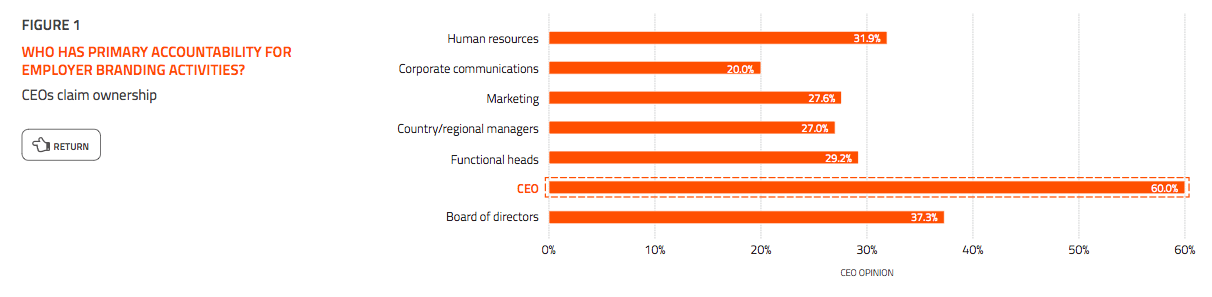
60% of CEOs think that they own it and only 32% think its HR. Which is in contrast to those in the talent acquisition sector, with 58% of HR execs and 57% of recruiters thinking its HR’s responsibility. Marketing execs are even more confused with 39% saying HR, 40% the CEO, and 27% themselves.

Whoever has internal responsibility, they seem in little doubt that the immediate main objective is to fulfil short term recruitment needs and the longer term main objective is to secure long term recruitment needs.

Of course the reality is that if anyone ‘owns’ it then it’s the employees, as it’s their experiences that are most visible to outsiders. How their employment experience is impacted by development opportunities, reward, performance management, inclusive management and a positive hiring experience is where HR come in to play. And if HR are doing their job and creating a great working environment, then they should also want to know how that is being communicated. The art is to let employees be the storytellers through encouragement, not control.

However some of employer brand is inextricably linked to general brand perception. Employer branding didn’t start with the internet, and just as Google, Apple and Facebook are brands that newer entrants to the job market would like to work for, so companies such as Virgin, M&S, John Lewis, BBC and numerous consulting firms and advertising agencies have been aspirational employers in the past. Often these preferences are based on general brand awareness, not the employment experience.

Is it the wider implications of branding and brand messages that maybe HR and recruiters struggle with?

On April 21st I’ll be heading off to blog and tweet from the European Brand Conference in London, which again is being run by Transform Magazine. There are a number of presentations around branding – perceptions, reputation, tone, experiential – with sessions specifically looking at employer branding too. There is a diverse range of companies speaking, including Cancer Research UK, BT, Oxfam, Eurostar, Orange, Fairtrade, Oxford University and Starbucks.

If you want to hear more then there are a small number of tickets available and blog readers can get a 10% discount the code TRANSCONF10 when booking here.

So if you’re thinking of dipping a toe in the branding conversation then come and join me, I’m sure the water’s just fine.