Social Media, Judging Others and The 5 Year Rule

The guy who first managed me in recruitment, the owner of the small agency I had joined, had a way of dealing with some of the slightly more overconfident outpourings of the younger, cockier me. He said…

“Write down what you just said.
Put it away.
Look at it again in 5 years’ time.
You’ll never believe you ever said that.”

It was a put down, deliberately aimed at making me feel immature with a lot to learn about the business world. Probably something I needed at the time, and certainly something that stayed with me. The 5 Year Rule. As individuals we do evolve, we learn, we gain experience and confidence. I had views, perspectives and opinions then that I didn’t have 5 years later. Probably not even 2 years later.

When it comes to social media I do wonder sometimes what to tell the kids. I see them using the platforms to communicate in their own way, in their own language and syntax, with their own friends and peers…trying to make their few followers laugh and trying to be more outrageous than each other.

Of course, at some stage they will be entering the workforce and all these old tweets, updates and snaps will be judged by an older generation who never said inappropriate things, made risqué jokes, swore and got drunk. Well, they did but only their close friends knew. Now they’re able to judge another generation by their own standards.

I expect stories of people in trouble for Twitter and Facebook updates to become so commonplace that we stop feeling the need to talk about them. But until then you will get storms like the hounding and eventual resignation of Paris Brown.

As Andy Hyatt from Hodes Group says in this blog:

“You see, part of being young is making mistakes. Saying and doing dumb things and learning from them.

As adults, we are supposed to understand this. We are supposed to provide the right environment to ensure that young people can grow into socially responsible adults. A positive learning environment. Teach them right from wrong. Ensure that children have access to facilities so they can maintain their physical, as well as intellectual wellbeing.

As adults, we are also supposed to recognise that sometimes, children can be childish: selfish, thoughtless, horrible and stupid. And more importantly, we are supposed to understand that this behaviour is only ‘acceptable’ (and again, I use the word loosely) until someone is deemed an adult. And this definition varies between the ages of 16 and 21 depending on where you are in the world”

I’m sure Paris Brown wasn’t the first and won’t be the last. Right now the next generation of public servants, low skilled service workers, MPs, doctors, journalists and bankers are saying what they damn well like on social media platforms. They’re dating on them, partying and sexting on them, and making people laugh on them.

I see them when I monitor mentions as part of the day job. I see more of the teen users now that I’ve got a search running for comments on the advert that my son is in. Often they have about 100 followers who they constantly try to amuse and/or shock. Sometimes they’ve got thousands of followers, and a level of interaction that some social media gurus can only dream of.

It’s no different whatever your generation. The humour, the insults, the in-speak are always different. The tone and content, the syntax and swear words look very different to an older person trying to judge out of context.

No-one thinks about the 5 year rule while they’re tweeting. Continue reading “Social Media, Judging Others and The 5 Year Rule”

The Cult of #TruLondon

Last Thursday saw the curtain come down on TruLondon7 (actually it was 8 for me if you include TruNora) and from last week’s attendees it was probably only me, Bill and one or two other stalwarts that have been at every one.

Jobsite weren’t sponsoring this time so I was able to experience the event purely as an attendee and track leader for the first time in a couple of years. And I was also able to see it through the experiences of first time attendee colleagues from the wider Evenbase & DMGT Group like Clair Bush (Broadbean) and Bethan Davies (RMS).

This event seemed quieter than previous ones. I’ll be writing about the takeaways and learning points elsewhere, so here’s what I think about TruLondon itself and how it’s evolved…and where it is now. All views my own, obviously…

The conversations may not seem to change but the people having them do.

There seems to be a (mis)conception that an event like Tru needs to push the boundaries; that the conversation constantly needs to evolve. There were tweets on the timeline along the lines of ‘are they still talking about…’ and regular Tru advocate and track leader Steve Ward had blogged about his frustrations in this respect.

I think we expect too much. Sure, there were a number of new topics discussed but then several tracks last week did contain much of the usual content. A lot of the key recruitment themes that usually get debated at #Tru – candidate experience, social recruiting, social sourcing, should recruitment be part of HR – were out in force again, most of them with the same track leaders as before, but the participants had changed. Different people were having the conversation and new people were grasping these concepts for the first time.

And with different people then the conversation is never quite the same.

It’s social.

There are people that I only get to see at #Tru events, and there’s a strong social side to these gatherings. Whilst we may have online interactions and the odd catch up at other events, it’s TruLondon that brings a group of people together twice a year to share thoughts and ideas and to generally hang out and have a good time. They come from the US and Europe, and further afield. Last week gave me the opportunity to meet Paul Jacobs for the first time…all the way from New Zealand.

It provides business opportunities.

Some of the people I spoke to go to other Tru events. Whether it’s the Nordics or the Baltics, Europe or Asia, there are quite a few people to whom these events represent a chance to develop International contacts, gain knowledge of upcoming global trends and launches, and spread awareness of what they do. It’s developed a sub-industry of its own.

TruLondon is like an academy.

Maybe the greatest strength of TruLondon is to introduce attendees to the conversations that bounce around the intersection of social media, recruitment and HR, sometimes called the people space. As I mentioned earlier, there are many who come to these events for the first time and who leave energised by the ideas they hear and the potential and opportunities that they bring to their businesses.

The unconference format of conversation and sharing over presentation and demonstration enables them to learn from others’ experiences in a wholly different way. It’s more personal and more informal, with everyone helping and giving of their time. It’s like a launchpad for the journey into social business.

It can be random and disorganised, and that can get frustrating, but it’s also part of the charm…you never quite know where the next idea is going to come from.

You get out what you put in.

If you’re going in the hope of finding potential consulting gigs or job opportunities then you may well be disappointed. It’s a global community thing and that is probably the most important point. There are opportunities to be had – I’ve written before how most of the attendees at the first events now have jobs in this space, me included – but they come from being part of a wider network. There are always new people to meet, and old friends to talk to.

The twitter stream may seem quieter that previously, as newbies aren’t quite up to live tweeting yet and the old timers have tweeted much of it before, but this shouldn’t be mistaken for there being nothing to say.

Whilst many of us have ‘moved on’ in terms of what we do in terms of social business, we mustn’t lose sight of the fact that there are many who are just starting.

The conversation has a way to go yet.

The most serendipitous moment for me came during a track on video when this tweet popped into my timeline. It’s from a political tweeter, so completely unconnected with the TruLondon conversations, yet somehow sums up why these conversations will be continuing for some time yet…

Facebook tweet

Seeing Off The Ninjas, Gurus and Mavens [Video]

At Salesforce’s recent Social Success evening for Social Predictions 2013 I teamed up with my good friend Karen Fewell (@DigitalBlonde) for a 5 minute session entitled ‘Goodbye Social Media Wizards, Ninjas & Gurus’.

With 181,000 Gurus, Ninjas, Masters, Mavens, Evangelists, Experts etc on Twitter alone it’s clearly becoming an overcrowded club…with even Social Media Whores weighing in at a relatively sparse 174.

So here’s our talk…

…you can find the other 5 Social Predictions 2013 talks in this blog from Salesforce

And here’s my review of the first Social Success event last September

So, What Do You Do?

I have just returned following a few days away. A short break usually means some random conversations with fellow holidaymakers and travellers, and at some stage in each conversation there will be the inevitable question…

‘So what do you do?’

In days gone by a quick ‘I work in recruitment‘ or ‘I recruit HR and Marketing people‘ was usually enough to ensure a change of subject but over the last two years it’s been slightly different.

I work in digital marketing’ will often induce glazed eyes but sometimes I feel quite bold and fess up with ‘I’m social media manager for a large digital recruitment business’

The conversation will then go something like…

Them : What, you mean Twitter and that stuff?

Me : Yes. It’s a bit more than that (insert quick explanation about creating content, brand monitoring and community engagement)

Them : Don’t get the point of that Twitter stuff. Or Facebook. Just another fad if you ask me.

Me : We’ll, I think it’s probably gone beyond the fad stage (insert an overview of the numbers and reach of the platforms, the rise of social business and peer recommendations etc)

Them : Sell it to me then. Why should I use it?

Me : Well I don’t like ‘selling’ it to people, but what line of business did you say you were in (insert examples of how social media impacts their industry or job, find out hobbies and interests and attempt to show the value of connecting with like-minded people)

Them : Well I can see that you’re passionate about it but I’m not convinced. The wife does Facebook. She spends all her time looking at photos that her friends put on there. Who can be bothered I ask myself.

Me : (thinking that I should be talking to the wife) Think of it as communication…

You get the picture. The conversation can sometimes go on quite a while with me increasingly adopting an almost exasperatingly apologetic tone as if I’ve got an embarrassing addiction that I need to defend. (Maybe I do)

So tell me…how do you guys explain what you do…


No More E-mail Any More at #HREvent13

It’s hardly a secret that I’m no big fan of e-mail…I’ve covered it in a few blogs. I find it unsociable, a conversation killer and too rooted in process and procedure.

No surprise then that an #HREvent13 session on transforming from an e-mail culture to one of social collaboration would get my attention. It was run by blueKiwi who are part of Atos – maybe not the easiest company to champion in these times but they are large so I was interested in how this transformation came about.

Simply put, it arose during a brainstorm on how to engage and empower the future workforce…a business world without e-mail was a subject up for discussion.

Here are some nuggets I picked up during the session…you may have seen one or two on my twitter fed:

“E-mail is annoying. It’s not a collaboration tool, it’s a communication tool and a task management tool”

“A move from e-mail to social collaboration is not just about systems & technology but really about organisation, culture & attitude as well”

“Social collaboration increases agility, productivity, speed & effectiveness through better talent mobilisation, knowledge sharing & communication”

“Next generation communication tools are necessary to attract & retain new generation talent not just in Europe but worldwide”

“E-mail based management style is creating distance between teams and management which diminishes engagement”

“Introduction of social collaboration flattens hierarchy. Everyone has the same voice. Management behaviours need to change”

OK, so it’s one business in a sea of electronic mail but here are my thoughts…

  • E-mail is not a natural communication medium to the next generation (apparently only 11% of 13-19 year olds use it to communicate with each other)
  • The future flexible, contract, project based, locationally free workforce need a collaboration tool not a communication tool
  • A move away from e-mail is cultural and psychological, rejection mainly a fear both of the unknown and of loss of control
  • Management mind-set and behaviours are the keys. Current e-mail usage is too centred on task assignation/management and control

Moving from e-mail to social collaboration requires significant change management – the presentation dealt with how this was being done. HR plays a key role, and the creation of a network of internal ambassadors is important.

Ultimately it’s also about showing employees how it will make their job easier, tasks quicker, productivity higher and allow quick access to essential information.

The end of e-mail? It’s all in the mind…

HR, Social Media & Punk Rock

I’m chairing the CIPDs Social Media in HR conference next week and so I’ve been thinking about how the conversations around social have grown and developed in the space at the apex of social networking, HR and recruitment – pretty much the bubble I live and work in.

I wrote in one of my blogs about CIPD12 of how the questions have clearly been moving from ‘why‘ to ‘how‘ and this is clearly a shift which informs much of the writing and speaking that I see and hear. Sure, there will be many who are going to need some evidence before taking teams and businesses on the social journey, and rather than stamp off in a strop I think more of those who do ‘get it’ need to raise the conversation away from statistics on usage and reach, and talk more of outcomes.

The more I think about the rise of ‘social‘ the more I seem to think about punk rock. Not sure why, but there are similarities.

Punk wasn’t enabled by technology but by attitude. Coming at a time when you needed an ology to be in a rock band it was a clear shout by a ‘forgotten’ generation who felt they had no voice.

The link here is that it started with a younger generation but quickly became more widely adopted. Just as with today’s social media consultants, gurus and evangelists who climbed on the bandwagon quite early, back in 76/77 you had many journeymen rockers getting a spiky haircut, skinny jeans and a few tattoos and ripping out some three chord thrashes to sudden acclaim.

Of course you had the doubters, those who thought it was a fad and would never really catch on. In music broadcasting, for every John Peel you had a Nicky Horne.

Nicky H was the serious ‘rock’ DJ on Capital Radio. He broadcast regular shows that we’re ironically called ‘Your Mother Wouldn’t Like It’ – ironic because it featured just the type of corporate rock music that most people’s mothers WOULD like.

He was quick to rubbish punk, famously and proudly proclaiming that his shows would be punk free, that you wouldn’t hear any punk music on them.

And guess what. Less than a year later you couldn’t move for the punk and reggae that he was playing on his shows!!

How many social engagement naysayers and doom mongers are now evangelising? Even the PM (he of the ‘tweeters are a bunch of twits‘ sound bite) now has an official account. Though I accept he may not have much input!

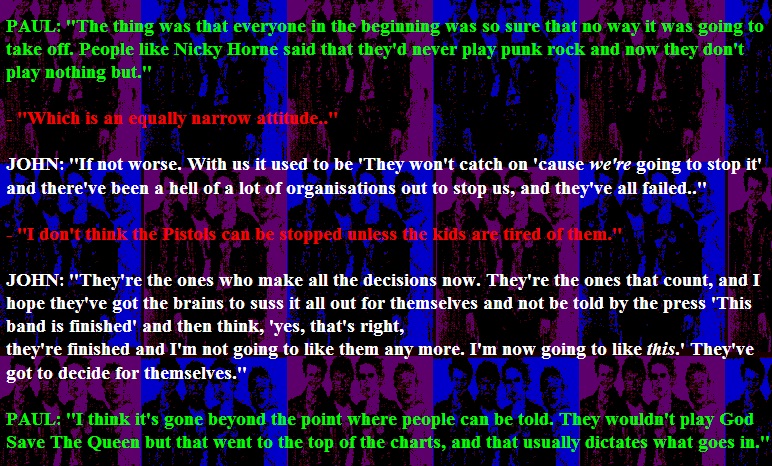
And just to square the Punk circle, here is part of an interview that the Sex Pistols gave to NME in the summer of 77. You can read more of the interview on this website – complete with the famous Sid Vicious ‘The definition of a grown-up is someone who catches on just as something becomes redundant”

Just read though this excerpt and substitute mentions and references to ‘punk rock’ with ‘social media’….

…uncanny!


Punk Rock

What I Talked About at The Drive Thru

Yesterday saw my first appearance on Bryan Wempen’s Drive Thru HR blog talk radio show. It was a wide ranging conversation covering everything from the Olympics to what topics am I so over.

If you’ve got some time then you can listen to the 30 minute show through this link. If you’re a bit time deficient then here’s what I was saying in a nutshell…

Get inspired, get determined, get good

Needless to say we started with chat about the Olympics. Luckily TeamGB had bagged a couple of gold medals earlier in the afternoon so I didn’t feel pressure under the weight of US gold medals. I talked about GBs first medal winner, Lizzie Armitstead, who won a silver cycling medal aged 23. What was so special about this? Well, she didn’t learn to ride a bicycle until she was 16. Her school got a visit from British Cycling’s Talent Team and it inspired her to take it up. Novice to silver Olympian in 7 years – shows what can happen when inspiration meets determination.

Before you go looking for new platforms get as good as you can be at the one’s you’re already using

Jay Kuhns posed a question on twitter in relation to my role as a social media manager – what did I see as the next platform after the ‘holy trinity’ (Bryan’s words) of LinkedIn, Facebook and Twitter. I talked a bit about Google+ and how useful it was. I managed a shameless plug for this blog on Jobsite Insider in which my colleague Gary Elliott talks about the value of Google+. But then I did add that there was little point in looking for a new plaything if you haven’t mastered the ones you’ve already got. Too many businesses try to jump on new bandwagons before they’ve properly navigated the one they’re already riding. Get as good as you can be at the ‘Holy Trinity’.

Make it simple for people to get involved

I talked about an initiative that I was rolling out at work to encourage colleagues who are interested in finding out more about social media networks, how they can use them and how they can get started. I’ll write more about it in a future blog but suffice to say that my belief is you need to get your people comfortable about using it for themselves before you can ask them to use it for you. If you over encourage people to use the platforms before they are comfortable then they’ll use them badly. Continue reading “What I Talked About at The Drive Thru”

HR and the Socially Connected Organisation


“I don’t know what I was expecting
But I’m sure I am detecting
The sounds of human beings connecting
And some pretty deep reflecting”

(Anon, previous ConnectingHR attendee)


It’s only 19 months since the very first ConnectingHR Unconference, and on 16th May we will be running our fourth. It has certainly been a revelation seeing the community come together, grow and develop in that time and how what could easily have been a one-off has become a regular event that inspires, challenges and entertains.

Looking back at my blog HR and the Social World, which previewed the very first event in 2010, it struck me how far the conversation has come…and how far we can still go.

The early discussions were around social media, the how and the why it should be used, the potential to change the way we work and shape the future of how we will be working. Subsequent events moved the debate on to people strategies and eventually to what the future of work may look like.

For #CHRU4 our theme is ‘The Power of a Socially Engaged Organisation’ and there are five key questions that we’ll be looking at:

  • How can organisations embrace social media/strategies internally to increase engagement?
  • What are the positive benefits and opportunities of embracing social and community strategies in organisations?
  • What tools are there to help increase collaboration and conversation in organisations?
  • Can a more social business create commercial value and increase engagement?
  • What alternatives are there to the traditional employee survey?

As always the actual agenda on the day will be attendee driven, yet there will be something new at the very start. To get the creative thinking juices flowing we’ll be seeing a series of 5 minute presentations which will combine a mixture of short case studies and think pieces aimed at challenging the way we see everything from workplace design to HR metrics! Continue reading “HR and the Socially Connected Organisation”

Social Media Policies in One Sentence

Ok Ok…I know its guidelines not policies but I needed to get your attention! After all, I’m a convert. An evangelist. And I spread the word whenever I get the chance.

I’ll be spreading it later today at #HRD12 and next week at the Recruiting Through Social Media conference – and I know from past experience that the burning questions will be:

  • should we block employee use of social media
  • what does a good social media policy look like

The answer to number 1 is simple – DON’T! Because you CAN’T! Block their access on a work desktop or laptop if you want but you will only drive them under the desk and on to their phones.

And if you’re about to call out ‘Aha, it’s a company phone so we can block it on there too‘ (as someone did when I was presenting recently) then the answer is…they’ll have another phone! Unless you make them give up their personal number or phone (never a good idea) then they will still be able to access social media – it’s the new cigarette break/coffee break after all – and all that will happen is that you’re unlikely to have visibility of it.

And, of course, the rest of the world will know that you’re a company that tries to block access to social media. Not a desirable bit of ’employer branding’ in Business 3.0 or Recruitment 5.0.

Now what about a policy or guideline?

Keep it simple and if possible limit it to one sentence that means something everyone can understand and relate to. Continue reading “Social Media Policies in One Sentence”

The Good, The Bad and The Cautious

Conference season is in full swing. In recent weeks I’ve attended four recruitment and HR conferences at which – surprise surprise – one of the burning topics was yet again social media.

Clearly it’s a subject that won’t go away – nor should it – but I can certainly detect a shift in attitudes with companies showing a distinct interest, even keenness, to embrace the opportunities.

Most heart-warmingly it was at Recruitment International’s seminar for SME recruitment agencies that I noticed a big shift. I delivered the session ‘The Key to Social Media’ which I started with the question ‘how many companies here have a twitter account?’ to find that over half did! Not only that, but they wanted to learn how to use them properly and get more from them!

I won’t repeat my session here. Suffice to say that leading them through the industry’s communication journey of phone and rolodex, to fax, then computer, e-mail, mobile and now social media highlighted that it’s an evolution not a revolution and companies will adapt much as they have done previously.

This approach helps to focus on the conversation not the medium. On participation, openness, conversation, community and the benefits of connectedness… and the rules of engagement as opposed to the fear of the unknown.

After all, with our previously preferred communication tools now seen as the biggest distractions in the workplace, and new trainees much more adept at communicating through social channels and messaging as opposed to the traditional land-line phone, this is a shift we may all have to accommodate sooner rather than later.

However it’s not all optimism and a sense of adventure at a conference now…there’s the ubiquitous presentation from a law firm to sit through. And don’t they see things differently!

We hear of benefits and opportunities from companies, then of problems and risks from the lawyers. Continue reading “The Good, The Bad and The Cautious”