Hybrid Working: Why Policy Isn’t the Problem – Leadership Is

It’s become a familiar story within organisations. A CEO or senior leader returns from a conference or forum convinced that really getting everyone back to the office will fix culture, collaboration, and performance.

But as recent research from MIT Sloan Management Review involving Brian Elliott, Nick Bloom and Prithwiraj Choudhury has highlighted, this focus is misplaced. Hybrid work isn’t a policy problem – it’s a leadership capability problem.

The most successful organisations aren’t arguing about office attendance. They’re building the skills, systems, and trust to help people work effectively – wherever they are. Here are some of my thoughts on the research and, in particular, what they mean for HR and business leaders.

1. The Policy Trap: RTO Mandates Miss the Point

Many leaders are treating hybrid work like a compliance issue: set a rule or guidelines, communicate it, and measure adherence. Yet despite the rise in return-to-office mandates – up 12% last year alone – actual attendance increased only by 1-3%.

Managers are quietly prioritising performance over presence. Faced with losing high performers or bending rigid rules, most choose results. The real cost of these mandates isn’t absenteeism – it’s the wasted leadership energy spent enforcing policies that don’t solve the real challenge: how to enable effective collaboration across distance.

2. What the Research Actually Shows

Despite much debate and rhetoric – in magazines, books, forums and from the conference stage – the evidence doesn’t support rigid office mandates. Peer-reviewed studies have shown:

  • Hybrid work does not reduce productivity and can lower attrition by a third, saving millions in turnover
  • Remote work can increase productivity (by up to 10% in call-centre studies) and broaden workforce diversity
  • When teams spend 23% – 40% of their time together, they perform best. What matters isn’t where people work – it’s how purposefully they connect.
  • Hybrid arrangements consistently boost engagement and innovation by expanding perspectives and increasing psychological safety.

The conclusion is clear: effectiveness comes from flexibility and clarity of purpose, not from counting badge swipes.

3. The Four Capabilities That Define Hybrid Success

The companies thriving in flexible work environments share four core leadership capabilities – none of which depend on fixed policies.

Know Your Talent Edge

Start with strategic clarity. Hybrid work should serve the organisation’s competitive advantage – whether that’s attracting hard-to-find talent, fostering creativity, or offering flexibility competitors can’t.

Allstate, Airbnb, and the European Central Bank have each tailored hybrid models to suit their unique needs. The best approach isn’t uniform; it’s fit for purpose.

Measure Results, Not Presence

This is the leadership mindset shift. High-performing companies judge employees on outcomes, not hours.

Synchrony and Atlassian are two organisations that have used transparent goal-setting systems so everyone can see progress and impact. This approach strengthens trust, reduces bias, and helps retain diverse talent – particularly women, who are disproportionately penalised by rigid in-office demands.

Let Teams Lead the Way

The most effective hybrid models are designed at the team level. Teams know their collaboration rhythms better than executives do. Atlassian empowers teams to agree on shared norms – like guaranteed overlap hours or quarterly in-person sprints. Microsoft and Teradyne are businesses that use similar flexibility within a broad corporate framework.

Uniform policies flatten nuance. Empowered teams create alignment and accountability.

Invest in Getting Better

Hybrid work isn’t a one-time policy shift – it’s an ongoing capability build. Leading companies are investing in:

  • Spaces: redesigned for collaboration, not occupancy
  • Resources: budgets for purposeful team gatherings, not daily commutes
  • Skills: manager training and playbooks for leading distributed teams

Hybrid success depends less on where people work and more on how leaders build trust, alignment, and capability across boundaries.

4. The Leadership Imperative

Research consistently makes it clear: hybrid is here to stay – and it’s working. The organisations moving ahead today are those that stopped treating flexibility as an HR issue and started treating it as a core leadership discipline.

The real question isn’t ‘how many days in the office’ – it’s ‘how effectively do we create connection, clarity, and accountability across teams’?

Leaders who master that shift will build organisations that can flex with whatever comes next. Because the future of work isn’t about place – it’s about how we work together to create value.

(This post originally appeared in my twice-weekly newsletter HR Means Business – subscribe to make sure you don’t miss my latest conversations, thoughts and writing)

Rethinking HR – Building a New Operating Model for the 2020s

For more than two decades, HR has been guided by variations of the Ulrich model – a structure that helped professionalise the function, but one that now struggles to keep pace with today’s complexity. I recently interviewed Perry Timms, Founder and Chief Energy Officer of People & Transformational HR Ltd, on my HR Means Business podcast, to talk about the concepts outlined in his new book The HR Operating Model.

Perry believes that the HR profession needs a blueprint built for the world we actually work in – not the one we used to. “It still feels like HR is an order-taking, administrative function. We’ve been knocking on the strategic door for a long time. It’s time to redesign the house.

From Function to System: A Holistic Redesign

Perry’s new model doesn’t simply tweak existing structures – it reimagines HR as an interconnected system, built around four intersecting circles Systems, Products, Science, and Technology – reflecting how people, processes, and performance actually interact inside modern organisations.

At its heart sits People Experience – a concept that connects every stage of the employee journey, from candidate to alumni. It’s not about engagement as a “soft” idea, but about creating value at every touchpoint. As Perry puts it, “People experience isn’t a supercharged version of wellness. It’s high performance, but sustainable — evidence-led, inclusive, and grounded in business outcomes.

From Data to Decision

One of the model’s key intersections is People and Performance Analytics. HR leaders have talked about data for years, but Perry’s approach brings it into the operating system itself. The idea isn’t to build separate analytics teams, but to embed insight everywhere – translating data into business intelligence that guides decisions in real time.

This shift moves HR beyond reporting on “what happened” toward understanding “why it happened” — and ultimately shaping “what happens next.

Redefining High Performance

In the previous model, high performance would often meant results at any cost. Perry argues for a more complete definition – one that includes social, human, and intellectual indicators.

High performance shouldn’t be one-dimensional,” he says. “It’s about thriving teams who deliver results and sustain themselves through learning, balance, and purpose.

The outcome is regenerative performance – where success fuels energy and capability, rather than exhaustion and turnover.

Technology as a Collective Responsibility

Technology, in Perry’s view, must move from being an HR project to being an HR practice. The most effective organisations he studied didn’t silo innovation; they built open, participatory infrastructures that tested tools in real use cases, gathered feedback, and aligned technology with the data they actually needed.

AI plays a role here too – not as a disruptor, but as a smoother of operations. When automation handles routine, rule-based work, HR professionals can focus on relationships, creativity, and context – the human edge that technology can’t replicate.

The Meaning Maker: HR’s New Purpose

One of the model’s most powerful ideas is the Meaning Maker role — a function dedicated to ensuring organisational purpose remains alive and visible.

“The purpose of an organisation ought to make people think, ‘I’m glad I’m here because I believe in this’” Perry explains. That sense of meaning is the new psychological contract.

In a world of automation and flux, meaning-making becomes HR’s bridge between strategy and soul – helping employees understand why their work matters.

Getting Started: From Products to Purpose

For HR teams wondering where to begin, Perry offers some clear guidance – start small, but start differently

Think of your HR services as products,” he says. “Ask: if people had to buy this service for the value it provides, would they?” Then build it to that standard.

This product mindset signals seriousness, relevance, and innovation – and begins to shift how the rest of the business perceives HR.

HR at the Front, Not the Back

Perry’s challenge to boards is equally direct: Let HR Lead. “You can’t ask HR to deliver what you want when you don’t know what you need,” he says. “In uncertain times, HR should be out front – interpreting signals, shaping workforce strategy, and helping organisations prepare for what’s next.

The Future: Adaptive, Human, and Purposeful

The new HR operating model isn’t just a redesign of roles and processes. It’s a cultural transformation – one that blends systems thinking, human science, and technology to build organisations that are fit for the 2020s and beyond.

And the journey doesn’t end here. “If HR can get ahead of the curve for a change,” he says, “we can help build organisations that are adaptive by design — not just efficient, but alive.

You can listen to my full conversation with Perry Timms here – https://www.hrhappyhour.net/episodes/creating-a-new-operating-model-for-hr/ – or through the image below:

Designing Job Search Tools That Work for Neurodivergent Candidates (and Everyone Else)

AI is transforming the job search, but without intentional design, it can just as easily raise barriers as remove them. If you want to attract – and fairly evaluate – neurodivergent talent, the mandate is simple: teach people how to use AI well, make the journey accessible, and build trust at every step.

At the HR Technology Conference & Exposition I was at a session run by my friend Crystal Lay, MBA MScIOP – an award winning Global Employer Brand & I/O psych executive – in which she talked through her research, and shared what AI reveals about hiring, bias and belonging. She highlighted a study with over 450 participants. Some of the key findings included men’s higher confidence in technology, women’s underestimation of their skills, and the importance of familiarity over gender in AI adoption. Neurodivergent individuals, particularly women, showed higher AI usage and developed skills.

Here are my main takeaways:

Start with skills, not slogans

Many candidates already use AI multiple times a day. Help them to use it well. Publish a plain-language “AI starter kit” on your careers site with:

  • Prompt guides for common tasks (CV tailoring, cover letters, portfolio curation, transcript summaries)
  • When/why to use AI for each role type and task
  • Advice and guidance on how to verify facts and use personal evidence
  • Personalisation tips (always begin with your own information, achievements, and voice)

When we show candidates how to work with AI – not like Google, but like a conversational partner – we lift the quality for everyone and reduce anxiety for people who benefit from structure and scaffolding.

Designing for neurodivergent accessibility

Language and layout matter. Use conversational copy, clear headings, white space, and short blocks that are easy to scan. Offer modal choices for high-stress steps:

  • If AI video interviews feel impersonal or confusing, provide equivalent alternatives: typed responses, audio-only, or off-camera options.
  • For screening tasks, let candidates choose between written or recorded submissions.

Accessibility isn’t about removing standards; it’s about providing multiple, comparable paths to demonstrate the same capability.

Put psychological safety on the record

Trust is earned, so state – explicitly – where ethical AI assistance is allowed (and where it isn’t), and describe your own use: how your teams rely on AI, how you review outputs, where humans stay accountable. Then maintain regular transparency updates: what bias tests you ran, what you found, and what you changed. When candidates see you’re on top of risk, they’re more willing to engage honestly.

Use AI where it helps – not everywhere

Not every step needs a bot. Prioritise bias-tested tools that add value at the right moment (e.g. prompt helpers embedded in the application form). Be cautious with practices candidates commonly flag as alienating – like automated video interviews – and make sure there’s a true opt-in alternative.

Fix the plumbing or don’t ship the chatbot

Your chatbot is only as good as the content you feed it. If your careers site or your knowledge base is thin, the bot will guess – and candidates will lose trust. Invest in a robust content layer (policies, FAQs, job frameworks) before you turn on AI. Screen vendor tools against your content footprint and accessibility requirements.

Co-design, don’t guess

Build with neurodivergent job seekers and other marginalised groups. Run iterative tests with mixed methods: qualitative sessions to hear what works and why, plus quantitative surveys to see patterns at scale. Test over time – accessibility is about repeatable ease, not a one-off demo.

Handle AI-written CVs thoughtfully

Yes, AI is in many applications. Treat detection signals as conversation starters and not auto-rejects – especially when writing isn’t the job’s core competency. For roles where original writing matters, be clear in the posting and request a supervised work sample. Blanket bans will disproportionately harm neurodivergent candidates for whom AI is a vital organisational support.

Keep supporting after day one

Onboarding is where equity becomes habit. Provide short trainings on ethical AI use, team norms, and verification practices. Create clear routes for reporting data or bias issues – frontline employees will spot problems faster than pre-scheduled audits – and close any loopholes with updates.

The Future of Work: From Jobs to Meaningful Work in a Tectonic Era

Work has always been one of the three pillars of human fulfilment – alongside relationships and health. When it’s organise and done well, meaningful work doesn’t just pay the bills; it keeps us healthier, helps us live longer, and fuels a sense of purpose. But the way we define, organise, and experience work is shifting faster than ever.

At O.C. Tanner‘s Influence Greatness conference this week I sat in a session by Rishad Tobaccowala, from the The Rethinking Work Platform, which got me thinking. The session was billed as ‘How to Lead in the Age of AI’ but his observations and research went much deeper than that.

He started with the observation that between 2019 and 2029, work has been – and is currently – projected to change more than it did over the previous 50 years. This is not just evolution – it’s a tectonic shift. Yet many leaders are still looking backward, focusing on office returns and outdated structures, metrics and roles, while the ground beneath them is moving. How forward thinking are todays business managers and leaders whilst the world of work around them shifts?

The Five Shifts Reshaping Work

  1. Demographics: Populations are shrinking in many developed countries, birth rates are falling, and societies are aging. This will create pressure to keep older workers engaged and to design flexible arrangements for those balancing work with caregiving. At the same time, generational attitudes toward work and capitalism are diverging sharply. Gen Z, in particular, wants independence, flexibility, and purpose – and not to replicate the lives of their parents.
  2. Technology: AI is widely misunderstood. Far from just hype, it will quietly strip the value of “knowledge for knowledge’s sake.” Around 20% of current work tasks can already be automated, saving up to 40% of time. This won’t eliminate work; it will change how we create and measure value. The winners will be those who redeploy saved time into innovation and new ideas.
  3. Marketplaces: Platforms like Uber, Etsy, Upwork, and Shopify are normalising side hustles and gig work. Increasingly, people will hold both W2 (earned income in the UK) jobs and 1099 income (unearned income in the UK) streams. Work is diversifying beyond traditional employment.
  4. COVID’s Legacy: The pandemic didn’t just change where we work – it changed why. Employees no longer want “bosses.” They want leaders, mentors, and guides. The authority of command-and-control is fading fast.
  5. Declassification of Work: Perhaps the most profound shift: jobs and work are not the same thing. There will be fewer jobs, but no shortage of work. Systems built around employment – healthcare, pensions, identity – must evolve as people assemble income from multiple streams.

A New Worker Ecosystem

The workforce of the future will be more diverse than ever, with five types of workers:

  • Full-time employees
  • Contract workers
  • Freelancers
  • Fractionalized employees (working 60–80% of the time with prorated pay and benefits)
  • Agentic employees (self-directed workers who leverage AI and platforms for autonomy)

This new mix will make “headcount” a less meaningful measure. Instead, revenue per worker will become the key performance metric. Agility – through more flexible, ‘plug-and-play’ teams – will separate resilient organisations from those still organised around outdated hierarchies.

A Crisis of Leadership, Not Culture

Many leaders talk about “bringing people back to the office for culture.” But culture has never been confined to an office. Collaboration, learning, and relationship-building often happened elsewhere – off-sites, conferences, even restaurants. The water cooler myth has long been just that.

What’s really at stake is leadership. Bosses who allocate, monitor, and control are out of sync with today’s workforce. Leadership in the future looks more like jazz than a classical orchestra: improvisational, responsive, and collaborative. Leaders must create conditions for excellence, growth, and trust – not try to control every note.

How We Adapt: New Mindsets and Practices

Rishad was clear – the future won’t adapt to us; we must adapt to it. That means upgrading our “mental operating systems.” Just as our smartphones update every year, we must commit to learning daily – at least one hour a day – to stay relevant and resilient.

Equally important is adopting what he calls the ‘immigrant mindset’:

  • Think like outsiders, questioning assumptions and seeing opportunities others miss
  • Act like underdogs, prepared to disrupt established “castles and moats”
  • Invest long-term, trading short-term comfort for long-term gain

The Human Centre of the Future

For all the talk about AI and automation, the future of work isn’t really about technology. It’s about people. Companies don’t transform – people do. Organisations that invest in leadership, flexibility, and meaning will thrive.

Work, in its essence, is not disappearing – it is being redefined. The challenge for leaders, workers, and society alike is to uncouple work from jobs, embrace new worker types, and design systems that give people both purpose and flexibility.

The future is an undiscovered country. To navigate it, we’ll need adaptability, courage, and above all, leadership that sees people as the centre of every transformation.

Article content

Happiness at Work: Why Leaders Hold the Key

Happiness is becoming one of the most discussed – and most misunderstood – topics in the modern workplace. We talk a lot about engagement, retention, and productivity, but beneath all of these lies a simple truth: people do their best work when they’re happy. And there is an undeniable link between how people are treated at work, and how happy they feel in other areas of their life.

Yet, despite the research, many organisations still treat happiness as a “nice to have.” The World Happiness Report consistently places the US lower than one might expect, and studies like the Global Flourishing Study reveal worrying patterns: young adults today are significantly less happy than previous generations. The workplace is not the sole reason, but it plays a powerful role.

In a recent episode of the #FromXtoZ podcast Danielle Farage and I talked about happiness at work and looked at research from the Global Flourishing Study and World Happiness Report. Here’s my take on our conversation….

The Shifting Landscape of Work and Happiness

For older generations, entering the workforce often meant joining an employer who invested in training, mapped out career paths, and offered stability. There was a sense of reciprocity: employees committed to their employer, and employers committed to developing their people.

Nowadays, many young professionals enter the workplace burdened by student debt, often competing for a smaller number of opportunities (especially in sectors disrupted by technology and, most recently, AI) and often navigating companies who are reluctant to invest until new hires “prove themselves.” Instead of stability, they are encountering uncertainty – and instead of development, they can often face a “sink or swim” mentality.

This lack of investment is more than a skills gap – it contributes directly to unhappiness, anxiety, and disengagement.

The Factors Behind Unhappiness

The Global Flourishing Study found that the unhappiness of young adults stems from a combination of:

  • Poor mental and physical health
  • Lack of meaning and direction in their careers
  • Financial insecurity
  • Weakened relationships

When these challenges are layered on top of work environments that lack support, training, and clear pathways, many employees start to feel adrift.

The Chicken-or-Egg Dilemma

Many organisations hesitate to invest in training and development because they fear people will leave. But as the old conundrum goes: “What if we invest in them and they leave? But what if we don’t and they stay?”

Leaders must accept that employee turnover is inevitable. What matters is whether your organisation earns a reputation as a place where people grow, thrive, and feel valued. A workplace known for investing in its people will always attract strong talent. A workplace that withholds investment creates a revolving door of disengagement.

The Role of Leaders: Parenting, Not Policing

Leadership plays a defining role in workplace happiness. The parallels between parenting and leadership are striking. Parents know that over-controlling, fear-driven rules often backfire, while support, guidance, and freedom to explore can build resilience and loyalty.

The same is true in the workplace. Leaders who cling to employees out of fear of losing them can often end up driving them away. Leaders who provide tools, training, and opportunities for growth — even if it means employees may one day leave — build trust and long-term commitment.

Culture and Colleagues Matter Too

Happiness is not just shaped by leaders, but by the culture and people employees interact with daily. A supportive team, a culture of recognition, and a sense of belonging can make the difference between a job that drains people and one that energises them.

Employees spend a large portion of their lives thinking about, or engaging with, their workplace, and if the culture is toxic or indifferent, unhappiness spills into life outside of work. Conversely, when people feel supported, trained, and valued, happiness at work enhances happiness in life.

Who Owns Workplace Happiness?

Some leaders will argue that happiness is ultimately a personal responsibility. They provide the platform and environment…and employees must bring their own positivity. There is some truth to this — no one can outsource their happiness entirely. But leaders cannot ignore their influence.

The reality is that organisations shape many of the factors tied to happiness: financial stability, growth opportunities, meaning in work, community, and recognition. Leaders may not be responsible for every aspect of happiness, but they are undeniably responsible for creating the conditions in which happiness can thrive.

So How Can Leaders Foster Real Happiness at Work?

If you want to foster real happiness at work, then here’s a plan:

  1. Start Development on Day One Give every new hire a clear onboarding plan and at least one formal training opportunity within their first 90 days. Pair them with a mentor or buddy so they feel supported and can learn informally as well as formally.
  2. Make Career Conversations Routine Schedule quarterly career check-ins that focus on growth, not performance ratings. Ask questions like: “What skills do you want to build this year?” and “Where do you see yourself in two years, and how can we help you get there?”
  3. Give Recognition Weekly, Not Annually Make it a habit to acknowledge good work in real time — a quick thank-you, a public shout-out, or a personal note goes a long way. Encourage peer-to-peer recognition so appreciation comes from all directions, not just the top down.
  4. Check the Pulse Regularly Use short pulse surveys or informal check-ins to understand how people are feeling — about workload, culture, and well-being. Act on feedback quickly so employees see that speaking up makes a difference.
  5. Be Transparent About Challenges Don’t gloss over tough realities (economic shifts, AI disruption, restructuring). Acknowledge them honestly, explain the “why,” and share how you’re supporting employees through them. Even a simple “I know this is a difficult time, here’s what we’re doing to help” builds trust.

Happiness at work isn’t a perk or a slogan. It’s the outcome of deliberate choices leaders make every day — to invest, to listen, to support, and to trust. Employees don’t expect perfection, but they do expect authenticity and care. And when leaders get that right, happiness follows.

Check out our full podcast chat here : https://www.youtube.com/watch?v=jJkwto14YlA or through the image below….

…and check out more episodes of #FromXtoZ here – https://www.purpleacornnetwork.com/shows/from-x-to-z

Why Are Gen Z the Most Miserable Generation?

For decades, research around happiness has suggested a predictable pattern: life satisfaction followed a “U-bend.” Young adults begin relatively optimistic, hit a slump in middle age, and then rebounded later in life. While the precise age of peak misery varied from country to country, the overall shape was remarkably consistent.

But new research published in PLOS research journal by economists David Blanchflower, Alex Bryson, and Xiaowei Xu reveals that this curve has shifted in a striking – and potentially troubling – way.

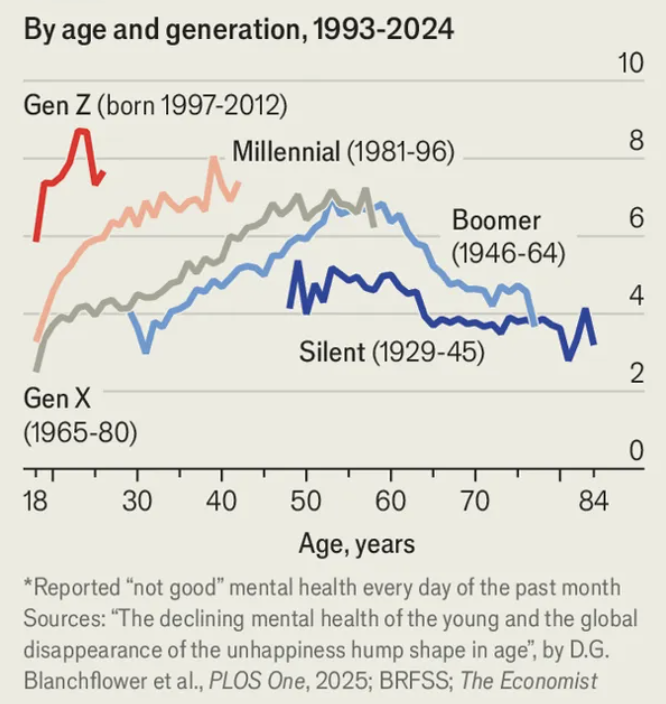
Across much of the world, it is no longer middle-aged adults who are the most miserable. Instead, young people, especially Gen Z, are reporting the highest levels of unhappiness of any age group.

A “Ski Slope” of Misery

The researchers analysed large-scale surveys in the United States, United Kingdom, and 44 other countries. Historically, data such as the Behavioural Risk Factor Surveillance System (BRFSS) in the US showed unhappiness peaking in middle age between 2009 and 2018.

Yet between 2019 and 2024, the familiar “hump” disappeared. Mental health among older groups remained stable, while despair amongst younger people climbed rapidly. A similar pattern emerged in Britain, where rates of anxiety and poor mental health surged among under-40s after 2016. The global picture is no different: across Africa, Asia, Latin America, Europe, and the Middle East, young people consistently report worse mental health than their elders.

This generational shift is profound. Older adults, once seen as the most vulnerable to despair, now appear more resilient than the youngest members of the workforce.

Why Are Younger People So Unhappy?

The causes are complex, and there is no real single explanation that fits across countries. But the research did highlight several possibilities:

  • Labour market changes. Traditionally, employment was a buffer against poor mental health. Yet for young American workers – particularly the least educated – this effect has weakened. Falling job satisfaction and economic insecurity are probably contributing factors.
  • Technology and social media. The rise of smartphones and social platforms has coincided with declining youth mental health since the early 2010s. Whilst they are usually blamed for this, the research covered a number of studies and found only a weak link between social media use and sustained declines in wellbeing.
  • Generational drift. Each successive generation has entered adulthood more miserable than the last – millennials and Gen X reported midlife malaise earlier than the baby boomers. Gen Z, however, are beginning their adult lives at historically low levels of happiness, raising concerns about how they will cope as they age.

In short, Gen Z are not only starting from a worse position than previous generations – they may also face deeper challenges as they approach midlife.

What This Means for Society and Work

The implications extend way beyond statistics. Rising despair among young people matters because they represent the current and future workforce. If left unaddressed, poor mental health risks affecting productivity, engagement, and social cohesion.

For organisations, this underscores the importance of investing in employee well-being, mental health support, and meaningful work. Younger workers may be the most digitally connected generation, but they also report the highest levels of disconnection, anxiety, and dissatisfaction. Employers who recognise and respond to this reality will not only support their people – they will also secure a competitive advantage in talent attraction and retention.

Cause for Cautious Optimism?

While the findings are sobering, they are not unchanging. Some evidence suggests that the mental health of young Americans has improved modestly in recent years, hinting that today’s “ski slope” of misery may not be permanent.

Still, the shift should serve as a wake-up call: the youngest generations, once assumed to be the happiest, are now struggling most.

Addressing this challenge will require action from policymakers, educators, employers, and communities alike. The “U-bend” of happiness may well return in time, but for now, Gen Z are facing an uphill climb. And organisations, professions and colleges can’t afford to look away.

How HR Can Drive Real Culture Change

Culture is often described as “how we do things around here.” It defines how employees interact, collaborate, and make decisions, shaping everything from day-to-day working relationships to an organisation’s reputation in the market.

My recent HR Means Business podcast chat with Jivan Dempsey FCIPD GMBPsS, Director of HR Transformation at FiveRivers Consulting, and author of The HR Change Manager’s Handbook, was about shifting company culture whilst preserving core organisational values and identity, and the critical role HR leaders play in shaping and shifting company culture.

During our conversation Jivan was quick to point out that culture isn’t about posters on a wall or catchy slogans in onboarding decks. It’s about how people behave when no one’s watching, and how an organisation responds when things get tough.

Yet many culture initiatives fail because they treat culture as a project rather than a practice. HR leaders are uniquely positioned to move culture work from surface-level campaigns to meaningful, sustainable change. Here’s how.

HR as Custodian and Amplifier of Culture

HR has a unique vantage point because it sees across all functions – from how people are hired to how they’re rewarded and developed. But being a custodian of culture doesn’t mean policing behaviours; it means amplifying what’s healthy, inclusive, and aligned with business strategy.

HR’s role starts with listening – understanding what employees and leaders actually value day to day, and where misalignments exist between stated values and lived experience. For example, if “innovation” is a core value, are employees empowered to take risks without fear of blame? HR must help bridge that gap through policies, leadership support, and recognition programs that make desired behaviours visible and celebrated.

Balancing Core Values with Evolving Behaviours

A common mistake is to treat culture as static – something defined once and left alone. In reality, culture is dynamic and adapts to external shifts (new technology, customer expectations, societal changes) and internal shifts (new leadership, growth, or restructuring).

Jivan emphasised the need to distinguish between core values, which remain stable, and behaviours, which can and should evolve. For instance, collaboration may remain a core value, but how collaboration happens in a hybrid or AI-augmented workplace will look different than it did five years ago. HR’s job is to help employees understand what stays the same and what must change – and why.

Avoiding Common Pitfalls in Culture Change

Many culture initiatives fail because they start with communications campaigns rather than focusing on behavioural change.

Slogans, posters, and value statements are easy; changing how managers give feedback or how decisions are made is harder – but it’s also where culture is truly shaped.

Another pitfall for HR is trying to tackle too much at once. Sweeping cultural transformations often stall because employees don’t see how the vision connects to their daily work. Instead, HR leaders should focus on a few critical behaviours – or “moments that matter” – where culture is most visible, such as team meetings, hiring decisions, and performance conversations.

Engaging Leaders and Overcoming Resistance

No culture initiative succeeds without leaders modelling the change. Yet leaders can be resistant – especially if the current culture has served them well. HR needs to treat leaders as both role models and co-creators.

This means coaching leaders on why change is necessary, showing them how it connects to performance and engagement, and equipping them with the skills to lead by example. It also means having difficult – but courageous – conversations when leaders’ behaviours are misaligned with the desired culture – a challenge HR must be ready to meet head-on.

Starting Small and Building Momentum

Culture change doesn’t have to start with a big-bang initiative. In fact, Jivan argues that starting small – focusing on one or two behaviours and piloting them in parts of the organisation – will often work better.

For example, if the goal is to build a more feedback-oriented culture, HR can start by training a single department in new feedback techniques, measuring the results, and then scaling what works. Early wins create stories and champions that help the broader organisation see what’s possible.

Making Culture Change Stick

The hardest part of culture work isn’t starting – it’s sustaining it. Many organisations see early momentum fade because behaviours aren’t embedded into processes and systems. HR must ensure cultural goals are built into how people are recruited, onboarded, rewarded, and promoted.

This also means measuring culture change, not just through engagement surveys but also through observable behaviours. Are leaders spending time differently? Are employees collaborating in new ways? Are recognition programs aligned with new priorities?

When culture goals become part of performance metrics and business outcomes, they stop being “HR’s project” and start being everyone’s responsibility.

The Bottom Line

Culture change is messy, human, and rarely linear – but it’s also where HR can have the biggest strategic impact. By moving beyond posters and slogans and focusing on real behaviours, HR leaders can guide organisations through change in a way that’s authentic and sustainable.

The work starts with listening, balancing stability with evolution, engaging leaders, and starting small. Most importantly, it requires persistence – because culture change isn’t a campaign; it’s a commitment.

You can check out my full conversation with Jivan here – https://www.hrhappyhour.net/episodes/hrs-role-in-shaping-company-culture/ – or through the image below, and let me know how you approach culture change in the comments.

The AI Effect on Entry-Level Jobs and Career Progression

Using ChatGPT might make you stupid.” That bold statement – based on a study – appeared on a number of news sites and in business journals recently. The article was accompanied by brain scan images suggesting that AI erodes critical thinking.

It’s the kind of story guaranteed to spark outrage – particularly among older generations who see technology as a shortcut rather than a skill. Needless to say it was a topic ripe for discussion between me and Danielle Farage on our #FromXtoZ podcast!

And also needless to say – the truth is far more complex, and raises bigger questions about how AI is reshaping not just how we work, but how we learn and progress in our careers.

The Disappearing Entry-Level Job

For decades, entry-level jobs were designed around repetitive, and often quite menial, tasks. Interns summarised files, created reports, and performed groundwork that provided valuable context and an understanding of how things fit together. While boring at times, those tasks were the building blocks for developing judgment and critical thinking. They helped you learn how to spot patterns, understand stakeholders, and prepare for more senior responsibilities.

Today, those very tasks are being done by AI in seconds. Need a summary? ChatGPT delivers one instantly. Need a cover letter? AI can generate multiple versions faster than you can type your name. For employers, this is a productivity boost. For graduates, juniors and interns, it means fewer “easy” tasks to start with – and potentially fewer opportunities to learn by doing.

Learning Gaps and Lost Context

One of the risks we talked bout is that when AI handles entry-level tasks, people may lose valuable context. The act of digging through files, for example, could teach you how information is structured, help to learn what’s important, and why things are done a certain way.

Without these experiences, new hires may have less foundational knowledge – and therefore slower long-term development opportunities – which echoes a common complaint among Gen Z workers that either they have little to do, or they are immediately thrown into complex tasks without the understanding that entry-level work used to provide.

That jump can accelerate learning for some, but for others, it can create stress and lead to potential skill gaps.

Shifting Skill Priorities

If AI can handle repetitive tasks, what skills will matter more?

Soft skills are rapidly rising to the top of the list – communication, collaboration, creativity, and emotional intelligence. Critical thinking is still essential, but it may shift away from basic data gathering and toward making strategic connections and asking better questions.

For example, instead of summarising a document, a junior analyst might now be expected to analyse AI’s summary and extract what’s missing or misleading. Instead of drafting a cover letter from scratch, they might focus on personalising and contextualising AI’s output in a way that resonates with their employers.

Changing Brains, Changing Learning

Our conversation also touched on how our brains – and our learning habits – are changing. Gen Z (and AlphaGen) have been exposed to technology and gamified learning from childhood so have different cognitive expectations. Tasks requiring deep focus and delayed gratification (like writing reports or doing long-form research) can feel more challenging when our brains are wired for quick dopamine hits from apps, games, and social media.

This is more than just a workplace issue; it’s a societal one. As technology accelerates, how we teach, train, and even design work needs to adapt to different cognitive baselines. Should we be worried about critical thinking decline? Or should we embrace the fact that tools like ChatGPT free up mental energy for deeper and more analytical thinking? The answer likely depends on how organisations and educators adapt.

Rethinking Entry-Level Work

The old career ladder was built on predictable steps: you start with basic tasks, learn the ropes, then climb upward as you gain experience. AI is dismantling some of those steps. That’s not necessarily bad – many interns now handle complex projects far earlier in their careers than previous generations ever did – but it requires intentional design. Employers need to:

  • Redefine entry-level roles to focus on applied problem-solving, creativity, and human interaction.
  • Provide context in new ways—mentorship, job shadowing, and structured learning can fill gaps left by disappearing grunt work.
  • Invest in soft skill development as AI takes over technical routine tasks.

A Transitional Phase

Ultimately, we’re currently in a transitional phase. Entry-level jobs are not disappearing, but they are transforming. The work experience of someone starting out today looks nothing like it did even five years ago. That can feel unsettling, but it’s also an opportunity – to design jobs, education, and career pathways that prepare people not just to survive in an AI-driven workplace but to thrive.

The big question is not whether AI is making us “stupid” – it’s how we will redefine learning, working, and progression in a world where machines handle the basics and humans focus on what truly requires a human touch.

You can check out the full podcast conversation here : https://www.youtube.com/watch?v=cu6W-UqLj2Q

Or through the image below

And let us know what you think in the comments…..

Intergenerational Harmony: Navigating Multigenerational Workplaces

I’ve always been interested in workplace dynamics. I’ve had, in some respects, an unusual career in that I started off professionally qualifying as an accountant and over the years have been through marketing, sales, HR and writing, and in all the different sectors and organisations I’ve worked in, I’m always most interested in how we collaborate and co-create, the relationships we build, and where there’s things maybe not working in the workplace, what causes friction and internal disruption.

What interests me most at the moment is the number of different generations in the workplace. When I started work, there were very few people in my company who were over the age of 55, let alone 60 or 67 (which is the standard retirement age in Europe) so it was it was quite different. Whereas now we’ve got people working longer –  there was a big piece in the Financial Times in Europe only a few weeks ago where they’re interviewing people in their 80s who are still working, pretty much on a full time basis, because they’re fit and healthy, and they enjoy it.

Something has changed: the structure, dynamics, and meaning of work have transformed. That’s what I explore on a regular basis with Danielle Farage on our From X to Z podcast series – and it’s why intergenerational harmony is more critical (and more possible) than ever.

It was an honour to be invited on to Adam Posner‘s Pozcast recently to talk with Rhona Barnett-Pierce about my thoughts on Intergenerational Harmony. You can listen to the whole conversation here – https://www.thepozcast.com/mervyn-dinnen-understanding-gen-z-the-future-of-work-live-from-unleash-2025/ – and these are the key things I talked about

1. A Lifetime of Learning Workplace Relationships

From ‘humble’ beginnings as a trainee accountant ticking off bank statements to navigating marketing, HR, sales, and writing, my journey has always centred around one question: how do people collaborate within organisations? Friction, alignment, mentorship, and teamwork – these dynamics really define our experience of work. And the more varied your background, the richer your insight into what drives co-operation, or causes a breakdown in internal relationships.

2. Generations: From Homogeneity to Multigenerational Workplaces

When I joined the workforce decades ago, your co-workers typically shared similar stages in life. Now, you routinely find 18 and 80 year-olds on the same Zoom call. That shift reshapes how we learn, mentor, lead – and think about opportunity. The diversity of life stages has created a complex, vibrant workplace with both promise and growing pains

3. Friction Is Nothing New (But a Different Flavour Now)

Young, aspirational hires have always challenged the status quo. I recall reluctantly ticking off bank statements as a trainee – it seemed a fairly menial thing to do after passing my first exams – until I realised (or was helped to realise!) that it was essential for mastering the job. Today’s younger employees bring a sharper dose of self-confidence, often backed by deep digital understanding and fluency. They’re less likely to accept “that’s just how we do it” – and more likely to say, “I can actually help with that.”

4. Gen Z’s Mindset: Driven by Flexibility, Not Just Pay

It wasn’t like this for Gen X. The blueprint was straightforward: work → overtime → promotion → house → family. Indeed, salary growth roughly matched the cost of living back then – meaning real progress was achievable. The maths is broken now: property prices have risen 30x while incomes only 10x. For Gen Z, traditional markers of financial stability are less attainable and are more likely to come from family support/inheritance, so instead they look for purpose, autonomy, and meaning in their roles.

5. When Tech Becomes a Generational Advantage—and a Challenge

Younger generations enter workplaces already fluent in digital tools, often surpassing seasoned managers and leaders. Add AI into the mix, and the resulting power shifts can be jarring if not handles well. Leaders may need help adapting – not because they lack authority, but because the toolkit they rely on has evolved. The trick? Recognise those new dynamics and harness them for innovation.

6. Gen X: The “Sandwich” Generation Under Pressure

If Gen Z is reinventing what work means, Gen X is struggling with identity at work. Often caring for aging parents and facing increased competition (even from freelance boomers staying in the mix), they feel squeezed. Neither at the top nor ready to retire, they’re redefining their place – experimenting with flexible work, consulting, or fractional roles. This volatility can fuel misunderstanding across generations.

7. Redefining Retirement: A Choice, Not a Deadline

Life expectancy keeps climbing, but state retirement ages aren’t keeping up. Many older professionals are choosing – or needing – to continue working well into their 70s and beyond. And if that pushes younger workers out of certain roles? It’s not malice – it’s a symptom of changing life arcs. For Gen Z, this adds competition; for Gen X, it’s both risk and opportunity.

8. Practical Steps for Multigenerational Harmony

  • Respect structure—but question rigidity: Hierarchies exist for a reason, but flexibility can unleash creativity.
  • Balance freedom with clarity: Autonomy works best when expectations and goals are clear.
  • Invest in intergenerational dialogue: Bring diverse voices into strategy and culture conversations.
  • Design flexible career paths: From gig roles to portfolio careers, accommodate evolving life stages.
  • Focus on shared purpose: Work aligned behind meaningful goals unites all ages.

Let me know what you think….and check out the full Pozcast chat here:

A Potential Framework for Mitigating AI Bias in Talent Acquisition

In a recent newsletter I wrote about some of the takeaways from my interview with Heidi Barnett, President at isolved Talent Acquisition (formerly ApplicantPro), at the Unleash conference about the evolution of Talent Acquisition. The integration of AI and advanced analytics in candidate profiling presents us with both a tremendous opportunity and also significant risk. While these technologies can enhance efficiency and improve matching accuracy, they also have the potential to perpetuate or amplify existing biases in hiring practices.

In this – the second part of my interview with Heidi – I’m specifically looking at some of the ways in which TA professionals can proactively address these challenges.

Understanding the Sources of AI Bias

AI bias in TA typically stems from three primary sources: historical data, algorithmic design, and implementation choices. Historical hiring data can often reflect previous discriminatory practices, unconscious biases, or systemic inequalities that existed in previous recruitment decisions. When AI systems learn from this data, they can inadvertently replicate these patterns.

Algorithmic design bias can occur when the parameters and weightings built into AI systems favour certain demographic groups or characteristics. For example, if an algorithm heavily weights specific educational institutions or previous company experiences, it may systematically exclude qualified candidates from underrepresented backgrounds.

Implementation bias happens when organisations fail to properly configure, monitor, or maintain their AI systems. This can include using inappropriate data sets, failing to regularly oversee and audit decision outcomes, or not accounting for changing market conditions and organisational needs.

Establishing Frameworks for Bias Detection

TA professionals must start taking a more systematic approach to identifying bias before it impacts hiring decisions. Start by conducting regular audits of your AI system’s outputs, and analysing hiring patterns across different demographic groups. This should help identify any statistical disparities in screening rates, interview invitations, and final hiring decisions.

Another way is to create baseline metrics that track diversity at each stage of the recruitment funnel, and then compare these metrics before and after AI implementation to help identify any trends that may give cause for concern. Pay particular attention to how multiple identity factors might compound bias effects.

It’s also key to establish feedback loops with hiring managers, candidates, and internal diversity teams to gather qualitative insights about any potential biases. Sometimes bias manifests in subtle ways that statistical analysis might miss, such as the language used in AI-generated communications or the types of questions prioritised in screening processes.

Implementing Technical Safeguards

It’s key to work with your technology vendors to understand how their algorithms function and what safeguards they’ve built in. Demand transparency about training data sources, algorithmic decision-making processes, and bias testing procedures. Reputable vendors should be able to provide detailed documentation about their bias mitigation efforts.

Also important to implement human oversight checkpoints at critical decision stages. While AI can handle initial screening efficiently, human reviewers should still be involved in final candidate selections. Train these reviewers to recognise potential bias indicators and provide them with diverse candidate profiles for consideration.

You can also consider using multiple AI tools or approaches for candidate evaluation, comparing results to identify potential bias blind spots. If different systems consistently exclude similar demographic groups, this may indicate systemic bias that requires investigation.

Building Inclusive Data Practices

Audit your historical hiring data before using it to train AI systems. Remove or adjust data points that reflect past discriminatory practices. This might include eliminating certain educational requirements that weren’t truly necessary for job success or adjusting for historical underrepresentation in specific roles.

Expand your data sources to include more diverse talent pools. If your historical data primarily reflects candidates from certain networks or sources, actively seek data from underrepresented communities, alternative education pathways, and non-traditional career backgrounds.

Regularly refresh your training data to reflect current market conditions and organisational values. AI systems trained on outdated data may not align with current diversity and inclusion goals or may miss emerging talent sources.

Creating Accountability Structures

Establish clear governance structures for AI bias monitoring and mitigation. Assign specific team members responsibility for conducting regular bias audits and create procedures for addressing findings that give rise for concern. This accountability should extend to senior leadership, ensuring that bias mitigation receives appropriate organisational priority.

Document your bias mitigation efforts thoroughly. This documentation can serve multiple purposes: it demonstrates due diligence in legal contexts, provides learning opportunities for continuous improvement, and creates institutional knowledge that survives personnel changes.

Set specific, measurable goals for bias reduction and diversity improvement. Regularly track progress against these goals and adjust your approaches based on results. Consider tying these metrics to team performance evaluations and organisational success measures.

Continuous Learning and Adaptation

The landscape of AI bias is constantly evolving as technology advances and our understanding deepens. Stay current with research, best practices, and regulatory developments in AI ethics and employment law. Try and participate in industry forums and professional development opportunities focused on responsible AI implementation.

Regularly reassess bias mitigation strategies as your organisation grows and changes. What works for a small company may not scale effectively, and what’s appropriate for one industry may not apply to another. Be prepared to adapt your approaches based on new insights and changing circumstances.

Foster a culture of continuous improvement around bias mitigation. Encourage team members to raise concerns about potential bias and create safe spaces for discussing these sensitive topics. The most effective bias mitigation happens when entire teams are engaged and committed to the effort.

Moving Forward Responsibly

Addressing AI bias in talent acquisition isn’t a one-time project – it’s an ongoing commitment that requires vigilance, resources, and organisational support. The goal isn’t to eliminate all AI tools due to bias concerns, but rather to implement them responsibly with appropriate safeguards and oversight.

By taking proactive steps to understand, detect, and mitigate bias, TA professionals can harness the power of AI while maintaining fair and inclusive hiring practices. This balanced approach will ultimately lead to better hiring outcomes, stronger organisational diversity, and reduced legal and reputational risks.

The future of Talent Acquisition depends on our ability to leverage technology while preserving human values of fairness and inclusion.

Check out my full interview conversation with Heidi here :