HR’s Role in Embracing the Future of Work

How is work evolving? What roles will Generative AI, taskification, the skills agenda and job disruption play in reshaping the future talent market? How can we create high value work? And what might future workforce dynamics look like?

Last year I was involved in a simulation run by business consultancy Wikistrat for Upwork in which I joined with a number of analysts, practitioners and consultants to map out a number of potential scenarios for the future of work – taking into account what we know about emerging technology, evolving trends and the preferences and priorities of the current and future workforce.

We came up with a number of potential outcomes using different frameworks and in a recent podcast chat I had with Kelly Monahan, Ph.D. Managing Director of Upwork‘s Research Institute, we talked about the the various trends and HR’s potential role in guiding the reinvention of work.

Accelerated Pace of Business and the Impact of Gen Z

It’s hard to look at how the future of work may develop without acknowledging the current exponential acceleration of all business operations fuelled by evolving tech. This pace of change needs real-time data insights to help inform decision-making, particularly within the HR team. The entry of Gen Z into the workplace will lead to further change – with Kelly Monahan anticipating that they will challenge traditional business norms and practices, and question the purpose of work, which could lead to fundamental shifts in organisational values.

Generative AI and Job Disruption

The advent of generative AI has been transformative but has capabilities taking us way beyond automation. Kelly emphasised how AI really acts as a catalyst, accelerating the development of allied technologies like IoT and 5G, which will require a re-evaluation of job roles, skills and work processes.

Taskification has emerged, and organisations need to start deconstructing their job roles into specific tasks and skills, potentially promoting more fluid work arrangements. Addressing the exponential growth in the number of tasks and skills needs to be high on HR’s learn ing and development agenda.

Up-skilling and Multiplexing Workforces

Responding to these evolving job landscapes will require continuous up-skilling to help effectively navigate any disruption bought about by technology or social change. This will lead to more ‘multiplexing’ – enabling workers to apply diverse skills across departments and tasks, that can boost organisational agility and resilience.

Community Formation and Digital Identities

As organisations evolve in this way, workers are likely to find identity and belonging through digital communities rather than traditional organisational structures. This could have a big impact on engagement, retention and experience as these communities, or digital hubs, are likely to provide cross-functional collaborative opportunities that transcend company, geographical and industry boundaries.

AI’s Impact on High-Value Work

One consequence of Generative AI is the elevation of the complexity and value of work. Kelly Monahan, Ph.D. talked about an increase in high-value projects, for which skilled workers will look for rewards and wage premiums. However, this shift also emphasises the need for continuous skill development if organisations are to remain competitive, which requires support for learning and development as well as recognition and financial rewards.

Grey Rhino vs. Black Swan: Proactive Adaptation

We talked about whether AI was ’a ’Black Swan’ or a ’Grey Rhino’ event. Ultimately it is a Grey Rhino – having a gradual impact that needs proactive adaptation rather than reactive responses. The emphasis is on organisations – particularly HR leaders – to prioritise understanding the evolving challenges their businesses face and navigate future workforce challenges effectively by restructuring work processes, and facilitating upskilling.

In essence, it’s essential for organisations to embrace agility and up-skilling, and transform job structures, in a landscape of ever evolving technology. This can then give HR leaders the platform to help ensure their businesses remain competitive and successful in navigating the future of work, whilst negating the potential for insecurity and instability in future talent markets.

You can listen to my full conversation on this episode of the HR Means Business podcast:

#HRTechConf – We’re All Technologists Now!

HRTech

The final keynote at the recent HR Technology Conference was from Jason Averbook, who delivered an overview of HR technology – where we were, where we are now and where we should be going.

His rallying call was that we need re-imagination – we’re getting bright shiny new technology but we’re doing old school things with it. To emphasise this point he ran through 5 generations of technological development, the 4 different eras of what we’ve called HR, and concluded that despite all that change we’re still basically doing what we’ve always done.

He also had news for the HR professionals who think that technology isn’t for them – We’re all technologists!Do you call IT when you want to search Google?” he asked. “Who keeps their smartphone nearby when they go to bed at night?” got a clear majority show of hands.

Another show of hands revealed that only 5 people in an audience of many hundreds were from the payroll function, yet payroll is usually the first HR process that we get technology for. A couple of comments on the twitter channel questioned whether this was because the process didn’t innovate – but I’m not sure that’s true.

When I first started work I got paid cash on a weekly basis, then by cheque on a monthly basis, and more recently by direct transfer. I used to be given payslips with my cash/cheque but now I have to log in to a system to find them. And because I don’t do it regularly I invariably have to reset passwords – coming up with a new on each time! Payroll evolves much the same as any other process, yet where were the specialists at this show?

Jason also touched on the irregularity with which people interact with their internal technology. He asked when we last got married, had a child or moved house, as these are three key events when we will interact with the HR technology at work. Clearly for most people these events happen very rarely – maybe every few years – giving them little reason to interact with that technology, yet most HR professionals will complain that employees aren’t using the tech. Again you need it to do different things if you want more interaction.

The importance of measuring for now was another key point. Performance reviews, engagement, development are all measured and reviewed historically, yet employees are more interested in what’s currently happening. The technology for real time measurement is available so why not use it for now as opposed to what’s already gone.

Some other points that Jason covered:

  • People come to work and expect to get connected, most people keep their phone within 3 feet at all times of the day and night, yet we often deny them that connectivity.
  • If you go to a website that sucks, you don’t stay on it for too long. But do you ever go back to see if it’s better? Probably not, this is why businesses need to get their tech right.
  • For possibly the first time consumers now have better technology than businesses do. Expectations are raised.
  • The Cloud doesn’t change cultures – it’s just a delivery mechanism.
  • Give them real time access to social channels – or they’ll post on Glassdoor!
  • “HR sucks at simple”. Contentious, but it got a reaction.

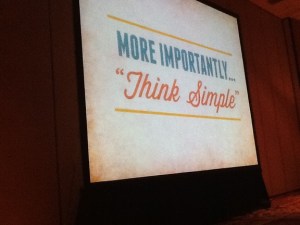
The closing call was ‘If interaction is not embedded in the process then it won’t get done’ with a plea to ‘think simple’.

Jason is a good speaker who puts his points across with energy and simplicity. I took away a clear message that too many HR professionals see technology as something that isn’t really their thing, but a box that needs to be ticked. Clearly everyone in the room used technology constantly in their personal lives and there shouldn’t be a disconnect when it comes to embedding it in the workplace.

My view is that the things we look for in the technology we use in our personal lives – ease, relevance, convenience, enhanced experience – should also apply to the technology we use in our working lives. Technology should not be a barrier to getting work done but should be an enabler to getting a better job done. As Jessica Merrell tweeted ‘innovation & technology change isn’t just the vendor’s responsibility – amen!’

Laurie Ruettiman’s blog on the automation of HR is worth a read – ‘you might want to think about understanding the technology that’s about to upset your apple cart. If you know your enemy, you can destroy it’

After all, it’s never really the computer that says no….