21st Century Vacancy, 20th Century Recruitment Process

Steve received many email notifications of LinkedIn messages, most of them spam, but this one grabbed his interest immediately. It was from a recruiter who worked for a leading global digital brand in his industry and said that his name had been recommended for a specific role she was recruiting and that his profile looked as if he was someone worth talking to. She attached a brief job spec.

Minutes later they were talking, the recruiter asking questions about his blogging and speaking, project work and experience of social campaigns. She told him that the role she had was a new one, the first time the business had created such a position. It was part storyteller, part brand advocate and evangelist, creating content and being the social face of the brand in the UK and Europe. He would be doing outreach and networking. The background wasn’t important, what was needed was someone who knew their industry and was known in their industry. A credible advocate who would bring the brand to life, make it live and breathe in the social space, stand up at conferences and be a quotable expert for the digital business news sites.

She said that his record in digital marketing spoke for itself. He was highly rated, always appearing on lists of people to follow, his content was creative and from what she could see he knew the industry. If he was interested then she wanted to recommend an interview with the hiring manager.

He told her that he was interested, that it was the kind of role that he was looking for, and she said great! The first stage would be for him to email over a CV.

A CV?

Yes, we’re going to need a CV so the hiring manager can see what you’ve been doing

But it’s there on my profile. It’s all public. There are links to presentations, videos of me being interviewed and presenting, blogs I’ve written and a couple of downloadable white papers. Testimonials. Happy for the hiring manager to contact anyone on there for a reference. Surely for this kind of role that’s everything you want to see

It’s definitely important but the hiring manager won’t agree to interview you until he’s seen a CV

Steve was concerned. Did they really understand this role? Everything they wanted was there, surely that should be enough. If they liked what he did then why wasn’t the interview about culture and vision, looking at brand alignment and whether he was the right person to personify their story. Still, he wanted the job so a CV it would have to be. Perhaps it was their culture. The recruiter said that it only need be a brief overview.

************

The first interview was over the phone and lasted half an hour. It started with the hiring manager asking Steve to talk through his CV, going back about 10 years. It was frustrating as most of the period before 4 years ago was irrelevant to this role, but Steve duly obliged and answered numerous questions about things he had done in a totally unrelated marketing role 6 years earlier.

The conversation moved on to Steve’s more recent track record but it soon became apparent that, beyond reading the CV, the hiring manager had done no background checking. She was oblivious to anything Steve had done that wasn’t on the brief CV. Hadn’t the recruiter briefed her?

They talked about the industry in general and Steve gave his take on mobile and social, customer behaviour and expectations. The hiring manager was impressed “There’s a lot about you that’s not on the CV” she said. Steve explained that the CV was meant only as an overview and that his LinkedIn profile and personal website was where the real information was. “I’ll make some time to have a look“.

The call ended positively and Steve gave his feedback to the recruiter first thing the next morning. A couple of days later he heard back that the hiring manager’s boss wanted to Skype interview him. This was great news. He spoke to the recruiter about prep and was told to do more of the same.

The Skype call started with pleasantries, the lady seemed friendly and approachable and, holding up a copy of Steve’s CV she asked him to talk her through it, explaining what he had been doing for the last few years. Steve’s heart sank. There was so much he wanted to talk about, so many possibilities that he could see in this role that he wanted to share, but here he was again talking about a digital marketing role that he did over 6 years ago and which bore no relation to the role that was being recruited. He had checked the interviewer’s LinkedIn profile and found it quite bare. She wasn’t a noticeable social media user and a Google search returned no mentions or links of any interest.

Still, he was as passionate as he could be. The questions were fairly similar to the first interview, in fact it didn’t seem that any notes had been passed over so much of it was repetition, but Steve felt that there was some good rapport and the interviewer agreed with a lot of what he said. It ended on a positive note.

************

Once again Steve fed back positively to the recruiter, but this time there was no response for over a week. He thought this was strange, given profile of the business, the importance they had placed on their reputation, and their keenness to employ someone who would live, eat and breathe the brand. Surely they should be doing more to keep him enthused and engaged, and even if they didn’t think he was the right person, they had acknowledged his reach and influence so he assumed would still want to keep him as an advocate.

Eventually he heard back. The previous interviewer wasn’t sure that Steve had enough experience, he seemed light on relevant content. But Steve had loads of it, there were links on his CV, his blog site was full of information, videos and slide decks were available. Why didn’t she ask him more about it if she wasn’t sure? The recruiter admitted that the interviewer probably hadn’t checked all that out (again maybe its part of their culture he thought…worrying) but was recommending him for the next stage – a Skype interview with a global VP of digital marketing, who was based in the US and had a busy diary, necessitating Steve to have his interview at 10.30pm one evening.

The recruiter recommended that Steve prepare a supplementary schedule to his CV detailing all relevant content, presentations, videos, blogs, lists, white papers and testimonials, with links. This he did, ensuring it was as detailed as possible; he wanted there to be no doubt this time that he was a serious player.

************

He logged in to Skype at 10.25 and within a minute a connection was established with his interviewer’s PA, who explained that the interview would start a couple of minutes late as the interviewer was wrapping up a previous call. A couple became five, and then ten and Steve felt his eyes beginning to close. It was very late now to start. Eventually after almost fifteen minutes there was lift off. No apology, or reference to Steve having been kept waiting, but there was thanks for agreeing to talk so late. And then it was question 1

Thanks for sending through a copy of your CV. Why don’t you talk me through the last few years and let me know what you’ve been doing

Once again Steve’s heart sank but he didn’t let it show. The first ten minutes were pretty much a repetition of the previous two interviews, same questions and same observations. It was becoming clear to Steve that the best conversation he’d had was his first with the recruiter. There was no CV and all the questions were about relevant work that Steve had done that she had seen online.

So you’ve sent me through some other information. Tell me about it” The interviewer held up a copy of a two page printout and Steve started explaining what it was and why he had produced it. “Ok, I’ll take a look at it after our chat

Steve’s heart couldn’t sink any lower. He had so much he wanted to get across, so much to add, but he never seemed to get the chance. He was asked who he thought was doing good things in the market, what were some of the upcoming trends he felt important, and he certainly felt that he gave as good account of himself as he could on those questions, but it was really one-way conversation. He asked questions about the role, tried to get a feel for what the global VP was thinking, but got the distinct impression that his interviewer’s mind was wandering elsewhere. Either that or he didn’t really understand the role himself and wasn’t sure what they ought to be looking out for.

The call ended at around 11.20pm and Steve promised to feedback.

************

He spoke to the recruiter first thing next morning and fed back positively and she promised to get back to him with feedback as soon as possible.

But in the end it took 10 days, and it was a no. Actually it was an ‘it’s not you it’s us’ call. They didn’t really know what they were looking for but they were pretty sure that Steve wasn’t it.

He told her of his disappointment with the process, that no-one had really taken the time to check him out or given him the opportunity to explain what he could really do, how even at the fourth interview he was still talking about roles from ten years before as no interviewer had properly read his CV in advance, that the best interview had been the first with her as she was the only one who had any idea on the scope of his experience and what skills he could bring.

She said that she would pass the feedback on.

Its OK” Steve said “they can read it for themselves. I’ve just left my feedback on your Glassdoor profile

************


Just Another Massive Monday

It started with Blue Monday. Not the New Order song, but some pseudoscience, with a complex mathematical formula, created to try and sell holidays by convincing us that one of the Mondays in January is the most depressing day of the year – due to be the 26th this year. Few take much notice of it now.

Recruiters don’t like to be outdone so we have our own version – Massive Monday. Its the first Monday of the year when everyone and their mother returns to work to start searching for a new job. And the evidence? The UKs biggest job board say that it’s the day that they get most traffic. Interestingly it’s also the same day they usually launch their new TV advertising campaign – this year is no different. Having worked for a job board I can vouch for the fact that a new burst of TV advertising produces a big spike in traffic.

Supposedly its the day we all look for new jobs. Or its the day we all quit our jobs. Or is it the day we switch jobs?

This year the Massive Monday bandwagon was rolling early. Reed themselves have a book to promote. And in a first you can now pay for a Massive Monday report, which will let you know which of your staff are likely to look for another job on the 5th January – and what you can do to keep them.

The first Monday of a new year for most recruiters isn’t traditionally about floods of applications but more than likely involves checking that all new starters have started, interview processes that were ongoing before Christmas are still moving ahead, candidates who had accepted offers before the break haven’t changed their minds, live briefs from late last year are still live…and many more such pressing concerns.

The Massive Monday noise sounds very outdated. Recruitment is no longer about driving volume applications, whilst job hunting is more nuanced than a knee jerk search of job boards to find lots of roles to apply to.

The pressing concerns for recruiters are pipelines, employer brand, hiring manager expectations, dealing with skill shortages, candidate experience, streamlining the application process, developing new routes to market. Reinventing talent acquisition. For agency recruiters it’s also about becoming a strategic business partner, knowing their market, offering insights and perspectives, being part of a tight supply chain, building networks.

New Year New You? New Year New Career? Massive Monday? All sounds like a bygone era.

Recruitment’s evolving. It’s about time the job hunting narrative did too.


(Image via John Rensten)


Are You Really Recruiting Socially?

My first tools in recruitment were a phone and a rolodex. I used them a lot but never said that I was telephone recruiting. My first MD had previously invested in a fax machine but regarded it as the devils own work come to wreck the recruitment industry so always discouraged us from using it. If anyone did they never said they were fax recruiting. Some candidates would put their CVs in an envelope with a handwritten covering letter and post it to us, clients would similarly send job description through the post, and some recruiters would also mailshot their clients with a selection of CVs. If placements occurred no-one called it postal recruiting.

But then the internet came and changed everything. We had emails, websites and job boards and were now internet recruiters or e-recruiters – because this was different but also a distraction. Funnily enough this approach is now just called recruitment, in fact it’s what most people would now refer to as ‘traditional recruitment’.

And then we got social.

Now the digital platforms would have us believe everyone is doing it. The latest Jobvite survey (an online survey completed by 1,855 recruiters and HR professionals) found 93% of recruiters using or planning to use social to support their efforts. But is this right? The recent employer perspectives survey from UKCES (drawn from 18,000 interviews with employers) found only 7% citing social as a recruitment channel. Whilst recruiters may not be well represented in this report, SMEs and smaller businesses – employers of around half UK employees, and unlikely to have specialist recruiters to complete online surveys – are.

So are we really doing that much social recruiting?

Well it depends on what you call social. Looking at the Jobvite results then their 93% only stands up if you regard LinkedIn as a social network…


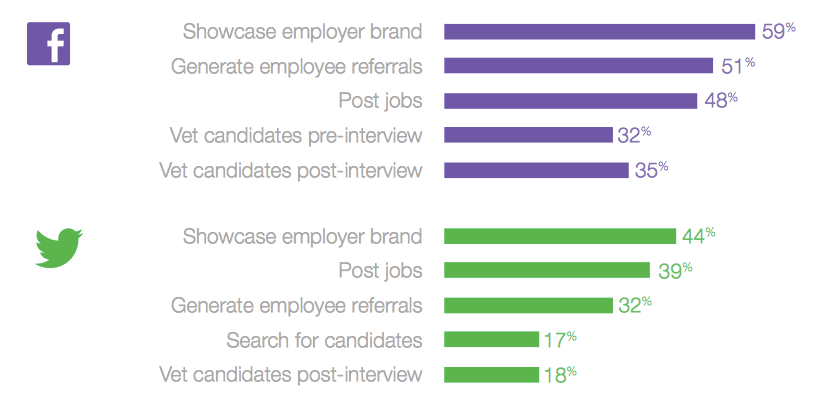
Some might see it this way, but I don’t. It’s not a social channel but a content publishing platform. A database. And look at how these recruiters use LinkedIn…


Makes it about as social a a CV database – which I’m sure no-one would ever really call a social platform. Searching, tracking and vetting aren’t social. More talking less stalking required.

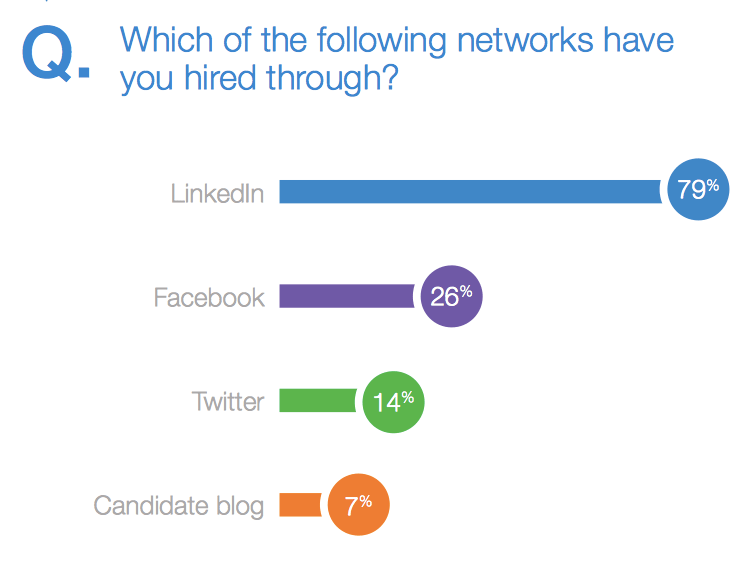
If we take away LinkedIn then recruiters don’t look quite as social as the 93% figure would have us believe. But how successful are the networks for hiring?

So LinkedIn gets results, as any database of more than 300 million people should. Not so good for Facebook and Twitter though…maybe it’s because of the way recruiters use them?


Showcasing and posting, instead of engaging and relationship building. At least there are mentions of referrals – as there should be given they still provide a large number of hires, particularly in the US – but then with enterprise social networks like Hollaroo there are possibly more effective ways to manage them.

Social recruiting is recruiting. Social networks can enable you to recruit well and more effectively. The bedrock of effective recruitment will always be understanding why you need someone new, what they will be doing, why you need to look externally, what exactly you have to offer the right person, whether the person you want will be happy with what you have to offer them, and lots more.

And once you know that then it will be about having the right conversations with the right people at the right time about the right things. Social should be enabling these to happen.

Everything else is just broadcast and advertising. Not very social.

Brand New Year. Same Old Recruitment Content?

In each of my many years working in and around the recruitment industry it’s always been the same old story as you put the Christmas presents away and turn your attention to all the different things you resolve to do in the new year – recruitment businesses in almost every sector dust down the ‘New Year, New Career‘ message.

It used to be print adverts, created in October and November and booked to appear in the first issues after Christmas. Then it was by email – actually I still got a few of those between 27th and 31st December this year. And now it’s on social media channels thanks to hashtags like #NewYear #NewCareer.

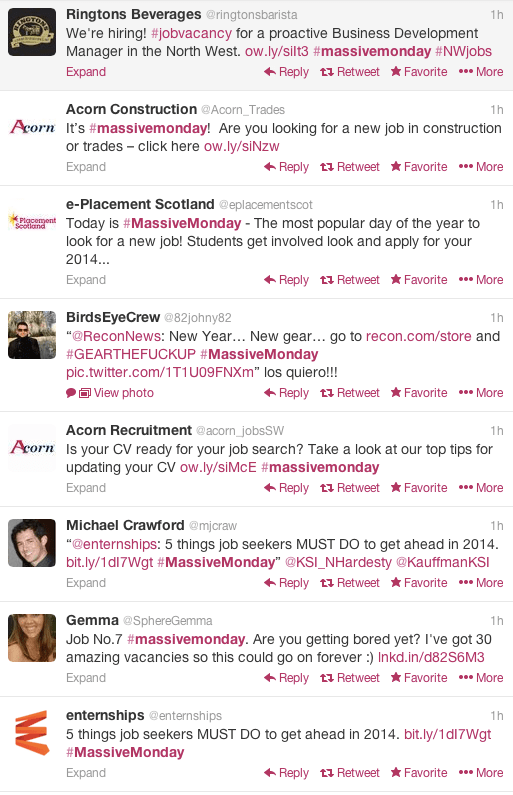
More of that later, because now we also have #MassiveMonday – the first Monday of the New Year when record numbers of people supposedly visit job boards and other digital recruitment sites. And hasn’t this hashtag taken a hammering this year – here’s just a few minutes worth of Twitter…all summed up with the ‘are you getting bored yet‘ tweet from an award winning digital marketing recruiter. Great message to their community!


So where does #MassiveMonday come from? Certainly in my years as a billing recruiter there was no surge in applications on the first Monday of the New Year. In fact the main things bothering recruiters straight back from a Christmas break were usually – Which clients are recruiting now? Who’s looking to interview straight away? Have the new starters all started? Has any client or candidate changed their mind over Christmas?

A quick search of Google to trace the origin leads you to a press release from Reed.co.uk as the primary source of all the #MassiveMonday stories in the print and digital media. They usually get more traffic on the first Monday of New Year. Not surprising really as in recent years that’s been the day on which most of the main job boards have started TV campaigns…which is the reason they get increased traffic.

No new insight, nothing of any real interest to candidates – they want an increase in job openings not CVs!

So what about #NewYear #NewCareer??

Well, what is a career?

An occupation undertaken for a significant period of a person’s life and with opportunities for progress

Now this can be a vocation or trade, or it can be a series of roles (possibly all in one or two companies) which should attract increasing levels of responsibility and rewards at each stage. Sorry guys, people don’t spend their Xmas break planning a new career.

A quick look at Google shows that the tumult of recruitment firms and sites that are gratuitously using this hashtag are clearly not attaching them to any roles that seem to imply progress, development or skill enhancements.

Of course people rarely change careers but they do change jobs. Now #NewYear #NewJob may not have the same ring but may be more accurate. After all, we call them JOB seekers and JOB hunters, not career seekers.

Amongst the plethora of New Year predictions for social business, the one constant was that 2014 is the year of story telling and content. The year of effective content that energises and engages, enchants and enlightens. The year where all businesses (and that includes recruiters) ask themselves what their candidate journey is, what are the pain points, where can they add value? What problems do their candidates have and how can they solve them.

Content is a big issue for recruiters this year. As the REC says in it’s 2014 industry forecast:

The challenge in many managerial and professional markets is the growing shortage of skills and talent…we are re-entering a candidate driven market. Successful recruiters will need to develop content that attracts this scarce talent whilst building meaningful relationships that keeps the talent close.

And what do you need to think about when producing meaningful, engaging, shareable content?

  • Quality content is what your clients want to read, not what you want to tell them
  • Content that gets highly shared is content with heart
  • Take time to engage with your online community

So recruiters, let’s get 2014 off on the right footing. Let’s engage our candidates and job seekers with what they want to know and read about. Stuff that addresses their concerns and doubts. Stories that they want to share and be part of. Let’s stop selling them nonsense like #MassiveMonday and #NewYearNewCareer because it adds nothing to their search and says very little about your understanding of their situation.

Fact is, if you got to ask them if they’re getting bored…then they most probably are…

…and there’s no such thing as a boring industry…just content creators who aren’t very creative


If you want to find out more about what good content looks like and how recruiters can use it to source and attract the best talent through social channels then book your place on this one day workshop when ace social recruiting trainer Katrina Collier and myself will tell you how

Can The Candidate be King Again?

Throne

When I first started working as an agency recruiter the candidate was most definitely king. Or queen. Without the best talent at your fingertips, and in your rolodex, you wouldn’t be able to get in front of clients on a regular basis. This helped to create a candidate driven mindset with importance placed on getting to know who was best, who had good training, who was open to something new and who was adaptable, and then the candidates that you helped would always recommend other friends and colleagues to you – they even invited recruiters to their leaving drinks (not always advisable if their bosses were there, as I found out on one occasion).

Clients would speak to you as an adviser, someone who knew what was going on in the market and would often confide future plans so that you could keep an eye open for specific skills. Some of your successful placements would invariably become clients too. The right candidate was often your value proposition. The only metric that seemed to matter was getting the right person.

Times changed and email, hiring boom, graduates needing to earn commission, LinkedIn, RPO, recession, direct sourcing models and now social have all helped to shape the service and change client, candidate and recruiter expectations. Many agencies that have prospered over the last fifteen years have followed a low cost blueprint involving (amongst other things) a transactional sales model, PSLs and volume job orders at a discounted rate.

The candidate has too often gone from king to cannon fodder, usually the last person to know what’s going on and considered needy or too demanding if they expect any more than a basic level of communication – effectively an email grunt of recognition. The individual candidate now seems of low value provided that time to hire and cost of hire metrics are met.

When I first started this blog over four years ago many posts were over the future of recruitment and what needed to change. The comment threads on posts about the transactional sales model, the telephone and relationship building indicate that as the recession began to really bite in the industry there was little consensus over how to move forward.

We’re now three years on from those posts and times have changed.

Last week I saw Kevin Green (CEO of the REC) present on the Future of Recruitment at the UK Recruiter Conference. You can see his slides here.

Starting with an overview of the market, we could see an improvement in vacancy and activity levels, even though they are still some way below the pre recession peak. However there was one rather concerning statistic that must have chilled perm recruiters – over the last year there has been a 12% increase in the volume of permanent placements, but only a 2.2% increase in fees. A lot more work for comparatively a lot less money. Average annual billings for perm recruiters are also running 13% below early 2008 levels.

The culprit was fingered as ‘procurement‘ but I think it goes a lot deeper than that. Attitudes have changed, budgets have changed and for many smaller businesses, agencies are becoming the talent supplier of last resort.

Kevin talked through what he sees as the three models of recruitment success now. Two interested me greatly as I have encountered them both already during my short time job hunting.

Specialist

Specialist

For me the focus on specialist knowledge, access to talent, strong relationships, consultancy and candidate centric behaviours kinda makes this The One Where We Go Back To Recruiting Principles As They Used To Be. The candidate, and market knowledge, is clearly part of the value proposition. To profitably operate this model you need to look after candidates and put them back on their throne! And, coincidentally, the type of agency mentioned in this post from Julia Briggs looking at recruitment from the HR angle.

Low Cost

Low Cost

Here I see the focus as being more operational, centred around process, scale and workforce management. The candidates are probably quite interchangeable and of similar skills, with the business value being in meeting cost/time metrics and managing budgets. I already have some experience of this approach and as the candidate you’re pretty much left to do the work. Light on detail, you fit in with set timeframes and do the chasing if you want any kind of feedback or perspective.

The third model was for smaller, multi-branch or regional generalists. Here the business focus was on SMEs and avoiding intermediaries, PSLs and public sector.

So, can the candidate be king again? Well, it will largely depend on which model you’re dealing with.

Certainly if you’re applying through a low cost operator, or multi branch group, then my personal experience combined with recruiter sixth sense tells me that canon fodder may well be the name of the game still.

However if you can get on the radar of a specialist recruiter who’s doing it right then maybe there’s a seat on the throne again.

Am I dreaming? Let me know what you think…

(Image via @godfather_90 and #IndiaHRChat)

5 Benefits of a Transformational Hire

Much as the ‘War for Talent’ supporters may encourage us to believe it, there is little correlation between the football transfer window and the day to day hiring processes of most businesses. There is one similarity though, in that it focuses the mind of an owner/manager on the teams that they have and how they can be improved.

Whilst football people only get to do this twice a year now, companies do it all year round. Even so, it often pays to take time out to think about what you really need for your team, what special ingredient (ie talent) could make a real change and take you on to the next level.

For some it may be that you just need more of the same – more bodies at the coalface to deal with workflows and production efficiencies. Possibly not an on-going need so some loan signings (that flexible workforce thing) may suffice.

Other companies may need to ship in specific skills and expertise to cover areas where they are weak or may lack the edge over their competition.

Most football clubs will have been addressing these two hiring areas over the last few weeks.

But then there is another type of hire – the Transformational Hire.

I’m guessing that most followers of this blog, and of my social profiles, will know that I’m an Arsenal fan – and it’s their piece of recruitment that has intrigued many over the last few days. Despite having a lack of cover in some of their specialist areas, and a definite lack of bodies in their overall first team squad, they’ve gone and hired a major global talent who will transform them in many ways but doesn’t necessary address some of the key and immediate deficiencies in the team. And I, for one, am really excited about it.

Now I’m not a fan of the ‘5 things recruitment can learn from the transfer window’ type of blog so I’m desperately trying not to write one! But one thing that has got me thinking more is how many commentators and players see this one transformational hire as somehow changing their perception of the club.

So focusing on the hire and not the football – what could a transformational hire do for your business?

Statement of Intent

Nothing tells the market, and your employees and customers, that you’re ambitious more than hiring one of the big guns, someone with a successful track record who is at the top of their game. Acquiring an undisputed talent from your field who shares your vision and wants to be part of it can make others sit up and think ‘Hey, they’ve got their act together. They’ve got a plan

Sending a message to the competition

The chances are that you’ll be hiring someone that the competition wanted. It may well be someone from the competition. It can make others look at you differently. In Arsenal’s case the inference behind Chelsea’s refusal to loan them a player was that after this hire they were seen more as rivals.

Inspiration to existing employees

Undoubtedly many of the younger and emerging players at Arsenal will be able to learn from their new player, but the existing team will also benefit. Most people like working with the best talent, provided the best is someone who has the humility and character to still be part of the team. Whilst some may feel that they will look poorer by comparison, the upside is that others will raise their game, learn and take inspiration from someone new. A new face, particularly one that brings experience, class and a strong work ethic, can galvanise a group of employees, give them belief and help them achieve results they haven’t before.

Talent follows talent

It’s not just the existing employees that are galvanised. Other people in the market will see your business in a new light, as a place where talent can thrive, which enables you to be more bold in team building. Someone who people respect has endorsed your vision. It’s not a coincidence that the last two occasions on which Arsenal ignored pressing needs, confounded expectations and broke their transfer record to buy a fully formed major talent saw the start of the two most successful 10 year periods in their history.

Re-invigoration of consumers

For Arsenal, the signing of Ozil makes commercial sense. He’ll sell shirts and sponsorship deals and put bums on seats. He’ll give supporters who were losing faith something to believe in, handily papering over one or two of the areas that haven’t been addressed. Aside from the legalities of someone taking clients and contacts with them to a new business there’s little doubt that in a competitive business sector, customers and clients often look to where the momentum is, the ideas and creativity, and a transformational hire can certainly bring this momentum.

But, a word of caution

Not every transformational hire works out. During my years as a recruiter, particularly in the recruitment to recruitment sector, I saw many ‘top billers’ and outstanding performers join a new business and flounder.

The infrastructure and support at one company may help some achieve great things, but then they can move to a different one and the same may not happen. The culture and values need to be right, and the reason for the hire must be one that builds on and enhances what is already there. It can’t be relied upon to paper over the cracks and keep an underperforming team afloat.

And these hires take time. The person who could transform your team almost certainly needs to be identified, courted and nurtured. You can’t rely on their CV being emailed your way.

And finally, whilst my enthusiasm for Mesut Ozil is getting me carried away here, let’s not forget that transformational hires need not necessarily always be about the most high profile talent. The Arsenal team that had much success between 1987 and 1994 did not need a big name for a spark…careful hiring of the right catalysts inspired a primarily young group of players to reach great heights.

So go find the transformational catalyst for your business…

Time to End Talk of This Phoney War

And so the dreaded expression ‘War for Talent’ rears its head again on my twitter timeline. You know some of the context…

  • Salaries at some levels are increasing, it’s because there’s a war for talent
  • Companies can’t find the skills, it’ll create a war for talent

Never mind that there’s abundant talent out there waiting for an opportunity; a willing workforce only a few days or weeks’ training away from filling that ‘skills gap’.

I’ve given my opinion on the gratuitous use of this phrase before here and here but there seems to be a never-ending need to talk up a lack of creativity and vision in talent acquisition as a phoney war.

So I’ve turned to source material – the book that the original authors of the ‘War for Talent’ report published in 2001. In it they put forward the case that winning the war for talent isn’t about frenzied recruiting tactics but the principles of attracting, developing and retaining highly talented managers, which will be applied in ever evolving ways.

Next time you think of using the phrase read this and think again…

“Excellent talent management has become a crucial source of competitive advantage.

Companies that do a better job of attracting, developing, exciting and retaining their talent will gain more than their fair share of this critical and scarce resource and will boost their performance dramatically.

Our War for Talent research shows this. The companies that scored in the top quintile of our talent management index earned, on average, 22 percentage points higher return to shareholders than their industry peers. The companies that scored in the bottom quintile earned no more points than their peers.

Certainly, many factors other than talent management are driving return to shareholders but this data provides compelling evidence that better talent management results in better performance.

Clearly, having more capable people isn’t the only thing companies will have to do to win. They will also have to set high aspirations and enact the right strategies and performance initiatives. They will have to energise and align all their people so they deliver their best performance. But talented leaders are needed to make these other performance drivers happen.

As companies respond to the war for talent, they will develop more powerful and more sophisticated approaches to talent management. Over the next decade we believe talent management will advance as far as marketing did in the 1960s and quality did in the 1980s. Some companies will advance in building this capability; others will fall behind.”

It’s a mind-set not an act. It’s about creating a business that aspires to give the best a place to thrive and be happy. It’s not about throwing money at people and it shouldn’t be an excuse for a lack of training and up-skilling.

A recruitment campaign devoid of strategy, creativity and transparency isn’t a war. It’s a resounding defeat.

The Year of Recruiting Sensibly

Thumbs_up

I had a lot of fun putting together my last two blogs – an allegorical fable about impulse recruitment, poor on-boarding, weak management and blinkered selection criteria – which drew from many scenarios encountered during my years as an agency recruiter, and from my current day to day interactions with job seekers.

There were some serious points to be made about mistakes and frustrations in the recruitment process, which I wanted to cover in an illustrative way. I’ve now listed some of them below…they may bring a bit of context to the story of Frank the Fish.

So as we begin a new recruiting year, let’s be sensible. This is what I want to see more of…and I know that every job seeker would like to see more of it too:

  • Properly defined recruitment brief. The why, the how, and the who of a perceived vacancy should be carefully thought out, budgeted and planned for. Knee jerk hiring decisions rarely produce long term beneficial results.
  • Robust on-boarding and assimilation. Once you’ve identified the person then how are you going to bring them in and get the best out of them?
  • Effective management. Who will manage them? Do they fully understand what the business wants from the new recruit? And can they incorporate them in a team or division that may not understand the rationale for the hire?
  • A proper plan for success. How will you measure whether it’s working out? Have you managed the new employee’s expectations…do they know how you will assess, manage and monitor them, and what is expected of them. And what will happen if they don’t measure up, or if something unforeseen happens to casts doubt on whether you need them.
  • Consider an ex-employee. So many companies close the door to re-hiring even when one of their alumni may be the most suitable candidate available. I tried to put a few clues in the story to show that Frank’s company hadn’t properly replaced him. Humility can be more potent than pride…on both sides.
  • Look at the person, not just the CV. This is not a new problem, but it seems to cause the most frustration. It may have seemed a stretch in my story to infer that companies wouldn’t consider Frank because of the previous 3 months, but unfortunately it isn’t. It’s a familiar tale. Look at what someone can bring in to a business, don’t try and second guess their current mind-set or skill-set based on recent events.

And one last thing.

Every person you hire is part of another network – friends, family, alumni and online connections. This network plays an important part in the decision and they will be affected by the decisions that you make about the employee. Each candidate will have their own motivations, commitments, concerns and goals.

I’m not absolving them of their obligations in a new role, nor suggesting that a poor hire is kept on for the sake of their kids, but suggesting a little sensitivity about someone’s situation before the decision to hire – particularly if there is some doubt over fit or the long term viability of a role. The ramifications of unsuccessful recruitment are felt by many, so maybe more care is needed to get the match right.

Let’s recruit sensibly this year…and get the best results for everyone.

The Tale of the Fish and the Bicycle – Part 2

[In Part 1 we heard about how Frank the fish had started working for a rival company. We pick up the story as he goes home to tell his wife about his pending transfer to the cyclists’ team]

*********

You can’t be serious Frank!!’ His wife was crying; she was frustrated and scared. Her job at the farm had gone and she was only able to get a few hours’ work filling in at another farm.

How are you going to ride a bicycle?? And not just ride it, but ride it fast? What about all the things you’ve told me about the other cyclists. How they don’t like to spend time with the customers?? You’ll never be able to do it. You’ll have to try and get your old job back’

‘I can’t‘ said Frank ‘I saw one of the old guys after work. They’ve trained up a new fish and he seems to be doing well. They don’t need anyone else. Let me give it a go…it may be good for me. Maybe I can ride a bicycle after all. The HR manager said they’d give me all the help I need over the next three months…’

THREE MONTHS!‘ his wife shouted ‘You’ll never master it in three months‘.

Well that’s the time they’ve given me. I’m not thinking about what would happen after that. Met my cycling coach today, he told me it was all in my mind. That if I really put all my positive energy into thinking like a cyclist it would happen…’

**********

It was a harsh autumn on the Island. Hard enough for the regular cyclists who were used to bad weather, but for a fish it was almost impossible.

Frank tried. He tried very hard. He had to change coach after a few weeks as the original one got himself a better assignment with Frank’s old company coaching the fish in customer engagement techniques. He put in a good word for Frank but that door was closed.

Frank’s new coach believed that anyone could achieve anything and spent ages getting Frank to concentrate on the tyres going round. When that didn’t work he got him to focus on the people at the end of the journey ‘if you feel their joy at seeing you it will inspire you‘ he used to say.

But it was all to no avail. The end of Frank’s three months came and he went to see the Regional Director and the HR Manager. They explained to Frank that they had given him all the support that they could but that he hadn’t been able to meet his target to be an operational cyclist. He argued his case that he had met his targets when he was swimming but they said that wasn’t relevant to this assessment meeting.

It’s only four weeks to Christmas‘ he pleaded ‘the busiest time for you. Let me deliver parcels by river. I’ll swim night and day; I won’t stop to talk to the customers. Just let me show what I can do for you‘.

They told him to wait outside whilst they had a short meeting but at the end of it they told him that his position was terminated. It seems that there were also cultural issues; that he didn’t really seem to fit in with the other cyclists.

We’ve invested enough time and money trying to get you up to speed here Frank‘ said the Regional Director ‘we’ve been more than fair to you’

**********

Frank hadn’t realised that because his termination was down to poor performance then his notice period was only 1 week. He hadn’t really read the contract before he joined as the Regional Director had been so persuasive about his vision for a two tier offering. The clause about 3 months’ notice for his role at the premium service, but if that was closed his contract would revert to a traditional cyclists contract had passed him by.

He promised his wife he would move boulder and driftwood to get a new position. He knew that he would have to get a job on the adjacent Island but at least there was work there. Some new village communities had been built and they had just expanded the Port. There were also many more delivery companies than on his own Island.

**********

I don’t understand. You were a swimmer but then you decided to become a cyclist. Why?’ The recruitment consultant who was interviewing Frank seemed very perplexed. Frank had already explained twice about how Parcels4U had changed their business model, and how he wanted to show he was a fighter, a resourceful fish who could overcome any challenge (surely exactly what a new employer would want, he thought) but the recruiter still didn’t seem to get it.

I’ve got jobs for swimmers but they want people who are swimming at the moment, not slow cyclists who want to swim again’ he said.

Can’t you just forget the last few months and explain that I was the top delivery operative at my previous company. That I was headhunted by Parcels4U to head up their new premium service but that they changed their business model and only had a job for a cyclist’ Frank was getting exasperated. This was the fourth of fifth recruiter interview that he had sat through this week and they all went the same way.

Look Frank, I’ll try to explain. It’s a Catch 22 type thing. Most employers are interested in what you’ve been doing most recently, and for you that’s cycling. To get round that we have to say that you tried it as something different but you really want to swim. And they will say to me – Why? Why would a fish want to try to ride a bicycle? If I say that the company made you then they would want to know why you didn’t just leave. If I say that you wanted to take on the challenge then it looks like you wanted to try something new so your commitment to swimming is in question. It’s a very competitive market out there. They want either swimmers or cyclists and you’re, well…you’re kind of in the middle now. Do you understand?’

No, Frank didn’t understand. He couldn’t understand. He was the number one delivery fish on the Island and less than 6 months later he’s a has been. Washed out. Of use to no-one.

Why don’t you freelance?’ said the recruiter in a Eureka moment ‘I may be able to get a client interested in you on a pay as you swim basis’.

Frank was unsure but went for the interview. He got on very well with the interviewer, who happened to know one or two fishes from Frank’s old company. He said that he knew of Frank’s reputation and he felt sure that there was room for someone of Frank’s experience in the company. He even talked about giving Frank a month’s trial after which he would take him on permanently, not on a freelance basis. He said that he would speak to HR and get back to Frank the next day.

But the next day became the next week, and Frank found himself contacting the recruiter every day but was unable to ever get through.

And then he heard from the company. The HR Director wanted to meet Frank. The original interviewer said that he felt it should be a formality but that the HR Director would need to be convinced that Frank was focused on swimming and that he hadn’t tried cycling because he had lost his swimming mojo. It was important to the company that every hire was effective.

By it was now almost Christmas and the interview wouldn’t be taking place until the New Year.

**********

Frank and his wife talked to their children that night and explained that there wouldn’t be any Christmas presents this year, but that if Frank got his new job then there would be New Year presents. The children understood. They had taken it well and had been making things at school to help cheer Frank up. He really liked the Christmas card they made him and their attempt at painting a picture of him holding a ‘Delivery Operative of the Month’ award like he used to win at his old company.

The fishes faced an uncertain few months but were drawing strength from their friends and family who had rallied round and showed support. Some of Frank’s old customers, who really missed his regular visits, had started a collection and they had bought him and his wife a Christmas hamper.

So will Frank be able to overcome objections and prejudices, show that he is a focused delivery operative who can add great value to a new company, and be able to buy his children New Year presents?

That, dear readers who earn a living in HR and Recruitment, is for you to decide……

The Tale of the Fish and the Bicycle – Part 1

Once upon a time, on a distant Island, there lived a fish called Frank. He was a very sociable fish, who loved swimming and meeting people.

The Island was a lovely place to live. It was self-sustaining and had a small number of village communities all situated at one end. In the middle was a large hill, and on the other side a port where all the nice things that the Islanders couldn’t grow or make for themselves were delivered.

If you didn’t have a particular craft yourself then there was work delivering the parcels and packages that came into the port.

Frank worked for a small business that delivered parcels. As they only employed fish, they had to use the river that meandered its way around the hill. To compensate for not having the fastest delivery service (the river did meander quite a bit) they made sure that they employed people who took pride in spreading happiness. You see, the fish that started the business had realised that these parcels bought something good and happy into people’s lives and he wanted delivery fish who could be part of that experience.

Frank loved this part of his job. People were so happy when they saw him swim up to their homes or businesses, as they knew that he would be bringing with him something they wanted. It could be a DVD, book or CD, some clothes, or even a voucher to try out a new restaurant in the village.

When he was small, Frank had watched lots of episodes of Postman Pat and he now saw himself as a similar character, an important member of the community, enjoying his work, and bringing happiness in to people’s lives.

The biggest rivals to Frank’s company were called Parcels4U. They were a very different kind of business, hiring the strongest and fastest cyclists to do the deliveries.

Whilst Frank’s company were able to charge more money per delivery, as they believed they were offering much more than just the delivery, Parcels4U charged much less. They believed that the important part was getting the parcels there quickly, so they employed cyclists who could navigate their way around the hill as fast as possible.

**********

The Regional Director of Parcels4U who looked after their operation on the Island was not happy. His bonus had been reduced as he had missed one of his key metrics. One of the findings from the annual customer satisfaction survey that his company conducted in every region was that, whilst Parcels4U were praised for the speed of their deliveries they came out very low in the ‘service you would recommend to a friend‘ category.

He was in a meeting with his Delivery Operatives Manager for the Island. Neither was happy, as neither could see quite why the company had placed so much importance on this metric. After all, their company statement, which was pinned to the wall of every room, clearly stated ‘The Fastest Service You Can Get. No Hill Too Big‘ – nowhere did it mention being nice to the customers. If the customers were too lazy to go to the port and pick it up for themselves then what did they expect.

If we give them a bonus for being nice to people instead of how many deliveries they complete in a day then they will all leave‘ said the Delivery Operatives Manager. ‘They’re athletes who train hard to be fast cyclists and like to be rewarded for that.

The Regional Director was staring out the window, ironically at the River which ran past their offices. ‘OK, we don’t want to unsettle them. I’ve got a bit of flexibility in the budget so why don’t we hire one of the fishes and set up a bespoke service? It will pay for itself. I’m sure we’ll be able to charge a lot for it. If they want a slow service with a smile at the end then they can pay for it

And so the plan was hatched. Find out who the best delivery operative fish was and make them an offer.

**********

Frank was quite flattered, and more than a little excited, to get the call. He swam home quickly to tell his wife and children.

‘I’ll get more money, my own team, and a real challenge to make a difference. Just think..‘ he was talking quickly and enthusiastically ‘…how great it would be for me if I was the fish that got Parcels4U known for a giving a great service‘.

His wife wasn’t so sure, but with her job at the neighbouring farm looking in jeopardy the extra money would come in useful ‘OK then‘ she said ‘if you think you can make it work, why not go for it!

She gave him a big hug and they made plans for a short family holiday during the time off he would have between jobs. Continue reading “The Tale of the Fish and the Bicycle – Part 1”