4 Questions About Talent and Technology

It’s nearly time for the HRTechEurope Spring Conference & Expo. I’ll be heading in to London on March 27th joining HR and Recruitment professionals, tech specialists and fellow bloggers to try and find out what’s old and what’s new, what we need and what we don’t.

It’s currently tough out there in the world of HR when it comes to talent acquisition. On a daily basis we’re fighting wars, covering skill shortages, putting a sticking plaster over long term people development and tearing our hair out over how to create the workforces our businesses need to face a future of growth and accelerating technological development.

Or so it seems. Rarely a day goes by without another report, white paper, survey or opinion piece on the huge challenges of creating the future workforce. They need to be highly skilled and motivated, locationally and contractually flexible, and ready to hit the ground running.

But this isn’t a perfect world, and people aren’t disposable goods to be chopped and changed. Instead of the constant and seemingly frenetic rush to get the best right now let’s look at some longer term issues that short term talent acquisition strategies may be covering up…

Are You Looking Everywhere?

By everywhere I mean everywhere. As I recently wrote for Monster, there’s a lot of talent right under your nose that you’re probably overlooking. Most probably…

  • Current employees who have skills and strengths that you haven’t recognised and can adapt to new challenges
  • Alumni who have moved on, had different experiences, gained knowledge and progressed
  • Candidates who have applied before and were not a good match then, and are now probably nestling in a black hole in your ATS hiding their very relevant talents
  • And remember, all the above have friends, collaborators and alumni who may be right

Is Your On-Boarding Good Enough?

We all know that if something’s going to go wrong then it will more than likely happen in the first 2/3 months so are your on-boarding and induction processes up to scratch? Is talent seeping away from the business because you’re not making the most of it when it first arrives? Think back to good people who just didn’t seem to work out with you and look at why. There may be a recurring theme.

Are You Growing From Within?

The people you’ve already invested in should be the first choice for new roles. My first job was within a medium-sized accountancy firm and we had PAs to Partner who had started as filing clerks (OK, you don’t get many of them any more) and accounting assistants who had originally joined in a clerical or admin role. The partners constantly tried to invest in developing the good, loyal people they had rather than demotivate and lose them by going outside. Do your people really feel that they have a future with you?

Have You Created the Right Environment?

To nurture talent you need a nurturing environment. One where people aren’t afraid to try and fail as part of the learning experience, and aren’t rewarded purely on achieving KPIs that preclude the opportunity to collaborate, innovate, share and provide feedback.

If the solution to filling new positions is always to go external and throw money at someone who’s performing at a competitor then this will become a self fulfilling modus operandi which will be difficult to break. And dangerous too as top achievers in a business usually benefit from a support structure and culture that enables them to do their best; there’s never a guarantee that they would achieve the same results in a different environment that offered a very different structure and culture.

There will probably be a lot of technology at HRTechEurope that can help enable this, but first it needs a mindset. A commitment to doing something fresh, an openness to new ideas and approaches.

Because to keep fighting the same mythical wars and keep moaning about shortages and expect to get different results would be insanity. Right?

(Image via SAP.info)
#HRTechConf – We’re All Technologists Now!

HRTech

The final keynote at the recent HR Technology Conference was from Jason Averbook, who delivered an overview of HR technology – where we were, where we are now and where we should be going.

His rallying call was that we need re-imagination – we’re getting bright shiny new technology but we’re doing old school things with it. To emphasise this point he ran through 5 generations of technological development, the 4 different eras of what we’ve called HR, and concluded that despite all that change we’re still basically doing what we’ve always done.

He also had news for the HR professionals who think that technology isn’t for them – We’re all technologists!Do you call IT when you want to search Google?” he asked. “Who keeps their smartphone nearby when they go to bed at night?” got a clear majority show of hands.

Another show of hands revealed that only 5 people in an audience of many hundreds were from the payroll function, yet payroll is usually the first HR process that we get technology for. A couple of comments on the twitter channel questioned whether this was because the process didn’t innovate – but I’m not sure that’s true.

When I first started work I got paid cash on a weekly basis, then by cheque on a monthly basis, and more recently by direct transfer. I used to be given payslips with my cash/cheque but now I have to log in to a system to find them. And because I don’t do it regularly I invariably have to reset passwords – coming up with a new on each time! Payroll evolves much the same as any other process, yet where were the specialists at this show?

Jason also touched on the irregularity with which people interact with their internal technology. He asked when we last got married, had a child or moved house, as these are three key events when we will interact with the HR technology at work. Clearly for most people these events happen very rarely – maybe every few years – giving them little reason to interact with that technology, yet most HR professionals will complain that employees aren’t using the tech. Again you need it to do different things if you want more interaction.

The importance of measuring for now was another key point. Performance reviews, engagement, development are all measured and reviewed historically, yet employees are more interested in what’s currently happening. The technology for real time measurement is available so why not use it for now as opposed to what’s already gone.

Some other points that Jason covered:

  • People come to work and expect to get connected, most people keep their phone within 3 feet at all times of the day and night, yet we often deny them that connectivity.
  • If you go to a website that sucks, you don’t stay on it for too long. But do you ever go back to see if it’s better? Probably not, this is why businesses need to get their tech right.
  • For possibly the first time consumers now have better technology than businesses do. Expectations are raised.
  • The Cloud doesn’t change cultures – it’s just a delivery mechanism.
  • Give them real time access to social channels – or they’ll post on Glassdoor!
  • “HR sucks at simple”. Contentious, but it got a reaction.

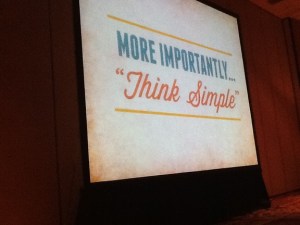
The closing call was ‘If interaction is not embedded in the process then it won’t get done’ with a plea to ‘think simple’.

Jason is a good speaker who puts his points across with energy and simplicity. I took away a clear message that too many HR professionals see technology as something that isn’t really their thing, but a box that needs to be ticked. Clearly everyone in the room used technology constantly in their personal lives and there shouldn’t be a disconnect when it comes to embedding it in the workplace.

My view is that the things we look for in the technology we use in our personal lives – ease, relevance, convenience, enhanced experience – should also apply to the technology we use in our working lives. Technology should not be a barrier to getting work done but should be an enabler to getting a better job done. As Jessica Merrell tweeted ‘innovation & technology change isn’t just the vendor’s responsibility – amen!’

Laurie Ruettiman’s blog on the automation of HR is worth a read – ‘you might want to think about understanding the technology that’s about to upset your apple cart. If you know your enemy, you can destroy it’

After all, it’s never really the computer that says no….

What I’m Looking For at #HRTechConf

I’ll be spending the next few days at the HR Technology Conference – the first time I’ve been able to go.

I’m lucky enough to be part of the blog squad so have been thinking about what new trends and innovations I’ll be looking for.

In recent months I’ve been at a recruiting leaders round table, as well as two FIRM (Forum for Inhouse Recruitment Managers) conferences, and at all three events current recruiting pain points have been discussed. Invariably they are very similar, whichever group of delegates has been bought together. The key ones, unsurprisingly, have been:

ATS – specifically how to get one to do what you want them to do
Creating a positive experience for everyone who applies
Reducing the volume of unsuitable candidates tied in with better screening
Talent pipelines
Improving internal mobility
Difference between generating names and creating candidates
Hiring for potential vs hiring for now

Many of those are linked to technology so wearing my recruiter’s hat I’m going to be looking at how tech suppliers can help ease that pain. And how they can give a better experience to applicants and candidates.

From an HR perspective I’m keen to see how the employee experience can be enhanced. From attraction and nurturing, through on-boarding and performance management to internal collaboration, personal development, promotion and succession, I’ll be interested to see if what works for the employer is also creating a great experience for the workforce. And how technology can help not hinder.

As the level of connectivity, and the demand for an experience that has a positive, shareable impact, all grow it will be interesting to see if technology that offers a streamlined, cost effective and superior service to the company can also create an enhanced experience for the end user – the job seekers, recruiters and employees.

Is Technology Driving Us To Distraction?

A recent survey from harmon.ie, the social e-mail and collaboration software company, looked into workplace interruptions and found that 57% are digitally derived. This was a wide ranging classification covering everything from processing e-mails to Facebook and personal web searches, but as a headline finding it got many in the media (social and traditional) excitedly pointing the figure at social networking.

To put into context, these workplace interruptions lead to over half of us losing an hour or more a day, which in turn costs businesses £3,277.50 a year per employee.

I downloaded the full survey (it’s free, you can do it here) and found that for all the furore over social networking wasting our time only 9% of people felt ‘Facebook and personal webs searches’ were a distraction.

So putting aside distinctions between digital, electronic and traditional, what actions cause the bulk of distractions? Which tool really is the baddie? Continue reading “Is Technology Driving Us To Distraction?”