Can We Talk About People Please?

Today started with a business leader on breakfast TV talking of how they had ‘tidied up’ a subsidiary that had made losses. There was something almost Hitlerian about this – part of this tidying up would have been restructuring and redundancies. That’s people – their expectations and ambitions, their commitments and responsibilities – being cleared away in the tidying up.

Then there were a couple of recruitment commentators in my timeline promoting the fact that more businesses were talking about increasing their use of flexible resources in the next 3 months. That’s people they’re talking about, now a flexible resource. People with dependants and responsibilities, plans and hopes, expectations and ambitions, people with full time commitments but now getting part time, flexible income.

A ray of sunshine appeared when Tim Oldman of Leesman Index talked of workplace design being a people business not a buildings business.

The language of business seems seriously skewed at the moment. It’s depersonalising and dehumanising jobs, driving a race to the bottom for the value and self-worth of those who do the work. And it’s self-defeating as those with precarious incomes live precarious lives, which benefits no-one in the long run.

Tomorrow I’ll be joining a bunch of fine HR folk in London for the 5th ConnectingHR unconference. The topic is Brave HR.

Maybe re-humanising and re-personalising the language of business would be a brave start.

Brave


(Image courtesy of Lessons From Fantasy)

Convincing the C-Suite

Following my recent blog on the barriers to embedding social media within an organisation, I made the offer that anyone who wanted to share their story, and maybe give a different view, could do so anonymously on this blog.

Here’s a guest post from an HR professional telling a slightly different story to the one that I did…

********************
‘It’s just so superficial’.  Said the MD to the HR type.  ‘I don’t see how it is relevant to us’.

Yes, you’ve got it; this conversation was about social media.  I’m writing this blog anonymously, mainly to avoid being fired.  I have a big mortgage you see.

This is the story of my so far futile attempts to convince our C Suite of the benefits of social media to them as leaders, to them as individuals, to our business.  So far, I have heard every dumb reason why we don’t need or want social.  (Klaxon alert).

  • It’s only going to interest younger employers.
  • I haven’t got time for it.
  • It’s intrusive.
  • I don’t see it as a main part of our internal communications.  Newsletters and roadshows are better for our sort of employees.
  • Yammer is a security risk.
  • If we give people access to social media sites then they will time waste.
  • Social networking is for personal not work.  If it is social that is what it means.
  • I wrote a blog once before and it didn’t work.
  • If we give people access to twitter then they may tweet inappropriate material about our company.  Said by our IT DIRECTOR.

And here is my current personal fave:

  • It’s irritating.

So I think that is pretty much the complete list, don’t you?

I’m guessing that the readers of Meryvn’s blog won’t need to have the benefits of social media explained to them.  If you’re reading blogs and tweets you get it already.  But how do we get other people to see it?  Right now I am taking some inspiration from Doug Shaw.  I am proceeding until apprehended.

We got Yammer up and running by just launching it, although the IT department aren’t speaking to me because we didn’t ask their permission.  Everyone now has access to Twitter and LinkedIn, although Facebook is a battle for another day.  And yes, I did have to throw my teddy out of my pram to get this.  I had to point out the absolute obvious.  If you want to tweet something rude about your employer, you can do it on your smartphone.  If you want to go on Facebook you can do it from your smartphone.  If you want to time waste you can do it on your smartphone.  At your desk, in the canteen…even in the toilet if you want to. Deal with it.  Or deal with the individual.  You think your employees don’t want it? So why did we get 200 of our employees joining Yammer in a matter of days? Perhaps you should go over and take a look at what they are talking about.

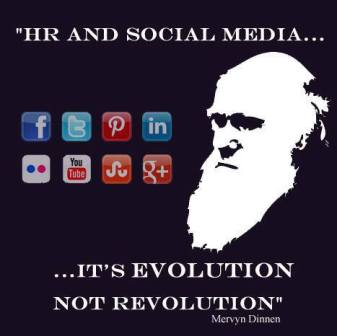
We now have a blog too, and a Pinterest page, and a twitter account. No one has actually contributed to the blog yet, and the twitter account only has 63 followers.  But we are getting there, we will get there, one new Yammer comment at a time.  As Mervyn himself said in a recent blog, it’s evolution not revolution.

So here is the rest of my rant to the C Suite.  You don’t have time not to do it.  You are missing a massive opportunity to talk directly to the people that work for you.  Turning up twice a year with a PowerPoint presentation with the great strategy from on high isn’t internal communications.  It is talking at people.  Communication implies dialogue.  You want to know what your people think? Get on twitter, write a blog, post on Yammer.  It will give you a little bit more real time information than that annual survey you get your wallet out for every year.  If none of those interest you?  What about staying in touch with your industry, making contacts, your personal brand, improving your job prospects?

Or maybe I’ll just do what Perry Timms does when they say they don’t have the time for it.  Just wish people well in keeping up to date in their careers without it.

********************

 …Is this similar to your experience?? Share in the comments…or offer your own guest post, either named or anonymously…
Here are some comments from Twitter…
CSuite tweet1
CSuite tweet2
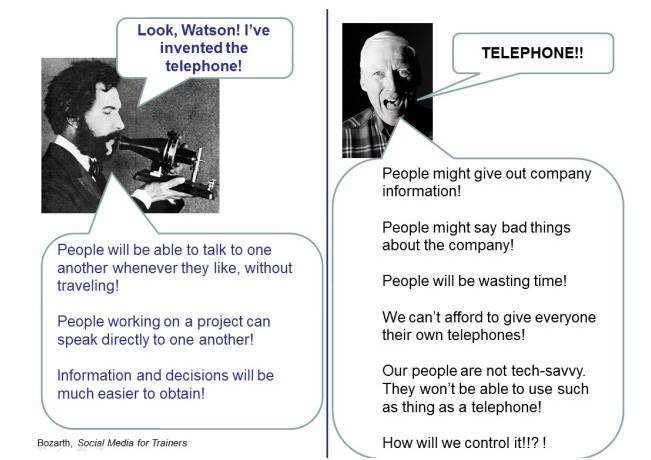
..and try this excellent graphic about Alexander Graham Bell from Jane Bozarth, author of Social Media for Trainers, if they still need convincing…
.
Bell

MIND’S EYE – Please Support Simon’s Initiative

Merv pointing


The above is a piece of artwork that the wonderful Simon Heath created for me. I’ve been lucky enough to have recently been the subject of 3 pieces created by him…the other two are below. It was created in response to some joshing on Twitter between myself and Perry Timms about my ‘pointing’ avatars and Rodin’s The Thinker.

The three pieces I’m using here just scratch the surface of the range of artwork he can produce – you can see a lot more of his work, both the professional and the fun reactive pieces, on his blog Work Musing.

He is a very talented illustrator, animator and cartoonist who works with businesses on communications artworking. I have met him once and found him to be warm, considerate, intelligent and very giving of his time, and I want to bring to your attention something that he is doing to help raise money for the mental health charity MIND.

You can read the full background on his own blog here – inspired by Jon Bartlett he is going to create a piece of unique artwork for a blind auction. Jon has recently blogged for MIND and his January post for Alison Chisnell’s guest blog series started the HR for Mental Health initiative.

Here is Simon’s offer, in his own words…

“I have been inspired by Jon to create something unique to raise money for this wonderful charity and I want someone to have the chance to determine what that is and to own the result. You can find examples of my cartoon work elsewhere on this blog. The premise is simple. If you would like a bespoke cartoon (no larger than A4 in size) created to your specification, you should email me at sjheath@live.co.uk with your bid. The auction is blind so you will not be aware of the value of other bids. The bidding period will last from the moment this post is published until midnight (British Summer Time) on Friday 14th June 2013. On Saturday 15th June, I will contact the highest bidder to notify them that they have submitted the winning bid and to find out what subject matter they would like the cartoon to cover. With their permission I will announce their name and chosen topic both here and on Twitter on the same day and also to publish the final artwork here for you all to see. I will of course need to see proof of donation”

I urge all regular readers to get involved with this initiative.

I’m not joining the auction as Simon has kindly already created these pieces of bespoke artwork about me…in recognition of which I will make my own donation to MIND.

Can’t wait to seeing the winning artwork in a couple of weeks!

Evolution


Merv Recruiting poster

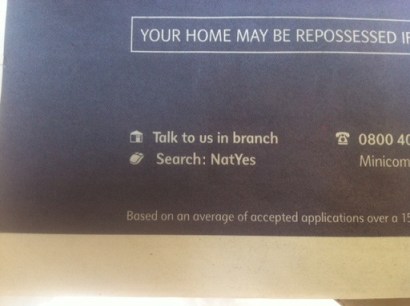
The Bank That Doesn’t Like to Say NatYes

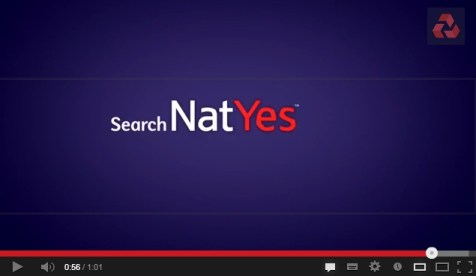
You may have picked up some of the online chatter around the new NatWest advert. If you’ve not seen it then it’s quite a nice ad, you can watch it here…and it ends with the call to action

NatYes2


The main message is that they say yes to 9 out of 10 mortgage applications (based on applications submitted over the last 15 months and excluding buy to let). And if you want to find out more you just ‘Search NatYes’

Clever, huh! Simple and punchy.

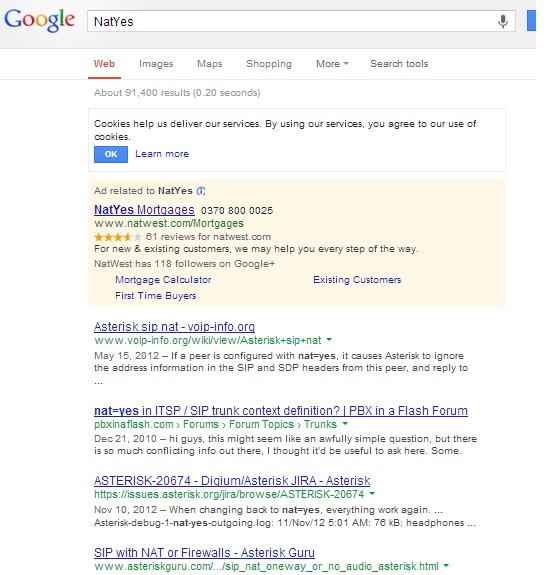
Except in 2013 if you tell people to search NatYes that’s exactly what they’ll do. On Google, Bing or whatever their search engine of choice is. And when you do you get…

NatYes


That’s right, one paid adwords ad. Try the domain names natyes.com and natyes.co.uk – and they’re available! D’oh! So no real further information. Nothing in the general listings.

At this stage I refer you to Gary Robinson’s excellent blog NatYes or NatLess: NatWest Campaign Lacking TV & Digital Integration – a great analysis from an experienced digital marketer on the missed opportunities.

I noticed something else about it too. The print ads show a graphic of a mouse with NatYes next to it….so they are telling you to search it from a computer as a way of connecting with the campaign. Except that all you’ll get is a Google ad, which I suspect is quite expensive. No other form of digital or social engagement to back up the campaign.

When I blogged about HMV earlier this year it was to highlight their failure to grasp the evolving digital and social landscape, and tellingly the failure to understand changes in consumer behaviours, and with NatWest here’s another case of a large brand failing to do the same. Or maybe it’s their advisers who are being remiss. I’m sure NatWest have a digital marketing team…were they consulted?

You see, the image of the mouse gave the game away for me…they are thinking of office desktop computers. How many people will ‘search NatYes’ using a mouse? Very few I would think.

If the call to action is at the end of a TV ad, and on newspaper ads, then the device for doing the searching is likely to be a smartphone, tablet or laptop. In fact they didn’t need a symbol at all! Merely the word ‘Search’ tells people what they want to know. The ad is aimed at a demographic that don’t need to be told to search.

Mouse


So is the mouse a giveaway? Millions spent on a campaign, but a telling failure to understand consumer behaviour in the most important call to action.

The message is you’ve got a 90% chance of getting your mortgage approved…the call to action of ‘Search NatYes’ appears a gratuitous, or ill thought out and planned, one.

In the way that ‘Go to work on an egg’ was probably pitched with the sentiment ‘Look, no-one is literally going to believe you can travel to work on an egg’ maybe ‘Search NatYes’ was pitched with ‘Look, very few are literally going to do a search for it

Be Social to Get Your People Social – The 3 E’s and Pizza

Clearly the readers of this blog like social media – my last post became my most viewed of the year within 48 hours, and the second most viewed is this one on social media judging.

I did get messages from those who wanted to agree with me but couldn’t publicly, and I also had some DM conversations with people who felt that it was the C-suite who were the barrier in their organisations – again they were unable to say so publicly. If anyone is up for it, I would be really keen to publish anonymously from any guest who wanted to write about their experiences.

One question that I’m often asked at conferences and events is how to get employees using social channels for business. It’s one thing getting buy in at either C or management level and sometimes another to get people using it effectively.

I gave a presentation at the recent Social Media Results Conference on some of the ways to get user generated content, with a particular emphasis on internal involvement.

My advice is to keep it simple and keep to the 3 E’s…Empower, Enable and Encourage.

Empower

Pretty much everyone in your organisation has some kind of digital footprint. Without going generationalisationist I think you can pretty much guarantee that any Millenial, Gen Y, Gen X type (and older ones too, now) will have a Facebook page as a minimum. Anyone in a client facing role or a specialist area – sales, marketing, finance, technology, HR, customer service – will almost certainly have a LinkedIn profile too. So don’t tell me that there’s no social capability in the company!

They know the tools to use; they just need the green light to use them. So let them! Remember its guidelines not policies, and conversations not targeted conversions.  And make twitter accessible too.

Enable

Of course, there’s a big difference between posting a picture from this morning’s dog walk, or adding something to your key skills section, and sharing something about what your company does. So in addition to giving people the green light to use social channels you need to up-skill them too. In a way that makes it easy and fun, not a chore.

The last thing you want is for people to get the impression you’re increasing their workload so this has to be natural, let them have the tools and have some fun with it.

Encourage

It’s not a test with a right and wrong answer. People won’t always get it right at first, which is why you need to encourage. Most early tweets can be embarrassing, so let people develop their own voice and style. Nothing will turn someone off quicker than being told they’re not doing it right…immediately it will feel like a measurable task , and if it isn’t in their job description then they won’t want to do it!

And, finally…

Be social to get social

I hold a monthly lunch – the Social Lunch – and get a group of colleagues together who want to find out more about social networks and how they can use them. I get some pizzas in and we talk about social, particularly how the can use it for themselves. Everyone is keen to know more about Twitter, so that’s where much of the focus has been. Some months we get someone else along from the business to talk about how they use the networks. We’re creating a blog too that everyone will contribute to.

It’s been going for a year and we have a loyal group that, crucially, keeps getting added to. People are talking about being the twitter champions for their teams, and more people from their teams want to find out what’s happening.

The pizza element is important. It needs to be fun and social, and there needs to be something in it for them, else it becomes a missable training session. Remember…

‘Is that cheese, tomato and lettuce on malted brown? I’ll have one of those please’. Said. No-one. Ever.

‘Is that a Chicken Supreme with extra mushrooms? I’ve never tried that before, I must have a slice’. Says. Everyone.

So make it fun and sociable and everyone will be keen to help share your message.

After all, your employer brand is what your past and present employees say about you, so why give them a bad experience of using the channels through which you need them to communicate it?

SMR2

SMR1

Hey Gurus, Leave those C – Suites Alone

Evolution


(many thanks to the wonderful illustrator, animator and cartoonist Simon Heath for this graphic)

Q: What’s the biggest barrier to embedding social media in your business
A: Getting buy in from the C Level

How many times have you heard that over the last 3 or 4 years? Loads of times, and it’s still being trotted out. Last week I was at a Digital Shoreditch event where a distinguished panel (of suppliers who also happen to be industry commentators) said much the same thing.

You need to get buy in from the C Level. Make the business case. Show them ROI. They sign the cheques and need to see proof.

I call bullsh*t!

In my experience most of the C suite are just fine with this. A lot of them like the online celebrity status it brings them, the opportunity to talk about their business (and have it talked about) and they place trust in the managers they appoint to make the right calls on usage, content and guidelines. Social networking platforms are conversation channels – no-one ever called the C suite a barrier to putting in a phone system, did they?

Middle managers are another thing entirely. In common with a number of owner managers in smaller businesses, many that I have met see it as a hindrance. They don’t like the transparency and immediacy it brings, the hierarchical flattening that comes with it, and the fact that those they manage know more about it (and are more adept at it) than they are.

They often have no time and little inclination and wrongly fear that their charges will spend too much time on it and will therefore fail to deliver the outcomes for which the manager is accountable.

So what’s the main barrier then?

It’s the structure. If you’ve got a traditional post-industrial age corporate structure of owners/directors supported by the usual hierarchies of management (senior managers, middle managers, junior managers) then the line managers who have the responsibility and accountability for ensuring things get done inevitably like to manage processes. That’s why e-mail is so prevalent… it’s all about managing activity and giving direction, with its cc capability giving visibility to the managing and direction.

Not everyone likes to learn new tricks that take them out of their comfort zone, especially when they have a position of responsibility.

So if you want to influence them here are three points to take into account next time you need to jump the barrier.

If you make people use it they’ll use it badly. You can’t force it, mandate it or set KPIs for it else they will do it wrong. Its conversation and you want online conversationalists. Broadcast messages are the preserve of those who don’t understand conversation.

You can train people in how to best use the platforms but if they don’t naturally get it then it won’t happen for them. It starts with hiring people who are comfortable using them.

It’s evolution not revolution. From letter to phone to telegraph to fax to e-mail to mobile, business always adapts to shifting ways of communicating…particularly when their customers and clients start communicating with them using those ways.

What’s the cost of NOT doing it? How many times do you hear ‘we’re not ready for that?’ or ‘it’s a fad that won’t take off’? Most businesses learn the lesson when it hits them in the pocket…the question isn’t why should you use the platforms but what are you missing by not using them.

If you think you’re not ready then don’t bury your head in the sand, because I’ll tell you who are ready…current, former and lapsed customers/clients, and current, past and future employees. And no doubt a lot of your competitors too.

And remember, anyone who says ‘we pay people to work, not to play around on social media’ has little understanding of how the platforms work, how people use them, and how they can be used to positive effect in the business…so show them.

There’s no better way than to start with the following slides from Paul Taylor at Bromford Group, a business in the social housing sector that gets it. Maybe because they have a CEO who favours hiring people with a digital footprint because ‘all future leaders will need a positive digital footprint…without the ability to communicate across all platforms they won’t survive as credible leaders

As Paul says in his latest blogThe medium is irrelevant. The conversation is everything

Cries for Help from the Boomer Organisations

Regular readers will know that there are certain things that raise the hackles here at T Recs, amongst them are:

Hence it will come as no surprise that HR Magazine’s ‘Global war for talent will intensify as baby boomer leaders retire’ scored a complete full house on Merv’s bullshit bingo scorecard.

Not sure what’s more frustrating…that an executive search firm felt the need to release this self-serving guff or that a respected online news resource felt obliged to re-print the press release in the name of ‘journalism’.

So we have a search firm commissioning a report – the grandly titled ‘After the baby boomers; The next generation of leadership’ – which was conducted through telephone interviews with 100 senior executives between 2010 and 2012. I’m guessing that some of the 2010 conversations may be a little out of date now.

There is an executive summary of findings which contains sections with titles like:

  • The war for talent will intensify
  • Most organisations underserve female markets
  • The feminisation of leadership
  • Organisations need to ease the intergenerational transition

The opening statement is:

Should it matter to our future leadership that the world is undergoing unprecedented demographic, gender and cultural change? Or that a whole cohort of leadership, characterised by the baby boomer era, is about to step down? Is it possible for organisations to be ‘prepared’ for such fundamental changes and adapt to a different style f management? Or, as one respondent said about the next generation of leaders, “They may think about the world in a different way but that doesn’t make them poor leaders.

And the conclusion is:

To continue to thrive, organisations must:

  • Transfer knowledge, by coaching, mentoring and codification.
  • Re-evaluate their organisational structure, including their incentive philosophy, and how they recruit and retain talent.
  • Build cultural awareness, designing leadership programmes that develop cultural diversity, flexibility and people skills.

I’m sure it’s a comfort to have Odgers around to help out, given that the next few years will clearly be the first time since before the industrial revolution that business leaders come up to retirement age and hand over to younger leaders. I’ll bet they’re glad that it’s been pointed out to them that they need to be grooming their new leaders, no doubt an easy thing to overlook when you’re running a large organisation.

Apparently only 41% of those interviewed thought their organisations ready ‘for the changing workplace demographics of age, gender and diversity’ but then a closer examination of the report shows only 9% believing their businesses to be not ready. (More scaremongering).

Now if you’ll allow me some generational stereotyping of my own, firms like Odgers and Deloittes (who authored the Gen Y research written about in my last blog) are, shall we say, Boomer organisations. They seem to have an unhealthy obsession with how different young people are.

And if the earlier section headings are anything to go by, women too. They even make a point in the introduction of mentioning that 30% of the leaders spoken to were women, whilst the use of the word ‘feminisation‘ to describe emotional intelligence and people skills is telling.

The generation of 45+year old business leaders have been well served by these Boomer organisations. They’ve found staff for them, helped them in their own careers, come in to do consulting around new projects and structures, and maybe, just maybe, those Boomer organisations are beginning to feel the winds of change themselves.

The next generation of business leaders may well have found shiny new ways to source talented staff, promote their own careers, and check the viability and feasibility of new projects and structures.

So maybe these attempts at creating a perceived problem for their core markets, that requires a solution that they can then help provide, are really just cries for help?

Here’s the blueprint – identify a problem with the young, developing workforce. Legitimise and amplify it by dressing the problem up as research or with a white paper (involving an academic or another Boomer organisation for extra effect) then offer simple solutions worded in a complex, serious way so that only by using your services will they be able to fully grasp and implement what needs to be done.

Well, you know something… I’m guessing most successful business leaders know this stuff already and know what needs to be done… and the younger, emerging leaders have a fairly good idea where to start cutting the budgets.

Generationalisationism

As a regular attendee and blogger at CIPD events I like the way they have got involved in, and tried to shape, conversations around youth unemployment and opportunities for tomorrow’s workforce.

In their centenary year it seems fitting that an organisation that came in to being with an aim to get children out of the workplace should now be spearheading efforts to get them in to work. I wrote about the Our Young People project last year and have written elsewhere about their newly launched research ‘Employers are from Mars, Young people are from Venus’.

However, mixed in between the learning and networking at the recent CIPD HRD conference were presentations of a different type that I could have done without…the dreaded ‘How to get the best out of/understand/manage/up-skill Gen Y’ bilge.

Generalisations about generations are nothing new (cap doffed to Gareth Jones for the inspiration behind the blog title btw) and I’ve written about it several times.

One speaker, a senior HR/Learning person from a major UK plc, hid behind the Deloitte Gen Y research with the usual generalisations – sense of entitlement, used to being placed on pedestals, lack of proactivity, dreamers, unrealistic – and even gave us an interesting conundrum. They don’t get information from people but prefer to source it online. This was seen as a problem as decisions are usually made in meetings. Yet barely two minutes later the presenter told us how difficult it was to organise internal meetings, problems over aligning diaries etc, whilst her 19 year old son can arrange a get together within a couple of minutes online. Opportunity or threat?

CIPD Gen


Further comments such as ‘They’ve grown up in times of an economic boom’ are clearly nonsense as anyone born ‘93 onwards has hit adolescence in a time of global recession, but that doesn’t stop them being presented as perceived wisdom. We were also told they are the most researched generation, with more data existing on them than any other…I quite liked Matt Charney’s observation…

CIPDtweet4


In all honesty, I’m getting more and more uneasy with this type of conversation, not just because there’s so much of it and its nonsense anyway, but because it’s really just stereotyping whole groups of people by certain perceived traits, somehow to imply that they are inferior, different or require special treatment. Yes, I do find it worryingly close to racism, sexism, anti-Semitism, homophobia and the rest by a different name.

The casualness of the way stereotypes are bandied around makes me particularly uneasy. The ‘I know about this because I have a teenage child’ line is really just ‘some of my best friends are’ using other words. People who spout generationalisationisms don’t really mean it, they love them really, they’re important because they can use social networking etc…just like casual racism and sexism.

I don’t think this has any place at an HR conference, either here on in the US – check out Laurie Ruettimann’s blog on this subject, written after her experiences at a US HR conference the same week as the CIPD event.

Different people bring different skills to the workplace, and different ages bring different perspectives. An understanding of the different social, cultural, economic and academic influences that shape these perspective and values is one thing.

But discrimination is discrimination, and age discrimination works two ways. HR above all people should not have these crass, and untrue, generalisations anywhere near their mind-set…

A Passion for Learning

Some readers may remember a TV ad campaign a few years ago aimed at getting more people interested in teaching as a career. Most scenes showed a child engaged with learning in school and the strap line was…

You never forget a good teacher

It came to mind during a fairly dull session at last week’s CIPD HRD 2013 conference when an L&D professional was running through some, quite frankly, very dull content. He talked tools, measurement and the like but it was done in such a listless manner that it moved me to tweet…

CIPDtweet1


I’m lucky enough to be connected to a number of inspiring and creative learning types (check out #ldconnect) so I know that people with a real passion for learning are out there. (Some were in attendance, sadly not on stage but in the audience as guest bloggers). Some tweeted back straight away…

CIPDtweet2


I couldn’t help but reminisce on several previously overheard workplace conversations over the years. You know the ones…I’m sure we’ve all heard them…

‘Two day training course next week’
‘Poor you’
‘I know. There’s a new system they want us to learn about/supposedly they’re going to help me be a better manager/they’re bringing in some new performance review thing/seems our engagement scores are too low’ (delete where appropriate)
‘Sounds like a yawn’
‘Well at least it gets me away from the desk’
‘Yeah, but think of all the e-mails you’ll go back to’
‘Actually you’re right about that. I may cry off the course. Pressure of work ‘n all that’

Too many L&D sessions at the conference seemed to follow the route of programmes, metrics and ROI, tools and feedback scores. Perspiration instead of inspiration. Ticking boxes not engaging hearts and minds.

Then I went to a session that was different. Neil Morrison and Jo Mallia of Random House were talking about ‘Transition of Leaders – Applying a Cultural Mind-shift Change’. Here was a different vision of L&D, more along the inspiration lines, making learning sound fun, enlightening and vital Their people were ‘like sponges’ eager to learn more and improve. OK Neil did explain that publishing tends to attract people with curious minds, but still I felt in little doubt that having the right approach, with passionate and creative people, created a learning culture.

Their industry needed it too. Publishing is facing many challenges and needs new ways of thinking and a new mind-set. Jo fosters collaboration and group thinking, setting free the ‘pink elephants’ (mavericks)

CIPDtweet3


It wasn’t surprising that in the final questions one delegate called the session, to much applause, the best thing they had seen over the 2 day conference. You can read more on Mr Airmiles’ blog.

I’m sure there were many worthy presentations over the 2 day CIPD HRD Conference from L&D professionals who have a real belief in what they do, the importance and value of it. Too many that I went to sounded bland, delivered in front of busy, indecipherable power point slides. Whether this is down to the people who gave them, or the way that their work is perceived in their organisations I’m not sure. Many were from large organisations with programmes, so perhaps it’s telling that the two presentations that seemed to most engage the audience, and the assembled bloggers, were…

  • Random House – the one from Neil and Jo where heads of HR and L&D stood together, an aligned approach
  • Hanover Housing – a small business doing interesting things

The words that kept cropping up to describe both sessions were passion, inspiration, belief and purpose – maybe the benchmark words for Learning & Development (or People Development) that leaders should use when choosing their specialists…and conferences their presenters.

Social Media, Judging Others and The 5 Year Rule

The guy who first managed me in recruitment, the owner of the small agency I had joined, had a way of dealing with some of the slightly more overconfident outpourings of the younger, cockier me. He said…

“Write down what you just said.
Put it away.
Look at it again in 5 years’ time.
You’ll never believe you ever said that.”

It was a put down, deliberately aimed at making me feel immature with a lot to learn about the business world. Probably something I needed at the time, and certainly something that stayed with me. The 5 Year Rule. As individuals we do evolve, we learn, we gain experience and confidence. I had views, perspectives and opinions then that I didn’t have 5 years later. Probably not even 2 years later.

When it comes to social media I do wonder sometimes what to tell the kids. I see them using the platforms to communicate in their own way, in their own language and syntax, with their own friends and peers…trying to make their few followers laugh and trying to be more outrageous than each other.

Of course, at some stage they will be entering the workforce and all these old tweets, updates and snaps will be judged by an older generation who never said inappropriate things, made risqué jokes, swore and got drunk. Well, they did but only their close friends knew. Now they’re able to judge another generation by their own standards.

I expect stories of people in trouble for Twitter and Facebook updates to become so commonplace that we stop feeling the need to talk about them. But until then you will get storms like the hounding and eventual resignation of Paris Brown.

As Andy Hyatt from Hodes Group says in this blog:

“You see, part of being young is making mistakes. Saying and doing dumb things and learning from them.

As adults, we are supposed to understand this. We are supposed to provide the right environment to ensure that young people can grow into socially responsible adults. A positive learning environment. Teach them right from wrong. Ensure that children have access to facilities so they can maintain their physical, as well as intellectual wellbeing.

As adults, we are also supposed to recognise that sometimes, children can be childish: selfish, thoughtless, horrible and stupid. And more importantly, we are supposed to understand that this behaviour is only ‘acceptable’ (and again, I use the word loosely) until someone is deemed an adult. And this definition varies between the ages of 16 and 21 depending on where you are in the world”

I’m sure Paris Brown wasn’t the first and won’t be the last. Right now the next generation of public servants, low skilled service workers, MPs, doctors, journalists and bankers are saying what they damn well like on social media platforms. They’re dating on them, partying and sexting on them, and making people laugh on them.

I see them when I monitor mentions as part of the day job. I see more of the teen users now that I’ve got a search running for comments on the advert that my son is in. Often they have about 100 followers who they constantly try to amuse and/or shock. Sometimes they’ve got thousands of followers, and a level of interaction that some social media gurus can only dream of.

It’s no different whatever your generation. The humour, the insults, the in-speak are always different. The tone and content, the syntax and swear words look very different to an older person trying to judge out of context.

No-one thinks about the 5 year rule while they’re tweeting. Continue reading “Social Media, Judging Others and The 5 Year Rule”