#HRTechEurope – HR Is Dead! Long Live HR!

Me & OracleOscar

My previous two blogs previewed the HRTechEurope Spring Conference and Exhibition , which I duly attended last Thursday.

It was a fun day with exhibitors offering lots of swag and jellybeans, stormtroopers and a robot – you can see a somewhat blurred picture of yours truly with OracleOscar above – and I was rather excited to win cinema vouchers in a prize draw from Oracle too. Thanks guys! The conference content ranged from why HR is doing it wrong to how tech can save the day, with a final call of ‘HR is dead, long live HR’.

My friend and co-blogger for the event Doug Shaw has offered his thoughts on some of the morning sessions so in this post I’ll look at the afternoon, and in particular two well received and thought provoking presentations from visiting US commentators – William Tincup and Jason Averbook.

In my pre-event posts I was mainly concerned with capability – does HR have what it takes to really grapple with technology and use it to create the kind of experience that employees want, and produce the data that helps decisions rather than fills out barely read monthly reports.

Getting it Right

William Tincup was looking at the process of buying HR software from the angle of getting both satisfaction and success. His presentation was thoughtful and well structured, taking HR professionals through the sales and implementation process. I often get the feeling that there is a reticence within the community to truly challenge the salesmen and account managers from the big vendors, as if the complexities of technology are off-putting. It’s their budget, but not their own money I guess, so maybe due diligence is glossed over.

William gave a simple plan through the 7 stages of the process – product, sales, negotiation, implementation, training, adoption and support – with 5 or 6 questions at each stage that need to be asked and answered.

Some of the key ones for me:

  • What reports and features are really important to us?
  • Do I feel like I’m being over-sold? Did the demo meet or exceed expectations and have they done significant work in my sector?
  • Who owns the data? Am I giving up things in the negotiation that are important to me?
  • Can I meet the implementation team before I sign? How will we manage change and communicate it to all employee users?
  • Will all users be trained the way they want to be? How will new users be on-boarded?
  • How will we get users to ‘love’ the new software and how will we know if they don’t?
  • How will vendor support handle help desk items versus things that are broken?

There were two things he said that really nailed some of the issues that I think HR has with technology…

Good software doesn’t fix a bad process, it just highlights how bad the process is.

A feature is not a feature unless users use said feature.

He also urged people to ask vendors how they make their money as the answers can be very illuminating. This is excellent advice but I wonder if it might be too confrontational for many within the HR profession? The whole process of acquiring technology is a major investment for the business which has to be done well – and needs to be approached with the professionalism and determination that such a major investment requires.

Facing the Future

The closing keynote was from Jason Averbook. Closing presentations can often feel slightly lack lustre – the space many be partially empty, exhibitors are dismantling stands, some people have already left and others may be suffering from information overload – but Jason played it just right with a fast paced, high impact session.

I’ve seen him speak before and do like his style and thinking. A couple of presentations earlier in the day had lacked pace and verve, giving the Impression that the speaker had delivered them before, but Jason’s was different to the one I had seen last Autumn and, importantly, showed a progression in his thinking.

The message I took away was simple – things around the workplace are changing and HR can’t deal with new challenges by doing what it’s always done, it’s going to require a shift in attitude and thinking.

There are many examples of this. Our expectations of technology, and in particular the user experience, have shifted immeasurably. When employees use our internal software, or complain about it, they aren’t comparing it to what went before but to the experience they get from Amazon or Apple. When something changes – be it interface or new application – they expect it to be seamless, just like downloading a new app. He showed the video I’ve embedded at the end of a 4 years old’s reaction to having to use IOS7.

Innovation, and the impact of technology, is more than a redesign of payslips and needs to culturally shift the way we do things. HR has to lead this, to know what differentiates the business – new systems don’t drive differentiation.

There was talk of the changing work practices, how some jobs are beginning to disintegrate into a series of tasks, and workers to perform these tasks are being crowdsourced. ‘Do you know how you manage contingent labour in your business?‘ he asked. Some of that contingent labour may also be working for 4 or 5 other companies at the same time – potential for disruption that HR needs to understand.

One important point is that away from the workplace we don’t phone call centres or help desks to buy something online, download a new app or integrate a new Facebook function. We work it out for ourselves or search for the solution online – either video or on a blog. A lot of employees will expect to do this with their HR systems and processes, to self-solve. Do you have that in place?

There were many more examples of how shifts in technology, expectations, workplace strategies and staffing arrangements are shaping how our people feel about the business. The need for real time data (not historical surveys) in areas such as performance illustrates the importance of information in helping solve real business issues, not being inward facing or merely a tick box exercise.

The final summing up was that HR as we know it was probably dead and that a new HR approach, driven by technology and evidence (data), will be developed. People no longer want hand holding; they need to know that the information is there when they need it and that they can access it when it suits them. They don’t want self service; they want direct access.

This summary caused much debate and consternation amongst both the attendees and people following the Twitter threads from afar. The conversations and debates that it prompted were still going on a day later.

Which sounds to me like exactly what a good conference presentation should do – explore ideas, prompt and provoke thinking and conversation that helps us to make sense of an evolving landscape that will require new attitudes and solutions. It was also good to see Jason get involved in the online chat personally.

Something that I had observed in the morning was that none of the the early speakers had a social media presence, yet the HRTech event has a very good social outreach. Those morning presentations, as Doug’s blog had pointed out, seemed to be a tad lacking in depth and rationale whereas both Jason and William Tincup demonstrated a good understanding of the issues that HR professionals face and reflected this in what they said. Maybe it’s no coincidence that they are very active on social channels and this almost certainly helped towards their engaging and insightful presentations.

Reports of the death of HR may be an exaggeration, but there are certainly some interesting conversations to be had about adapting to meet future challenges.


4 Questions About Talent and Technology

It’s nearly time for the HRTechEurope Spring Conference & Expo. I’ll be heading in to London on March 27th joining HR and Recruitment professionals, tech specialists and fellow bloggers to try and find out what’s old and what’s new, what we need and what we don’t.

It’s currently tough out there in the world of HR when it comes to talent acquisition. On a daily basis we’re fighting wars, covering skill shortages, putting a sticking plaster over long term people development and tearing our hair out over how to create the workforces our businesses need to face a future of growth and accelerating technological development.

Or so it seems. Rarely a day goes by without another report, white paper, survey or opinion piece on the huge challenges of creating the future workforce. They need to be highly skilled and motivated, locationally and contractually flexible, and ready to hit the ground running.

But this isn’t a perfect world, and people aren’t disposable goods to be chopped and changed. Instead of the constant and seemingly frenetic rush to get the best right now let’s look at some longer term issues that short term talent acquisition strategies may be covering up…

Are You Looking Everywhere?

By everywhere I mean everywhere. As I recently wrote for Monster, there’s a lot of talent right under your nose that you’re probably overlooking. Most probably…

  • Current employees who have skills and strengths that you haven’t recognised and can adapt to new challenges
  • Alumni who have moved on, had different experiences, gained knowledge and progressed
  • Candidates who have applied before and were not a good match then, and are now probably nestling in a black hole in your ATS hiding their very relevant talents
  • And remember, all the above have friends, collaborators and alumni who may be right

Is Your On-Boarding Good Enough?

We all know that if something’s going to go wrong then it will more than likely happen in the first 2/3 months so are your on-boarding and induction processes up to scratch? Is talent seeping away from the business because you’re not making the most of it when it first arrives? Think back to good people who just didn’t seem to work out with you and look at why. There may be a recurring theme.

Are You Growing From Within?

The people you’ve already invested in should be the first choice for new roles. My first job was within a medium-sized accountancy firm and we had PAs to Partner who had started as filing clerks (OK, you don’t get many of them any more) and accounting assistants who had originally joined in a clerical or admin role. The partners constantly tried to invest in developing the good, loyal people they had rather than demotivate and lose them by going outside. Do your people really feel that they have a future with you?

Have You Created the Right Environment?

To nurture talent you need a nurturing environment. One where people aren’t afraid to try and fail as part of the learning experience, and aren’t rewarded purely on achieving KPIs that preclude the opportunity to collaborate, innovate, share and provide feedback.

If the solution to filling new positions is always to go external and throw money at someone who’s performing at a competitor then this will become a self fulfilling modus operandi which will be difficult to break. And dangerous too as top achievers in a business usually benefit from a support structure and culture that enables them to do their best; there’s never a guarantee that they would achieve the same results in a different environment that offered a very different structure and culture.

There will probably be a lot of technology at HRTechEurope that can help enable this, but first it needs a mindset. A commitment to doing something fresh, an openness to new ideas and approaches.

Because to keep fighting the same mythical wars and keep moaning about shortages and expect to get different results would be insanity. Right?

(Image via SAP.info)

Social is an HR Issue

Social-media

Next week I’ll be chairing the CIPD Social Media in HR Conference 2013. I chaired last years’ too so it’s nice of them to invite me back! At the event they will be presenting survey findings from their ‘Social Technology, Social Business‘ research.

They have already written about some key findings. Unsurprisingly they find that younger employees use social channels more than their older counterparts, but they do find some more interesting behaviours amongst senior employees:

  • Over 50% of senior leaders use social media for work, compared to 33% of Managers and 20% of non Managers.
  • Senior leaders are externally focussed and see social media as a way to build networks
  • 52% of the senior leaders who use social use LinkedIn
  • Senior leaders are more likely to comment on forums and post blogs
  • Managers are more likely than non-Managers to job hunt using social media

There was one point of caution sounded though…

“However, senior leaders don’t seem to have seen the potential for social media as an internal leadership tool, helping them to be visible to their employees, gain trust and focus employees on strategy – indeed the data suggests thy could learn a thing or two from their middle managers here”

This interest in using the platforms probably won’t come as a surprise to regular readers. I’ve always believed that senior leaders, the C-Suite, are quite comfortable with social and that the real roadblock often lies within middle management. But the inability to see social as an enabler of better leadership is very disappointing, as is the nagging reluctance of many in HR to see this whole area as one for them. If anything should bring HR to the social table its the potential for better and more engaging leadership – visibility, trust and focus.

There’s not really a road back. This is evolution in the way that people connect and share information, and just like the phone and email, businesses need to adapt it if they are to survive and thrive in future.

Too often HR practitioners seem to see social technologies as something for marketing or internal comms to get their heads around, happy to leave it to the broadcasters and external message conveyors, but this is a gross dereliction of duty!

These tools and platforms aren’t just for external use – they are for internal use too! And that’s the point at which marketing need to let go of the reins.

  • If an an employee says something on Twitter that causes the business a problem, then that’s ultimately an HR issue.
  • If your key workers are posting on how they hate Mondays and wish the weekend could last an extra day or two, then that’s likely to be an issue for HR they are highlighting too.
  • If they go on to Glassdoor and post an anonymous review of how awful it is to work four you, then that’s also flagging up an issue for HR.
  • If you’re missing out on the talent you need because other companies have social technologies embedded, and a range of employee advocates telling their story online, then that’s another HR issue.
  • If there’s a lack collaborative working in the company, then that’s a managerial issue, which will almost certainly become an issue for HR.
  • If employees are disengaged through a lack of leadership visibility or a lack of trust in senior management, then that’s certainly an HR issue.
  • If your employees already have their own social media policy (as Euan Semple has said) then it’s certainly an issue for HR to make sure that the company is included in it.

When I say it’s an issue for HR, I don’t mean for HR to control and police…I mean for HR to get with the programme and start understanding how these tools are used and how they can be harnessed for creating the type of work environment in which employees feel valued, proud and able to give their best efforts. Not workplaces where people moan, hide, feel undervalued and generally have no desire to perform.

Of course, some of these issues require HR to challenge, not to accept the status quo or meekly follow leadership will. As Neil Morrison says, HR needs to be a trusted partner, and that means knowing when to tell a hard truth.

And to tell that hard truth you need to understand it. The opportunities are there for collaboration, learning, sharing of knowledge, different working arrangements, and creating a stronger bond with customers, clients, suppliers and partners…it needs to be grabbed.

As the recent book Attenzi – A Social Business Story defines ‘social business’:

“Social business is about adapting the way in which an organisation delivers its mission and pursues its vision by designing the organisation around influence flows, connecting: its people, partners, customers and other stakeholders; data, information and knowledge in and all around it…more openly, productively and profitably with the application of social web, big data and related information technologies.”

In my conference preview a year ago I likened social media to punk rock, but the clock is now ticking and this time it’s even more vital, not something you can indulge in if you like.

As Peter Cheese said when he opened CIPD13 “The future’s already here. It’s just happening at different speeds in different companies

I’m hoping #CIPDSocial13 offers a great way to start getting everyone up to speed…

(image via xln business blog)

Social Snarks and Hashtag Hecklers

I’m heading off to Manchester later for the CIPD Annual Conference and Exhibition. Condensed to two days this year there promises to be much rich content with a wide range of speakers and contributors. We’ll be opening with a keynote on ‘Creating the Best Workplace on Earth‘ and closing with ‘Leadership and the New Principles of Influence‘. The latter session will be delivered by Daniel Pink – after live tweeting, and blogging about, his two presentations at HRTechEurope I’m in danger of becoming a fanboy!

For this event the CIPD have put together a blog squad of more than 20 of your favourite HR bloggers and tweeters, and between us we will endeavour to capture the essence of what’s being said, and which exhibitors have an interesting story to tell.

For some of the squad it will be their first live tweeting/blogging experience – I’m looking forward to reading what they have to say – and with such a cross section of people there will inevitably be a range of styles and viewpoints.

I noticed during my visits to HRTechConference and HRTechEurope a greater embedding of bloggers in to the event conversation as they become important conduits of the various messages. Everyone has their own style – I tend to live tweet a lot of what’s being said as an aide memoire to help me blog about it later. I don’t often give my perspective on it until my post event review – I see my role as someone who is taking the content to people who aren’t able to attend, drawing in a much wider audience than usual, and then reviewing afterwards. A bit like a sports journalist commenting on the live action and the writing an opinion piece later.

Others in the blog squad are likely to do it differently, giving a view or perspective on what’s being said. Only by following the hashtag #CIPD13, rather than individual tweeters, can you get the full picture.

For those of you following from afar there are three channels to follow:

The event hashtag on Twitter – #CIPD13

The individual blog squad members, their tweets and blogs – this list from Steve Bridger will help

The CIPD Tumblr – curated by Doug Shaw

It’s been noticeable during events over the last year or two, particularly those around recruitment and HR, that the twitter hashtag thread often draws in comments from those not in attendance. This is a good thing as it broadens the conversations, and also offers a useful way to spot examples of those two growing live event phenomena – the Social Snark and the Hashtag Heckler.

Social Snark

They aren’t in attendance, usually because they are too busy – but not so busy they aren’t following the twitter chat for 140 character updates that they find less than insightful or (cardinal sin) something they’ve said before. They are usually dismissive of the quality of the content believing that the conversation hasn’t moved on and hence justifying their decision not to go.

Hashtag Heckler

They can’t shoot down the message so take it out on the messenger. They’re different from the snarks in that they want a debate, usually to publicly call out the speaker, so start disagreeing with the live tweeter. Again there is usually a link to something that the heckler has blogged previously. This type is not to be confused with the Hashtag Hijacker who basically uses any popular conversation thread to promote themselves irrespective of whether they have anything to contribute.

Enjoy the conversation and if the buzzword bingo gets too much you can always go snark and heckler hunting 😉

Here are a few posts I’ve written from previous CIPD conferences:

Unlocking the Potential of Our Future Workforce
The Elephant in The Room for Tomorrow’s Workforce
Blogging and Learning at #CIPD11
Trust is The Word

Myths and Learnings at #HRTechEurope

Euan slide

Latest stop on my Autumn Tour of Discovery (previous stop Vegas, next stop Manchester) was Amsterdam for HRTech Europe, a two day HR Technology exhibition plus conference with content stretching from talent management, data analytics and technology to building social businesses and the future of work and learning. The event attracted upward of 1500 delegates across the two days and logistically was focused around a central exhibition hall with auditorium attached and breakout rooms upstairs. The networking sessions and coffee breaks also took place around the central hall which created a lot of buzz and energy, rippling through the whole event.

There were some top notch speakers from the US as well as a few from Europe – I have some sympathy with those who feel that we could have done with stronger representation from Europe on the main platform, but the important thing for me is that the speakers have something to say that makes me think and can back that up with research, case study or some clear rationale.

Here are four of the main talking points that got me thinking…

Organisational Nakedness

I’ve used the expression before but, just as in Don Tapscott’s opening at HRTech in Vegas, this was a noticeable thread running through many of the main sessions dealing with collaboration, sharing, connectivity and the new social openness, particularly those from Prof Costas Markides (London Business School) and Euan Semple. The talk was very much about people not processes. However much a business may try to resist the urge to embrace social collaborative platforms, their employees, customers and partners – their advocates – are almost certainly using it…and will expect to communicate openly. This exposes the organisation, its structure and values, to wider scrutiny – are they ready for it?

We’re all Technologists, Sales Professionals, Marketers and Recruiters Now!

Jason Averbook said that we’re all technologists. Daniel Pink said that we’re all sales people with everyone having persuasion somewhere in their role. And we’ve known for some time that every employee is potential marketer, recruiter and source of referrals – they represent the company, its internal culture and proposition, to everyone who knows them. In the new world of work we’re all ambassadors for our business, role, skills, products and services – having said that we probably always have been, but now we’re much more visible. There is also an expectation of multi-skills, adaptability and resourcefulness that will drive the future workforce.

The Importance of Mobile is UNDER Hyped

For possibly the first time our customers/clients and our current and future employees have better technology than the business…and this leads to greater expectations. ‘The importance of mobile is UNDER hyped‘ said Dan Pink at the start of his masterclass. Most people keep their smartphone within 3 feet all day and night and expect to communicate through variety of channels at all times. If you lose their luggage they’ll write a song and/or make a video. If you treat them badly they’ll resign in a spectacular way.

When they interact with technology they expect it to do what they want it to do in the easiest, simplest and quickest way – ‘solve my problem and make me feel good‘ as my old boss Felix Wetzel used to say – and they have little time for a process that is difficult, obtrusive or leaves them in the dark about what’s happening.

Customer and employee expectations are heightened. Whether they are using it to apply for a job, or book leave, or to buy your latest product, the technology we use in our businesses needs to deliver an experience to the end user that matches theses greater expectations.

The Manager of the Future

I had two really interesting and insightful conversations with Dr Katherine Jones from Bersin by Deloitte about management, the future of work and the future of HR. I’ll write more about them in a different post, but one thing that really intrigued me was when she talked about the opportunity for managers to take over many of HRs responsibilities.

Currently we tend to promote people who do a good job to manager level, but what if employees are empowered and responsible for their own workloads and careers? Then we would be looking for people who could develop, counsel and manage – different competencies requiring different promotion criteria. I remember Daniel Pink saying ‘human beings don’t engage by being managed or controlled but by self-direction‘ and also how ‘control leads to compliance whilst autonomy leads to engagement‘ implying that a different approach to management was required. I could also sense this need for a shift in emphasis when he spoke of how cognitive skills were becoming increasingly important – ‘Analytical skills are necessary but not sufficient. Artistry, empathy, imagination and conceptual now more important‘.

Costas Markides also spoke of the need to embed your values in the hearts of your workers, much like a family. Tomorrow’s managers will need to inspire as well as develop.

Many of the conversations that I had around the event indicated a clear shift for job seekers from looking for jobs to looking for work. People who may be joining your team or business may not be doing so for long term prospects but to help you complete a task or project. This will require a different kind of management and engagement.

So what about the HR myths?

Well, they came from Josh Bersin, during his session on the datafication of HR. During the section ‘Applying Science to People Decisions‘ he debunked 5 Workplace myths. Each one solid gold!

  1. People from top universities with good grades are high performers
  2. Training and education reduces loss and fraud
  3. Customer service will increase client retention
  4. People will leave their jobs if we don’t pay them enough
  5. Our leadership development process will work around the world

I was blogging from the event on behalf of RC Euro – check out the posts that I wrote for them…

Once again I noticed an increasingly important role at the event for bloggers – there were more than 20 – encompassing vendors and speakers in an attempt to reflect the full range of content and solutions available and give some insight behind both. With 61% of HR professionals seemingly looking to change their technology within the next 18 months practitioners, vendors and bloggers are very much part of the same conversation.

There is an appetite for a richer and more in-depth level of online event coverage – will be interesting to see how this develops at other events over the coming months, and how it translates to UK conferences. The HRTech Europe event moves on to London in March 2014 and will be back in Amsterdam for October 2014 – I’m looking forward to seeing how the conversations develop.

(Image from Euan Semple presentation)

#HRTechConf – We’re All Technologists Now!

HRTech

The final keynote at the recent HR Technology Conference was from Jason Averbook, who delivered an overview of HR technology – where we were, where we are now and where we should be going.

His rallying call was that we need re-imagination – we’re getting bright shiny new technology but we’re doing old school things with it. To emphasise this point he ran through 5 generations of technological development, the 4 different eras of what we’ve called HR, and concluded that despite all that change we’re still basically doing what we’ve always done.

He also had news for the HR professionals who think that technology isn’t for them – We’re all technologists!Do you call IT when you want to search Google?” he asked. “Who keeps their smartphone nearby when they go to bed at night?” got a clear majority show of hands.

Another show of hands revealed that only 5 people in an audience of many hundreds were from the payroll function, yet payroll is usually the first HR process that we get technology for. A couple of comments on the twitter channel questioned whether this was because the process didn’t innovate – but I’m not sure that’s true.

When I first started work I got paid cash on a weekly basis, then by cheque on a monthly basis, and more recently by direct transfer. I used to be given payslips with my cash/cheque but now I have to log in to a system to find them. And because I don’t do it regularly I invariably have to reset passwords – coming up with a new on each time! Payroll evolves much the same as any other process, yet where were the specialists at this show?

Jason also touched on the irregularity with which people interact with their internal technology. He asked when we last got married, had a child or moved house, as these are three key events when we will interact with the HR technology at work. Clearly for most people these events happen very rarely – maybe every few years – giving them little reason to interact with that technology, yet most HR professionals will complain that employees aren’t using the tech. Again you need it to do different things if you want more interaction.

The importance of measuring for now was another key point. Performance reviews, engagement, development are all measured and reviewed historically, yet employees are more interested in what’s currently happening. The technology for real time measurement is available so why not use it for now as opposed to what’s already gone.

Some other points that Jason covered:

  • People come to work and expect to get connected, most people keep their phone within 3 feet at all times of the day and night, yet we often deny them that connectivity.
  • If you go to a website that sucks, you don’t stay on it for too long. But do you ever go back to see if it’s better? Probably not, this is why businesses need to get their tech right.
  • For possibly the first time consumers now have better technology than businesses do. Expectations are raised.
  • The Cloud doesn’t change cultures – it’s just a delivery mechanism.
  • Give them real time access to social channels – or they’ll post on Glassdoor!
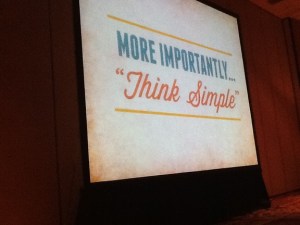
  • “HR sucks at simple”. Contentious, but it got a reaction.

The closing call was ‘If interaction is not embedded in the process then it won’t get done’ with a plea to ‘think simple’.

Jason is a good speaker who puts his points across with energy and simplicity. I took away a clear message that too many HR professionals see technology as something that isn’t really their thing, but a box that needs to be ticked. Clearly everyone in the room used technology constantly in their personal lives and there shouldn’t be a disconnect when it comes to embedding it in the workplace.

My view is that the things we look for in the technology we use in our personal lives – ease, relevance, convenience, enhanced experience – should also apply to the technology we use in our working lives. Technology should not be a barrier to getting work done but should be an enabler to getting a better job done. As Jessica Merrell tweeted ‘innovation & technology change isn’t just the vendor’s responsibility – amen!’

Laurie Ruettiman’s blog on the automation of HR is worth a read – ‘you might want to think about understanding the technology that’s about to upset your apple cart. If you know your enemy, you can destroy it’

After all, it’s never really the computer that says no….

What I’m Looking For at #HRTechConf

I’ll be spending the next few days at the HR Technology Conference – the first time I’ve been able to go.

I’m lucky enough to be part of the blog squad so have been thinking about what new trends and innovations I’ll be looking for.

In recent months I’ve been at a recruiting leaders round table, as well as two FIRM (Forum for Inhouse Recruitment Managers) conferences, and at all three events current recruiting pain points have been discussed. Invariably they are very similar, whichever group of delegates has been bought together. The key ones, unsurprisingly, have been:

ATS – specifically how to get one to do what you want them to do
Creating a positive experience for everyone who applies
Reducing the volume of unsuitable candidates tied in with better screening
Talent pipelines
Improving internal mobility
Difference between generating names and creating candidates
Hiring for potential vs hiring for now

Many of those are linked to technology so wearing my recruiter’s hat I’m going to be looking at how tech suppliers can help ease that pain. And how they can give a better experience to applicants and candidates.

From an HR perspective I’m keen to see how the employee experience can be enhanced. From attraction and nurturing, through on-boarding and performance management to internal collaboration, personal development, promotion and succession, I’ll be interested to see if what works for the employer is also creating a great experience for the workforce. And how technology can help not hinder.

As the level of connectivity, and the demand for an experience that has a positive, shareable impact, all grow it will be interesting to see if technology that offers a streamlined, cost effective and superior service to the company can also create an enhanced experience for the end user – the job seekers, recruiters and employees.

Gonna Set My Soul on Fire With Some HR Technology

About the time you’re getting the chicken and roasties out the oven this Sunday I’ll probably be starting to jam your Twitter timelines with talk of Gen Y mythbusters, HR improv, hickeys and employer brand (not at the same time I hope), not to mention passion and great places to work.

Yep, that means I’ll be hanging out with some of my US HR friends at HRevolution. (#HRevolution)

And by the time Coronation Street starts on Monday I’ll be immersed in radical openness and workforce analytics. I’ll be at the HR Technology Conference too. (#HRTechConf)

So apologies in advance if I get a bit carried away with this stuff.

I’ll be joining an awesome blogging team and don’t want to let the side down so I’ll do my best to make sense of it all and write about it here.

According to Blogging4Jobs I’m in for 3 days of conference sessions, expo hall madness, and parties galore – sounds like it might be a tough gig, but someone’s gotta try and do it 😉 And this time there’s also a wedding (#ZuCoWedding)

Maybe that’s what Elvis meant with how I wish that there were more than the twenty-four hours in the day, cause even if there were forty more I wouldn’t sleep a minute away

I’ve been to Chicago and Atlanta for HRevolution in the past so I sort of know what to expect, but this is my first time at HRTech – can’t wait to experience it.

If you’re reading this and planning to be there – then let’s make sure we meet up.

And if you’re in the UK I hope I give you some insight into what’s going on through Twitter and this blog.

I promise that what happens in Vegas will stay on the blog…well, the bits you need to know about anyway 😉

Vegas

(Image via @Jeremywaite)

No-one Likes Us. We Do Care.

No one likes us2

As long as I’ve been around the HR profession there have been regular bouts of navel gazing. You only have to look at some of the most-shared HR blogs and join in the usual conference chats about seats at the table, making a difference and the need to change. I’ve facilitated discussions about the purpose and value of HR, whether we should do away with it and how to demonstrate the value.

I’ve often said that I know of no other business function that beats itself up so. I know of few sales people who responded to the PPI mis-selling scandal with a long hard look into their soul to question the job and personal values, and neither did I see a wave of accountants post-Enron self-flagellating over whether the finance function had lost credibility and could no longer be taken seriously as a business function.

Any who did have self-doubt would doubtless strive to show how the profession could improve to stop a repeat, with those guilty of wrong doing not just being wrong, but also rogue outliers and not indicative of the overall standards of most of the profession.

In my experience though the HR function never quite seems to have the same self-belief, which may be why it can sometimes be seen to overreact to perceived attacks on its credibility and value.

Hence my lack of surprise at the brouhaha caused by this week’s online opinion piece from the Daily Telegraph’s Deputy Women’ Editor, Louisa Peacock – It’s Official: Lucy Adams Has Killed off the HR Profession Once and For All.

There are plenty of blogs and responses from both the online community and the online HR media on Peacockgate* and I don’t particularly want to add to the she was wrong/no she wasn’t/yes she was debate, however much of the immediate response seemed to me typical of a group who maybe lack the necessary self-confidence needed to brush this kind of thing off and hence end up taking offence at what they see as an attack.

What’s often missing from this kind of debate is perspective and context, so here are a few observations:

  • The piece did not appear in the business or finance section but in the Women’s section. It queried the career suitability of a profession which is 70% female and was portrayed as a women’s issue and not necessarily a business issue.
  • Although it was written by the Deputy Editor of the women’s section, part of the problem for the HR profession may have been that is it was written by someone seen as one of their own. Someone who learned her trade in the HR media, has covered CIPD conferences and interviewed many leading HR practitioners.
  • It appeared in the online edition of a staunchly right of centre broadsheet newspaper. One who editorially challenge wastage of public funds and the BBC in general, who broadly support Beecroft and the stripping away of red tape around business, are seen as business friendly and often publish opinion writers (Jeremy Warner, Allister Heath) who ideologically appear to favour much looser employment rights. An HR function being profligate with public money would be in the firing line from an editorial viewpoint.
  • It was an opinion piece. Not quite a Littlejohn or Clarkson, but as with many such pieces it is there primarily to provoke debate, promote sharing, create a noise, get traffic to the site. Some criticism has been levelled around the lack of supporting evidence – but this is fairly common with such pieces. Take something that’s happened, frame it slightly out of context and then use it to prove a different point is a modus operandi for many opinion pieces in the media (and some blogs for that matter). Whether it is the journalist or the sub-editor driving the narrative is unclear and hence I wouldn’t necessarily draw conclusions. **

Before I fall too far into the trap of over intellectualising, the reaction to all this displayed a siege mentality, but not necessarily one with the passion and belief that would indicate success…hence the name calling and umbrage.

I think the CIPD missed an opportunity to take the passion and desire to debate that was displayed by its members as a platform to open a wider conversation. After all, the main thrust of the piece was over career choices for young women so here was an opportunity to use it as a springboard to positively showcase the HR profession.

They could have produced a blog almost immediately, not criticising but summarising and showing an understanding of whatever points were being made. Reference the fact that any profession will have its rogue elements and that bad (or less than best) practice won’t be defended or tolerated, but also isn’t necessarily indicative of the rest of the profession.

Then let members debate, adding their views on the CIPD blog platform. No profession is one spokesperson but is the cumulative views of its members and hence they were in pole position to reflect the views of their members on this. Hell, why not look for a right of reply, a follow up post on the Telegraph site espousing the positives of a career in HR, why and how CIPD members make a difference to working lives.

As Neil Morrison says in his recent blog on this issue

…as a profession we should showcase good performance and role models AND we should hold bad practise to account. It isn’t a weakness to admit that HR is a profession in need of improvement, it’s a strength. And when we do, when we show the critical skills of self-analysis, you know what? We make people take us a whole lot more seriously

It’s often said that people rarely talk about good customer service but will always talk about bad customer service, and the same is probably true with HR. There’s plenty of good stuff out there – it doesn’t mean that the bad stuff doesn’t happen, but that you need to work a bit harder to get the good stuff out in the open.

And a healthy dose of context and perspective is a good starting point…

(* If you read this Louisa, I am joshing, treat it as a badge of honour 🙂 )

(** Later that evening I was at an event where the editor of the FT gave a short talk around the journalism profession and how it was reacting to the digital challenges. Listening to some stories from earlier in his career reminded me that not every piece that gets published is necessarily as the journalist originally intended)

10 Things about Social Media and Business

Social Media Network


Over the 4 years I’ve been a regular user of social networking platforms for business I’ve heard, and been asked for, plenty of pearls of wisdom to help newcomers, or those looking to get more involved.

Clearly there are far too many to include in one blog post, but here are 10 of my favourites for a start.

Remember, no saying, slogan or cliché (nor speaker or blogger for that matter) can tell you everything you need to know…only by jumping in, experimenting and trying different things can you ever really experience the joys of social media and find out what works for you…

Your brand is what others say about you, not what you say about yourself

You’d think that everyone would know this by now but sadly not. There’s no point broadcasting air brushed messages about how wonderful you are. Over 80% of your potential, lapsed and current customers and employees will trust the experience of a peer over anything you say about yourself so embrace your satisfied customers and employees, make them your advocates, and let them tell your story.

Brands don’t tweet, people do

I won’t try and take credit for paraphrasing Euan Semple’s must-read book but changing ‘organisations’ to ‘brands’ reminds those using social platforms for business that behind every corporate update, every piece of content, is a person…talking to a person. It may also be worth remembering the words of Adobe’s Head of Social Jeremy WaiteIt’s no longer about B2B or B2C, it’s now P2P’

If you make people use social media they’ll use it badly

Once a business embraces social platforms there’s often a sudden desire to get everyone in the business using them. As someone who has had to encourage employee participation in a business I say Don’t! Identify your internal advocates and influencers who are comfortable using the tools and start with them. Then encourage, empower and enable all who want to use them. As Content Marketing author Jay Baer says “if you don’t love social media you will suck at social media” so go find the passion in your business.

Social Media – It’s Evolution not Revolution

From carrier pigeon and letter, through post, telephone, telegram, telex, fax, computers, email and mobile to social platforms… business always adapts to the way their customers, partners and collaborators communicate. Social platforms are another stage along the business communication evolutionary cycle.

I don’t think you should have a social media policy – what you are saying is ‘we don’t trust you’

This is one of Neil Morrison’s sayings, and is usually likely to cause apoplexy amongst the lawyers. It’s harsh but it’s true. If you can’t trust someone to use a communication platform properly then what are you doing employing them.

Remember who you are, what you are, and who you represent

This is one of my favourite one sentence social media guidelines. When you take to the platforms it’s often easy to try and entertain and challenge, but if you’re doing it as part of your business role then remember your duty to that role, to peers and colleagues, your profession…and your friends and family.

Get as good as you can be at the platforms you’re already using before you go looking for new ones to try

At every conference, exhibition or event I attend there are always people wanting to know what’s next. Which up and coming platforms are the ones to try out, and what new ways of creating and presenting content can be embraced. My advice is always to get really good on the wagon you’re driving before jumping to a new one. The principles of engagement and reach, content and community, will be the same on whichever platform you try – if you’re not yet good at one then you quite possibly won’t be good at another.

You don’t need to be big to make a big noise

Social media is a great leveller. The big companies may have big budgets but in the land of connect, engage, share and learn it’s the quality of conversation that usually counts. If you’re going to run a twitter campaign for recruitment you’ve got to have good content to put out there, irrespective of size. Check out my coverage of Bromford Group’s #gottalovecake campaign to find out more.

You don’t need 1,000,000 likes. You need 1,000 new customers

This is one of Jeremy Waite’s 80 Rules of Social Media, and one that should never be forgotten. At the heart of your business you need an outcome from social interactions, and producing content that gets liked is only one small part. You need to make sure that what you do on social channels also supports the business objectives. And you should check out Jeremy’s other 79 rules too!

The conversation that never sleeps

Unashamedly this is one of my own sayings and also the title of one of my earliest blogs! Social media, especially twitter, literally is a 24/7 365 days a year conversation and if you’re a global brand, or have an interest in global business or global HR issues, then every minute of every day there will probably be someone saying something that’s deserving of your attention.